What if I don't temper O1?

Joined
Apr 7, 2006
Messages
5,215
I just made two knives out of O1 steel. Heat treated them with a torch and motor oil quench. I have waited about 6 hours so far without tempering them. I'm wondering what I am missing out on if I don't temper them. I would like to keep them as hard as possible because they are cutters, not choppers. They are 5" and 3" blades at 3/16" thick.
 
snap. it can crack all by its self. it will be very very brittle so much so that the edge might chip when sharpening. you dont lose much with a temper but gane tons. also you might not get the edge you think because the very tip of the edge will be very unstable and hard to sharpen.
 
I have (back in the days) heat treated A2 in pit of coals and also 01 with a mapp torch and didn't really understand tempering at all and thought that 1 hour per inch of thickness for tempering time meant i could temper an 1/8" thick blade for 7.5 minutes. Well apparently I was wrong, however, I put blades like in a VISE and hit them as hard as I could on the flat of the blade and it did not SNAP at all. Granted, they were not flat grinds, but it's amazing what incorrectly heat treated blades will take abuse wise. Funny thing is, i have snapped blades (in the past) that were tempered for 2 hours twice that were heat treated in a kiln, etc etc. So it's all about the luck of the draw.

You've probably maybe caused microscopic cracks in the steel, maybe maybe by not tempering it, however, if you're just using them for cutting and not chopping of any type, you're probably fine leaving them hard the way they are. You're probably going to be chipping the blade quite a bit if you're going to chop wood or whatever though. I say heat treating the blade with a torch first off, was incorrect to begin with, so tempering it now, isn't going make it suddenly better by much as unless i'm guessing you were heat treating it at a constant 1500ish degrees, who knows what you actually did to the molecules *AHEM* i mean "atoms" of the steel.

Or you can try tempering it at maybe 400 degrees for an hour and that should still leave it hard, and possibly add some toughness to it! :D
 
Last edited:
...but it's amazing what incorrectly heat treated blades will take abuse wise. ...

Tragically true:(! I also agree that as long as they were not overheated the torch and motor oil probably left enough undissolved structures that going without the temper has not been as catastrophic yet.

P.S. you still have time to change the word "molecules" to atoms, microstrucuture, crystalline structure etc... before mete sees it;).
 
Ha! I love this:p

P.S. you still have time to change the word "molecules" to atoms, microstrucuture, crystalline structure etc... before mete sees it;).[/QUOTE]
 
In the oven right now at just below 350

I already fitted and attached the G-11 handle scales which are rated at 338 degrees F. They're cooking right now because the joint is too smooth to mess up. I guess this is a test of McMaster-Carr's tech specs...
 
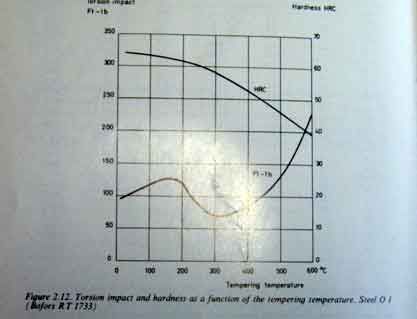
Why not just temper on the lower end of the temp range? I'd think you should still notice some differences in the way the steel behaves, even though the hardness barely goes down. I've participated in discussions about using torsional toughness curves for knife edges and am still not sure what to make of it. But these curves definitely show that something is changing within the steel. Take a look at this one-

o1_torsional.jpg


Tempering at about 350 degrees only drops the hardness a point or two, but makes a significant change in the curve. In fact it doesn't regain the same level of integrity until the tempering temperatures approach 575 degrees.
 
I see that the X value on that chart is Temp (in Celsius, 575C = 1067F = yikes!), what is the Y Value?

I it is Torsion Impact (Probably in kg), then you get about your best Torsion Impact and Hardness rating at about 325F
 
I see that the X value on that chart is Temp (in Celsius, 575C = 1067F = yikes!), what is the Y Value?

Sorry, should have mentioned I already did convert the temps from celcius to farenheit since that's what I'm accustomed to. I was looking at the point around 300* C (575*F) where the curve comes back up to where it was at around 150* C. (350* F) There are two Y scale values- the one on the left is showing torsional impact in Ft-lbs, and the one on the right is showing hardness Rockwell C. The upper curve shows that the Rockwell only drops about a point or so with a 350* F temper. Cliff claimed these torsional charts matched up well with his experiences using fine slicing knives at high hardness; others say they're not so sure. FWIW.
 
Possum, thanks for the chart and explanation.

I just took the knives out of the oven. Lightly sharpened, and snapped a few pics. I left the scale and straw on for now:

DSC01844.jpg

DSC01854.jpg

DSC01864.jpg
 
nice looking blades! You're definitely not going to lose much hardness with tempering and definitely will be adding some toughness!
 
Back
Top