
-
The BladeForums.com 2024 Traditional Knife is available! Price is $250 ea (shipped within CONUS).
Order here: https://www.bladeforums.com/help/2024-traditional/ -
America has reached 250 years, and I am grateful to be here, in the best country in the world. Thank every one of you who helps make this country a better place, those who have gone before and risked it all, and those who've paid the ultimate price to make the United States what we are today.
Happy Birthday America! Let Freedom Ring for all time!
You are using an out of date browser. It may not display this or other websites correctly.
You should upgrade or use an alternative browser.
You should upgrade or use an alternative browser.
what is a burr?
- Thread starter Legenda
- Start date

dericdesmond
Gold Member
- Joined
- Sep 10, 2007
- Messages
- 15,598


- Joined
- Apr 12, 2009
- Messages
- 13,644
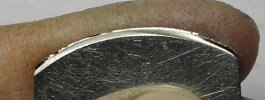
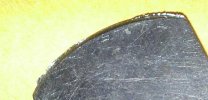
The above posts are all good and, additionally, keep in mind that burrs can vary greatly in size. That big, honkin' burr shown in Richard's pic is a good visual, but many or most times, burrs will be smaller (much smaller, I hope  ). It'll usually be easier to feel it, as opposed to actually seeing it, by sliding a thumbnail down the blade's side, towards the edge. A burr (or wire edge) will usually catch the fingernail. Same could be done by sliding a sharp toothpick or needle tip towards the edge, and it'll stop against a burr/wire there, on the side that the burr/wire 'leans to'.
'Wire edge' usually refers to a burr that runs continuously along the length of the edge. A 'burr', on the other hand, might sometimes only be an isolated 'tatter' of steel in a small section. Many here use the terms somewhat interchangably. They both essentially imply the same thing: the edge has been thinned enough, at that location, to make the steel sufficiently flimsy/weak to allow it to fold over. When you see/feel it, that's the indication that the edge has been 'apexed' (both sides ground to make the bevels meet in a sharp intersection).
). It'll usually be easier to feel it, as opposed to actually seeing it, by sliding a thumbnail down the blade's side, towards the edge. A burr (or wire edge) will usually catch the fingernail. Same could be done by sliding a sharp toothpick or needle tip towards the edge, and it'll stop against a burr/wire there, on the side that the burr/wire 'leans to'.'Wire edge' usually refers to a burr that runs continuously along the length of the edge. A 'burr', on the other hand, might sometimes only be an isolated 'tatter' of steel in a small section. Many here use the terms somewhat interchangably. They both essentially imply the same thing: the edge has been thinned enough, at that location, to make the steel sufficiently flimsy/weak to allow it to fold over. When you see/feel it, that's the indication that the edge has been 'apexed' (both sides ground to make the bevels meet in a sharp intersection).
Last edited:

i made the burr on the putty knife long so it would show up better. here is a picture of a small burr which is probably more than what is needed to get a knife sharp. i made the burr in this picture longer also so it would show up. i cropped the picture so that portion of the edge is roughly 1 1/2" long and the burr is roughly the size of a human hair. 
you must be thinking of a burlUnless you're talking about wood, in which case it is an abnormal growth on a tree usually following parasitic attack.

 http://www.bladeforums.com/forums/showthread.php/896379-i-found-a-huge-burl?daysprune=30
- Joined
- Apr 12, 2009
- Messages
- 13,644
Actually, the 'wood' reference made me look it up in my dictionary (Random House Webster's Unabridged). I wasn't aware of it previously, but here's one of the accepted definitions for 'burr':
"a rough or irregular protuberance on any object, as on a tree."
And from Wiki, for 'burl' --->: http://en.wikipedia.org/wiki/Burl , with a pic here --->: http://en.wikipedia.org/wiki/File:Corsehillburr.JPG
"A burl (American English) or bur or burr (British English) is a tree growth in which the grain has grown in a deformed manner. It is commonly found in the form of a rounded outgrowth on a tree trunk or branch that is filled with small knots from dormant buds."
Learned something new once again.
"a rough or irregular protuberance on any object, as on a tree."
And from Wiki, for 'burl' --->: http://en.wikipedia.org/wiki/Burl , with a pic here --->: http://en.wikipedia.org/wiki/File:Corsehillburr.JPG
"A burl (American English) or bur or burr (British English) is a tree growth in which the grain has grown in a deformed manner. It is commonly found in the form of a rounded outgrowth on a tree trunk or branch that is filled with small knots from dormant buds."
Learned something new once again.
Last edited:

dantzk8
Basic Member
- Joined
- Nov 1, 2005
- Messages
- 1,989
That big, honkin' burr shown in Richard's pic is a good visual, but many or most times, burrs will be smaller (much smaller, I hope
A burr can even be so tiny you will not notice it with a fingernail. But if you can shave your arm hair on one side of the blade and not on the other one then you have a burr.
dantzk.

- Joined
- Jun 4, 2010
- Messages
- 6,642
Verhoeven describes another type of burr as well. The steel directly behind the apex can bulge outward from impacting the abrasive field - this is most common on coarser grits and I've seen it on steel as tough as 154cm and Sandvic.
- Joined
- Apr 12, 2009
- Messages
- 13,644
A burr can even be so tiny you will not notice it with a fingernail. But if you can shave your arm hair on one side of the blade and not on the other one then you have a burr.
dantzk.
Yes, good point. :thumbup:
(in fact, I've seen that one a lot. Troublesome li'l buggers, aren't they?)