
-
The BladeForums.com 2024 Traditional Knife is available! Price is $250 ea (shipped within CONUS).
Order here: https://www.bladeforums.com/help/2024-traditional/
You are using an out of date browser. It may not display this or other websites correctly.
You should upgrade or use an alternative browser.
You should upgrade or use an alternative browser.
What is the clay in clay quenched?
- Thread starter cgdavid
- Start date

- Joined
- Aug 27, 2004
- Messages
- 2,524
Many folks use "Satanite", which is a hight-temp refractory cement.
You can get it several places, however, I recommend Darren Ellis at http://refractory.elliscustomknifeworks.com/
Robert
You can get it several places, however, I recommend Darren Ellis at http://refractory.elliscustomknifeworks.com/
Robert

- Joined
- Jun 17, 2001
- Messages
- 5,705
Once I get set back up I've often wondered how quick set drywall mud would work or even Fixall. The small amount of clay that is actually used it just doesn't seem like it would make a difference unless it won't hold up to the heat. One of the things I've done with the clay is mix in a small amount of vermiculite to add to the insulating properties. Also to help keep what ever it is you want to use from falling off make a few wraps with iron wire and it will give it something to hold onto.


- Joined
- Jan 10, 2005
- Messages
- 655
I use satanite as well, usually with some wood ash mixed in. My stuff always falls off after it's done, (knock on wood) which makes clean up easier. When I was out of satanite a while back I picked up some poly modified high temperature mortar to play with, supposed to survive to like 2300 degrees, not enough to line a forge, but I'd think it was good enough for clay coating..... never did play with it though, darren got my satanite too me before I expected it.
Tony
Tony
- Joined
- Aug 27, 2004
- Messages
- 2,524
I got a bright idea and mixed some "Charcoal-Grill" ashes with my Satanite........... Trying to get back to basics you know........
Well.........I guess I should have strained the ashes first, because those little "specks" of unburned charcoal mixed with Satanite resulted in a "Polka-Dotted" hamon when etched...........Not a good idea :grumpy:
Children....Pay attention.........Never try this at home.........We are professionals....
Robert
Well.........I guess I should have strained the ashes first, because those little "specks" of unburned charcoal mixed with Satanite resulted in a "Polka-Dotted" hamon when etched...........Not a good idea :grumpy:
Children....Pay attention.........Never try this at home.........We are professionals....
Robert

Do you think a standard clay (aka powdered kitty litter) with some ground vermiculite would work? Maybe a little fiberglass thrown in to make things hang together - carbon fiber might even work better as it moves heat fast.
Keep in mind that I don't have a forge. Have an OA torch, a small stack of O1 steel plus enough old files to sink a ship.
Thanks...Curt
Keep in mind that I don't have a forge. Have an OA torch, a small stack of O1 steel plus enough old files to sink a ship.
Thanks...Curt
- Joined
- Jun 24, 2005
- Messages
- 78
I belive it was Chiro75 talking about imperial stove and fireplace cement. You can buy it in the fireplace isle of lowes.

Stacy E. Apelt - Bladesmith
ilmarinen - MODERATOR
Moderator
Knifemaker / Craftsman / Service Provider
- Joined
- Aug 20, 2004
- Messages
- 38,235
High temperature furnace cement.Get it at old style hardware stores or the warehouse place (Lowe's,Home depot) works well.May need a few drops of water to thin it up.Adding fine ashes makes it creamier.As ROOSKO found out,sift the ash through a fine sieve first.
The rice ash mentioned is - rice STRAW ash ,used for everything from welding flux to clay coating,to polishing,and many things in-between,by the traditional Japanese smiths.
Stacy
The rice ash mentioned is - rice STRAW ash ,used for everything from welding flux to clay coating,to polishing,and many things in-between,by the traditional Japanese smiths.
Stacy
- Joined
- Aug 15, 2005
- Messages
- 1,297
Greetings,
Rick Barrett gave a heat treating demo at Ashokan in 2004. At that time he was using Rutland Furnace Cement to coat his blades. He showed us some very nice hamons that he had achieved using the cement. Rick stated that the cement sticks very well and needs little, if any, drying time. He did note that it puffs up quite a bit when you heat it, so you need to be careful how thickly you apply it. The Rutland cement seems to be available at most any hardware store, ex. http://www.acehardware.com/sm-rutland-furnace-cement-pack--pi-1308063.html
Hope this helps. -Chris
Rick Barrett gave a heat treating demo at Ashokan in 2004. At that time he was using Rutland Furnace Cement to coat his blades. He showed us some very nice hamons that he had achieved using the cement. Rick stated that the cement sticks very well and needs little, if any, drying time. He did note that it puffs up quite a bit when you heat it, so you need to be careful how thickly you apply it. The Rutland cement seems to be available at most any hardware store, ex. http://www.acehardware.com/sm-rutland-furnace-cement-pack--pi-1308063.html
Hope this helps. -Chris

- Joined
- Jul 11, 2003
- Messages
- 3,258
I use Satanite with some ash mixed in. We are lucky up here to have a lot of poplar trees (beaver food). Poplar doesn't give off as much heat as oak or maple when burning, in fact it kind of sucks as firewood, but it leaves a fine white ash. The Natives used it for treating stomach ailments. Anyway, thats what I use. I don't bother screening it. I just pick out any big chunks and I haven't had any troubles yet.

Fred.Rowe
Knifemaker / Craftsman / Service Provider
- Joined
- May 2, 2004
- Messages
- 6,848
I don't believe its practical to do clay hardening with an OA. torch, simple because you need to heat the entire blade to get the benifit of using the clay. Adding potters clay[dry powder] to the furnace cement makes it a lot more cohesive. One part clay to three parts furnace cement is a good mix.
JAMS, Fred
JAMS, Fred
I am not a maker but consumer of various Smiths and makers. I would take all adivce, but the person who consistantly can produce a Hamon in the steel I use would be my target. If is is true that some steels show better hardning line production, I would also seek that individual. You have probably already hit on the solution though. Making sure the light in the shop is off a second time is OK.
This is a fine group of talented people, better than I have seen in 40+ years of puchasing knives.
Floyd O`Leary
If I should not post here do not kick me, I am old. Just tell me to go away.
This is a fine group of talented people, better than I have seen in 40+ years of puchasing knives.
Floyd O`Leary
If I should not post here do not kick me, I am old. Just tell me to go away.
Fred.Rowe
Knifemaker / Craftsman / Service Provider
- Joined
- May 2, 2004
- Messages
- 6,848
Floyd, If you have been purchasing knives for 40 years you have all the credentials it takes to post here. An old forge saying:"You are not really considered old untill you stop pounding your hammer" FredFWO said:I am not a maker but consumer of various Smiths and makers. I would take all adivce, but the person who consistantly can produce a Hamon in the steel I use would be my target. If is is true that some steels show better hardning line production, I would also seek that individual. You have probably already hit on the solution though. Making sure the light in the shop is off a second time is OK.
This is a fine group of talented people, better than I have seen in 40+ years of puchasing knives.
Floyd O`Leary
If I should not post here do not kick me, I am old. Just tell me to go away.
u

- Joined
- Feb 23, 2002
- Messages
- 166
here's one I just finished up today....1095 with just plain ol' satanite, water quenched:
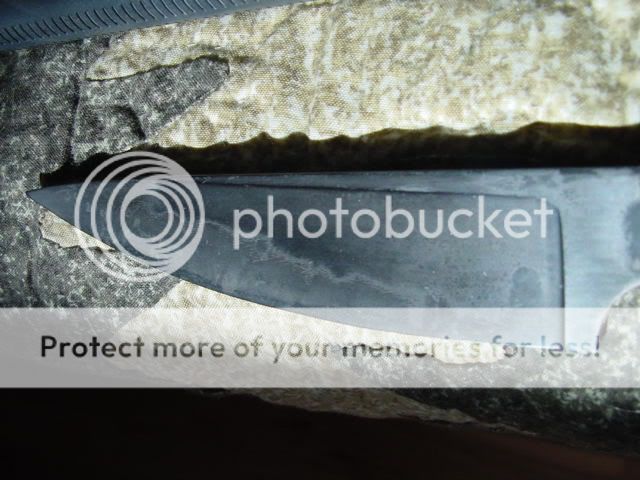
I don't mix mine with anything but water
I don't mix mine with anything but water
Fred.Rowe
Knifemaker / Craftsman / Service Provider
- Joined
- May 2, 2004
- Messages
- 6,848
S.Shepherd said:here's one I just finished up today....1095 with just plain ol' satanite, water quenched:
I don't mix mine with anything but water
 S.That is going to be one fine hamon when you get it pollished out. I, for one would like to see it finished. Fred
- Joined
- Jun 25, 2001
- Messages
- 8,474
Kaliandk9s said:I belive it was Chiro75 talking about imperial stove and fireplace cement. You can buy it in the fireplace isle of lowes.
http://www.bladeforums.com/forums/showthread.php?t=353661