PhilipWimberly
Gold Member
- Joined
- Oct 31, 2023
- Messages
- 97

The BladeForums.com 2024 Traditional Knife is available! Price is $250 ea (shipped within CONUS).
Order here: https://www.bladeforums.com/help/2024-traditional/

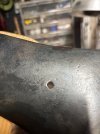
a sit hole (so to speak)Very possibly for use with a USFS modified belt sander jig. Such a divot would give a consistent spot to securely anchor the tip of the angle adjustment bolt.


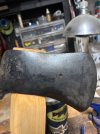
What is this hole? (Fill in your own joke here).
Not in the eye . . .. What is it?

Worth noting that the edge not matching an arc doesn't indicate that it wasn't being maintained for at least part of its life with one of those modified grinding tools--it just means that it would have been producing a different edge angle at different points along whatever the shape was. The toe is naturally always going to wear faster than the rest of it and going to need more work done on it over time. And at the same time, we don't know if it spent it's whole life being maintained via that method.Hole lot of potential answers.
Does the hole go all the way through the head? If it does not, is there a matching hole on the other side?
Was the axe from the factory:
- double beveled, single beveled?
- if double beveled were the bevels symmetrical?
- bevel or bevels flat, convex, concave?
- edge based on an arc?
Have you struck an arc along the blade edge using the hole as the center? Something like this:
Bob

Hole lot of potential answers.
Does the hole go all the way through the head? If it does not, is there a matching hole on the other side?
Was the axe from the factory:
- double beveled, single beveled?
- if double beveled were the bevels symmetrical?
- bevel or bevels flat, convex, concave?
- edge based on an arc?
Have you struck an arc along the blade edge using the hole as the center? Something like this:
Bob
Worth noting that the edge not matching an arc doesn't indicate that it wasn't being maintained for at least part of its life with one of those modified grinding tools--
And at the same time, we don't know if it spent it's whole life being maintained via that method.
Correct on all counts, but I mention it because it could be interpreted by some that the lack of a circular form to the bit excludes the possibility that it was a divot for those purposes, when it does not. I'm not even arguing that it definitely was for one of those grinding tools--merely that it's a possibility. And that the possibility so far remains unless we have evidence to the contrary. It could also be a bunch of other things, including a divot formed by whatever specific tooling and manufacturing processes the maker used when making that axe.and
Worth noting that the edge matching an arc doesn't indicate that it wasn't being maintained for at least part of its life with one of those modified grinding tools
and
Worth noting that the edge not matching an arc doesn't indicate that it was being maintained for at least part of its life with one of those modified grinding tools
and
Worth noting that the edge matching an arc doesn't indicate that it was being maintained for at least part of its life with one of those modified grinding tools
The post you are responding to DOES NOT say anything about "modified grinding tools" ("that method"?) and I do not hold a conclusion that the hole in the OP's axe head is either for or not for aiding sharpening.
Until definitive documentation comes along, the purpose of the hole in the OP's axe is unknown. Until then there are many possibilities with a greater than zero probability of being true.
Bob

updated links for images inLast but not least a big ole Plumb I weight it on my scale with the handle and it weighed in at 6lbs 8 ounces so maybe a 5lb single bit?
Is this a Connecticut? If so its my first and goes with my 5lb Plumb double bit that I got from the same old fella.
 Zymologist
post above:
Zymologist
post above:


As long as we're doing dbl photos, I'll include my other favorite, a HSB&Co OVB. It measures 32 1/2 inches overall and is marked 4 on the back, next to the square hole. Just what is that square hole for, anyway?


I have a couple of 3.5# heads that have that kind of “divot” in them. No idea what purpose it serves.


It could be, but I've seen them before -- I just can't recall specifics of many of the ones it was found on. Certainly more cases than would indicate it just being used as a marking method, especially since it tends to be rather deep and narrow, more like it was produced with some kind of pointed punch or fixture while the metal was hot rather than a drill.Could it just be someones way of marking their tool?
Do you know who made them?I have a couple of 3.5# heads that have that kind of “divot” in them. No idea what purpose it serves.