
-
The BladeForums.com 2024 Traditional Knife is available! Price is $250 ea (shipped within CONUS).
Order here: https://www.bladeforums.com/help/2024-traditional/
You are using an out of date browser. It may not display this or other websites correctly.
You should upgrade or use an alternative browser.
You should upgrade or use an alternative browser.
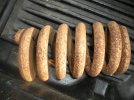
what kinda steel can this be
- Thread starter marekz
- Start date


Nathan the Machinist
KnifeMaker / Machinist / Evil Genius
Moderator
Knifemaker / Craftsman / Service Provider
- Joined
- Feb 13, 2007
- Messages
- 19,515
Could be many things, but 5160 is a reasonable guess.


- Joined
- Aug 6, 2007
- Messages
- 5,060
If they are off of a train, a buddy had some that spec'd out to 1095. Take a slice to your local Fastenal that would be beneficial to know as there is ALOT of material you have there.

- Joined
- Feb 28, 2006
- Messages
- 3,494
I make a fair amount of various chisels and punches, etc, out of coil spring with solid fuel forges, hammers and oil quench. It's fun heating them to watch the colors run for tempering. We just put them to use in the shop. If we didn't get the HT right, we try it again.
If you want to make blades or tools for sale, you might need to go further and either get an analysis and/or do some clear headed thorough destructive testing to establish proper HT parameters.
If you want to make blades or tools for sale, you might need to go further and either get an analysis and/or do some clear headed thorough destructive testing to establish proper HT parameters.
- Joined
- Feb 4, 2005
- Messages
- 834
What is it Matt... uh, besides a coil spring, that is... that you tested out as 1065? =]
Mike
Mike

- Joined
- Jun 16, 2008
- Messages
- 1,699
ok yall-- ive only worked with purchsed flat precision steel. ive only messed around with the forge with different steels. how would i go about turning some of this coil into a blade? do i try to fit it into my forge and bang it then cut it. i was gonna try and cut off a piece and work it into the forge. it seems like it would be difficult for a forging amature like me--any advice would be helpful--thanks marrekz---matt can you clarify abit about the 1065--kinda reply to Mike's question-thanks again

- Joined
- Jul 23, 1999
- Messages
- 1,409
I used to use a lot of that sort of thing. With a cutting torch, cut down one side of the coil and you'll get a bunch of cut loops. Cut about 3/8" of each torchcut end off with a chop saw, then forge it into a straight round bar. Then forge it down into flat stock and then forge out blades.
I've learned a lot since the time I used stuff like that, and would recommend finding out exactly what the material is....that would save you a lot of time and effort, rather than having to experiment and hope to figure it out.
I've learned a lot since the time I used stuff like that, and would recommend finding out exactly what the material is....that would save you a lot of time and effort, rather than having to experiment and hope to figure it out.

- Joined
- Oct 6, 2008
- Messages
- 4,076
Am I the only one that noticed, if you don't enlarge the thumbnail pic, it looks like a row of bratwurst or hot dogs on a grill? It must be lunchtime...
Am I the only one that noticed, if you don't enlarge the thumbnail pic, it looks like a row of bratwurst or hot dogs on a grill? It must be lunchtime...
I saw that too!
- Joined
- Feb 28, 2006
- Messages
- 3,494
+1 on what Ed said.
Some times I don't fire up the cutting torch and just cut a section off with a cutting disk on an angle grinder. I've also put the whole coil in the forge to heat up a spot for hot cutting (with a chisel).
You can do a lot of the straighten of the cut section with the vise and crescent wrench. Straighten it out (under heat) by uncoiling it. Get a section of the piece red hot and quickly clamp the end in the vise. Use the crescent wrench as a sort of pry bar/clamp and bend it back straight. Hammer the section straighter on the anvil on your way back to the forge for more heat. Repeat until completed.
Now you can start your forging to flat, then your blade. Once you get good hammer control you might want to start thinking integral. That is something that can be done when starting with material like this that cannot be when starting with just flat bar.
Have fun! Post pix.
Some times I don't fire up the cutting torch and just cut a section off with a cutting disk on an angle grinder. I've also put the whole coil in the forge to heat up a spot for hot cutting (with a chisel).
You can do a lot of the straighten of the cut section with the vise and crescent wrench. Straighten it out (under heat) by uncoiling it. Get a section of the piece red hot and quickly clamp the end in the vise. Use the crescent wrench as a sort of pry bar/clamp and bend it back straight. Hammer the section straighter on the anvil on your way back to the forge for more heat. Repeat until completed.
Now you can start your forging to flat, then your blade. Once you get good hammer control you might want to start thinking integral. That is something that can be done when starting with material like this that cannot be when starting with just flat bar.
Have fun! Post pix.

- Joined
- Nov 20, 2008
- Messages
- 1,855
it seems like it would be difficult for a forging amature like me--any advice would be helpful
My only advice related to forging it into a knife is; get it HOT.
As for finding out what it is or isn't. cut a 3/16" disc off and heat it to 1500F soak for 5 min and quench it in room temp oil. if it doesn't harden, it may be 1095. if it does harden chances are pretty good that it's not 1095. If it doesn't harden, repeat the process and quench in water.
That's all I got.
I can't remember exactly but I think there's a slight difference in the spark between 5160 and 1065ish steels.

Stacy E. Apelt - Bladesmith
ilmarinen - MODERATOR
Moderator
Knifemaker / Craftsman / Service Provider
- Joined
- Aug 20, 2004
- Messages
- 38,714
markez,
You can get some serious forging practice in just cutting the spring up and straightening it out. Once you have slit it down the side ( torch, disc grinder, hack saw,recip saw, etc.), heat each piece up and when fully red, straighten it out. It will be good practice to make each piece as straight as possible.
1) You can set the round bars aside until you can get them tested.
2) Or, you can forge knives from them, treating it as 1095, and set the knives aside until the steel is tested and you know the HT.
3) Or, you can do some shop testing on the steel, and get an approximate idea of how to HT it. The normal tests are spark test; water quench and bend/break ; quench in slow oil, fast oil, water ( to test hardenability). I would forge a round piece out to a 1" by 1/4" flat bar for these tests.
Once you have some idea about the steel type, forge out a simple blade and try and do the HT on that blade. Test the blade for edge holding, brass rod test, sharpness, and bend test to destruction. If it works well, use those HT specs for the rest. If not,either try a different HT recipe,or set the steel aside until you can get it tested.
Stacy
You can get some serious forging practice in just cutting the spring up and straightening it out. Once you have slit it down the side ( torch, disc grinder, hack saw,recip saw, etc.), heat each piece up and when fully red, straighten it out. It will be good practice to make each piece as straight as possible.
1) You can set the round bars aside until you can get them tested.
2) Or, you can forge knives from them, treating it as 1095, and set the knives aside until the steel is tested and you know the HT.
3) Or, you can do some shop testing on the steel, and get an approximate idea of how to HT it. The normal tests are spark test; water quench and bend/break ; quench in slow oil, fast oil, water ( to test hardenability). I would forge a round piece out to a 1" by 1/4" flat bar for these tests.
Once you have some idea about the steel type, forge out a simple blade and try and do the HT on that blade. Test the blade for edge holding, brass rod test, sharpness, and bend test to destruction. If it works well, use those HT specs for the rest. If not,either try a different HT recipe,or set the steel aside until you can get it tested.
Stacy
ok yall-- ive only worked with purchsed flat precision steel. ive only messed around with the forge with different steels. how would i go about turning some of this coil into a blade? do i try to fit it into my forge and bang it then cut it. i was gonna try and cut off a piece and work it into the forge. it seems like it would be difficult for a forging amature like me--any advice would be helpful--thanks marrekz---matt can you clarify abit about the 1065--kinda reply to Mike's question-thanks again
Marekz
I'm sorry I thought this was kinda self explanitory. What I meant was that the only coil spring that I personally tested, turned out to be 1065 steel. I'm not saying they all are, just that the one I tested WAS. Not sure what else you need me to clarify.
Matt
- Joined
- Feb 4, 2005
- Messages
- 834
Marekz
I'm sorry I thought this was kinda self explanitory. What I meant was that the only coil spring that I personally tested, turned out to be 1065 steel. I'm not saying they all are, just that the one I tested WAS. Not sure what else you need me to clarify.
Matt
Matt,
Me, I was wondering if you knew what the coil spring you tested was from.
Mike