
-
The BladeForums.com 2024 Traditional Knife is available! Price is $250 ea (shipped within CONUS).
Order here: https://www.bladeforums.com/help/2024-traditional/
You are using an out of date browser. It may not display this or other websites correctly.
You should upgrade or use an alternative browser.
You should upgrade or use an alternative browser.
What makes a custom
- Thread starter kolec94
- Start date

- Joined
- Jan 8, 2013
- Messages
- 1,354
"Custom" is a marketing term with no engineering-type of definition. Some stretch the meaning so far that they call production knives "semi-custom" because some employee hand-sanded the handle.
Seeing the word "custom" does not tell you how the knife was made in any given case. You need to ask particulars. Yes, many knives cut by CNC are called custom when finished.
Seeing the word "custom" does not tell you how the knife was made in any given case. You need to ask particulars. Yes, many knives cut by CNC are called custom when finished.
Custom means you tell the maker what you want the knife to be; double recurve tanto with one G-10 and one wood scale with Damascus bolsters.
Not how the knife is made. You could have a custom knife that was 100% CNC; or fully hammered out on an anvil old timey blacksmith style.
Not how the knife is made. You could have a custom knife that was 100% CNC; or fully hammered out on an anvil old timey blacksmith style.

- Joined
- May 21, 2007
- Messages
- 72
Custom means you tell the maker what you want the knife to be; double recurve tanto with one G-10 and one wood scale with Damascus bolsters.
Not how the knife is made. You could have a custom knife that was 100% CNC; or fully hammered out on an anvil old timey blacksmith style.
I like this definition and agree. The custom aspect is a function of being able to get exactly what was asked for rather than a pre-made product. Note I mention the ability, if it was made to someone else's wishes and you end up buying it, that doesn't make it less a custom.
You get to open the can of worms when you start talking about "handmade". There's some good threads on that in the knifemakers subforums.I like this definition and agree. The custom aspect is a function of being able to get exactly what was asked for rather than a pre-made product. Note I mention the ability, if it was made to someone else's wishes and you end up buying it, that doesn't make it less a custom.

- Joined
- May 4, 2015
- Messages
- 947
http://www.bladeforums.com/threads/what-are-midtech-knives.293969/
Here's the thread with Ken Onion's official "divider line" between midtech and custom. He's the one who came up with the term so I'd say this is a pretty clear definition.
Here's the thread with Ken Onion's official "divider line" between midtech and custom. He's the one who came up with the term so I'd say this is a pretty clear definition.

NJBillK
Custom Leather and Fixed Blade modifications.
- Joined
- Mar 27, 2014
- Messages
- 9,594
It isn't like anyone can just walk up to a CNC and spit out a knife.
Those that program a CNC have Plenty of hours (if not years) in training to come up with and write programs... On top of that, most Knifemakers that use a CNC still need to hand finish a knife, which is often more daunting than rough grinding a blade...
CNC can be custom or factory, it depends on what the scale and operation is.
I am sure there are some purist folks that rely solely on forging that will say that stock removal is "cheating" and not how a custom should be made. I am sure just as many folks would say that about CNC as well...
Those that program a CNC have Plenty of hours (if not years) in training to come up with and write programs... On top of that, most Knifemakers that use a CNC still need to hand finish a knife, which is often more daunting than rough grinding a blade...
CNC can be custom or factory, it depends on what the scale and operation is.
I am sure there are some purist folks that rely solely on forging that will say that stock removal is "cheating" and not how a custom should be made. I am sure just as many folks would say that about CNC as well...
Can't see how using a CNC machine is any more cheating than using a grinder, bandsaw, and sanding belts to make it. To me it's custom if it's made to the customer's design. I don't see a standard design knife with a simple change in scale material to be truly custom, perhaps semi-custom would be more accurate.
I have 3 handmade knives. The first was a kiridashi I bought on the exchange. The second was essentially a fixed blade version of a folder I liked. And the last was entirely my own design. I drew it up, made cardboard models of the handle, selected the steel, handle material, and even the mosaic pins. That's the only one I consider custom.
I have 3 handmade knives. The first was a kiridashi I bought on the exchange. The second was essentially a fixed blade version of a folder I liked. And the last was entirely my own design. I drew it up, made cardboard models of the handle, selected the steel, handle material, and even the mosaic pins. That's the only one I consider custom.

- Joined
- Nov 1, 2000
- Messages
- 28,365
I generally don't build a knife until funds are sent... Meaning the buyer calls all the shots. That's custom. Every major decision point, buyer is involved.
Here's a recent example...
Custom order EDC for Bladeforums member "Whetstone39" in .157" Nitro V hardened to 59-60RC with cryo. Black linen micarta scales with stainless pins.
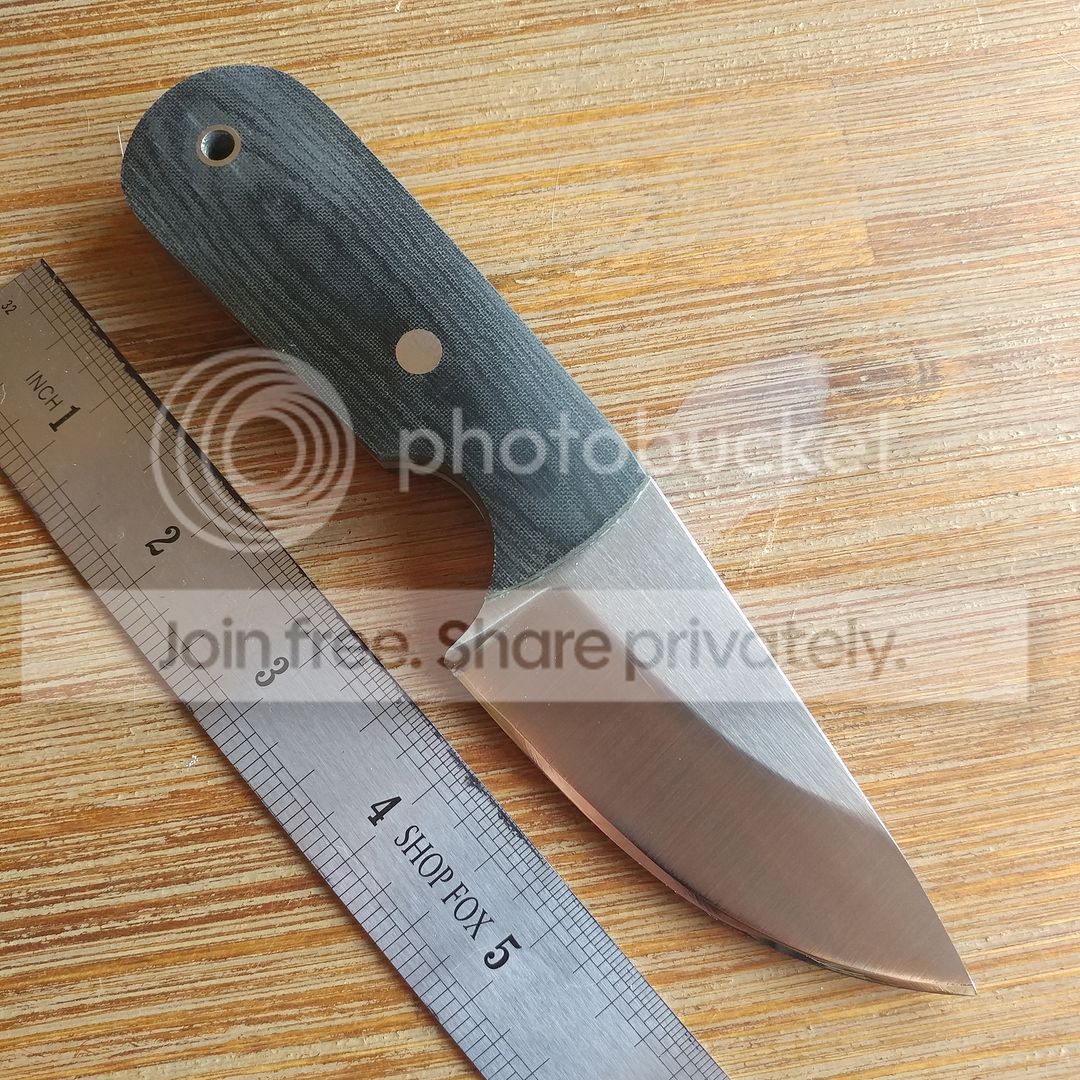
Here's a recent example...
Custom order EDC for Bladeforums member "Whetstone39" in .157" Nitro V hardened to 59-60RC with cryo. Black linen micarta scales with stainless pins.


SpySmasher
Lead Guitar
- Joined
- Sep 1, 2016
- Messages
- 5,016
This is a much more useful definition than the one I had in my head. We all know that as they're typically used the lines between "custom", "customized", and "midtech" have become hopelessly blurred.Custom means you tell the maker what you want the knife to be; double recurve tanto with one G-10 and one wood scale with Damascus bolsters.
Not how the knife is made. You could have a custom knife that was 100% CNC; or fully hammered out on an anvil old timey blacksmith style.

brancron
Gold Member
- Joined
- Dec 14, 2011
- Messages
- 3,059
Since there are so many variables at play, and CNC machining has added yet another variable in recent years, I think the best approach is to just give up on classifications and have knife makers simply be clear about the origins of the knife.
- Joined
- Jul 1, 2013
- Messages
- 32,479
As a maker I tell my customers my process and tell them what I can do for them after they tell me their wants.. I leave most of the terms to the Experts!Since there are so many variables at play, and CNC machining has added yet another variable in recent years, I think the best approach is to just give up on classifications and have knife makers simply be clear about the origins of the knife.
