What should a Bowie Knife be in 2026?

Why are we concerned with what the original Bowie looked like? It was one of one and the Bowie brothers changed the design almost immediately according to some authors. There was money to made on their brother’s fame, after all. The term Bowie Knife is more of a style envelop (or design language) than it is a specific design.
 
I agree, there are so many designs, shapes, sizes, steel types and materials that there’s no correlation between most of them in this modern era. I have to laugh when I see someone referring to a folding bowie 😆 there was never no such thing.

The thing is I’ve seen several articles written about the supposed actual Jim Bowie knife and they all have differing opinions , drawings and supposed first hand accounts each claiming intimate knowledge . So who’s to know what actually happened to it or any pictures or provenance. The actual knife that Jim Bowie had was a one of a kind handcrafted to his specifications. As far as I know nobody has it and is probably lost to history or rusted beyond recognition buried in the ground somewhere.
I don't even know if the exact original knife is as important as the cultural movement that it created anyways.

There's a lot of evidence that shows that it looked very closely to the Edwin Forest Bowie.

I'm sure once the story caught on the Bowie brothers probably decided they didn't want to show off such a rustic looking, handmade knife that was never meant to be any kind of showcase for a national story since that would be anticlimatic.

It's like a monster movie that doesn't show the monster. A person's imagination is much more powerful.

The story of it sure was effective though, I mean 200 years later and we're still talking about it.

I feel guys like James Keating and Bill Bagwell really highlighted the unique qualities of what it turned into and was capable of in trained hands.

I've also been enjoying the Rolando Estocada videos about the subject.
 
Why are we concerned with what the original Bowie looked like? It was one of one and the Bowie brothers changed the design almost immediately according to some authors. There was money to made on their brother’s fame, after all. The term Bowie Knife is more of a style envelop (or design language) than it is a specific design.
Some or should I say many aren’t even close to the specs that the Bowie brothers said they had built it to . To me it’s the same as the Buck 110, it has been copied and called a Buck knife so much that it is like a term for a type of knife not the actual model made by Buck. If it has any similarities to it they will call it a Buck knife no matter the brand or origin . It brings lots of confusion for anyone not well informed to the facts . And it is using the name to make money off of a family company name.
 
I don’t disagree. However, there hasn’t been a Bowie knife company to my knowledge, and there certainly isn’t a family company now.

This sort of thing is why modern companies like Coca Cola, Kleenex, Xerox, Kodak, and others so fiercely defend their trademarks. Once it’s in the public domain it’s next to impossible to recover it. Also once it’s in the public domain it will morph and change over time. It’s inevitable.
 
Rezin Bowie was the brother behind the knives, and he had a number of different makers create 'Bowie' knives. I'm particularly fond of the D. Searles style, the original tactical chef's knife. But, I believe, as do many others, that the Edwin Forrest knife is likely the original Sandbar Duel knife.
 
This reminds me of arguments over religion. Who the rightful heirs to the original prophet are, which interpretation is correct, which parts are fanciful inventions. But the truth is inevitably lost to time. The development of legends follow a familiar pattern.
 
I have done no research at all on the subject, only read some articles and followed forum discussions etc. However, general observations on belt knives of the period seem to indicate that something along the lines of kitchen knives of varying profiles with wooden handles was the general theme.

gif-20260529-221205.gif

And I think what probably originally really got the attention moving was that the Bowie knife was a really big knife. And perhaps a really big "kitchen knife" with a thick blade, substantial handle. Maybe some type of guard, or perhaps just a thick rounded blade heel.

Are there many, any, authenticated examples of knives of the period with cross guards? Modern "Bowies" all seem to feature cross guards - and clip point blades. Are there many, any, authenticated knives of the period with distinct clip point blades? In the absence of both or either I would tend to go along with something like the Edwin Forest knife.
 
I tend to think the Edwin Forest is closer in style to the original sandbar Bowie knife, and the knife itself has many attributes that make it more special than just a slab of metal with wood handles on it. My personal favorites are the Searles type as well. The Bowie legend certainly took off and then Sheffield took advantage of & shipped all kinds of Bowies to the US market, many great collections can be seen online. I also tend to like more of the rustic or simpler Bowies than the highly decorated ones, except I do like an occasional California Bowie made by Price.i like to think a civil war soldier would carry something from home like a butcher knife or chef knife or something made by a blacksmith on a farm, not elegant but will do the job….which would be more camp life use rather actually used in battle. I do like D-guard Bowies too, but they would be very unpractical unless used to to clear areas for cannon. Just my two cents.

Here is a trade knife I like that would be useful not as a Bowie but for life in camp or on rhe homestead.

IMG_1062.jpeg
 
Last edited:
Overall, I think a Bowie nowadays should be available and ready to grab as you go out the door, so a smaller Bowie is what I mentioned before, with a 5 to 6 inch blade, what I call a cowboy Bowie size, I don’t think a cowboy would be carrying a whopper on his belt when doing his ranch jobs. Now the exception to all this is like the ranch cook who is preparing the afternoon meals, much like that guy who worked form Dave Ferry and his place, have you seen some of those pics? I am sure he could handle a big blade.
 
Last edited:
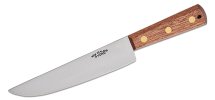
I think a Bowie "should" look like this:

View attachment 3165474

But I've seen lots of fantastic Bowie knives with notable variations. Tony Mont, Nick Wheeler, Ben Seward, Jerry Fisk, and Bill Bagwell come to mind for makers known for their Bowie knives, although there are many others doing great work. I'd be tickled pink to own a knife from any of them.

The W49 is also pretty hard to beat.

View attachment 3165490
I was surprised to find how relatively thin the bladestock is on the W49. You'd think a Bowie that big would be chunky, but it's quite the opposite. It's still tough and the broad blade chops and slices very well.

I also really like Cold Steel's Bowies. The Recon Scout is handy, but the Trail Master is my most used Bowie to date. I tend to gravitate to larger Bowies: if I'm going to carry a Bowie I'd might as well make it count.

View attachment 3165492

View attachment 3165495

As for steel types, something tough that holds a good edge for a long time. I've been happy with O1, 52100, Carbon V (1076-B, I think?), and 3V so far so something of that ilk would work. I'll bet AEB-L would do great.

A classic coffin handle and sharpened swedge is a winning combination.

View attachment 3165496

I like that W49. Back in the late 1970s, I interned with a small accounting firm as part of my college's co-operative education professional development program. The owner had a W49. It was mounted on a nice hardwood plaque and hanging on a wall behind his desk.
 
Are there many, any, authenticated examples of knives of the period with cross guards? Modern "Bowies" all seem to feature cross guards - and clip point blades. Are there many, any, authenticated knives of the period with distinct clip point blades? In the absence of both or either I would tend to go along with something like the Edwin Forest knife.
Yes, you'll see cross guards and clip points, what you don't see is overly broad, overly heavy knives. Although when the few real examples of those come up, they get a lot of attention. On old knives, the thicknesses can vary quite a bit, usually from 1/8" through 5/16". The thicker knives tend to do a lot of tapering, etc.....

The widths are similar to today on average, 1 1/4" - 1 3/4".

Length can vary quite a bit, the oldest Bowies tend to be longer, I'd say 8-11" was pretty common, and they got shorter as guns got better, and America got more urbanized.

There's also a sister knife, a bit later, made for the English and European markets that was made for the mixed use of soldiering and dangerous game hunting, Bowie shaped, these can be a bit larger and heavier than your average American Bowie. Collectors sometimes call these London Hunting Knives or Adventurers knives.
 
Last edited:
Yes, you'll see cross guards and clip points, what you don't see is overly broad, overly heavy knives. Although when the few real examples of those come up, they get a lot of attention. On old knives, the thicknesses can very quite a bit, usually from 1/8" through 5/16". The thicker knives tend to do a lot of tapering, etc.....

The widths are similar to today on average, 1 1/4" - 1 3/4".

Length can vary quite a bit, the oldest Bowies tend to be longer, I'd say 8-11" was pretty common, and they got shorter as guns got better, and America got more urbanized.

There's also a sister knife, a bit later, made for the English and European markets that was made for the mixed use of soldiering and dangerous game hunting, Bowie shaped, these can be a bit larger and heavier than your average American Bowie. Collectors sometimes call these London Hunting Knives or Adventurers knives.

The English and European market was probably steered toward hunters, explorers - and the colonials in general. The Alexander von Humboldt and Frederick Courtney Selous types. This would have been a far greater market than the U.S., with not just the Colonial military forces, but also the private and corporate operations everywhere from South America, Africa to the Far East.
 
My view of a Bowie knife (not The Bowie knife) is anything that was a large fighting/utility knife used by men in the civil war and in frontier areas. The original pattern doesn't matter as much as the popular patterns and forms that developed in the wake of Jim Bowies legend. From what I have read a great deal of the civil war era blades and later came out of Sheffield England, so those knifemakers take on the Bowie knife are more influential than the real deal was. I love looking at old west and civil war era photos seeing everything from elaborate to simple knives, D guard, S guard, clip point and spear point knives.
 
I can't say for certain what a Bowie knife is beyond 19th-21st century marketing, but assuming a large clip point blade designed for combatives and/or utility, I am partial to the original Gerber Coffin Handle version. Ted Frizzell has some models that are exceptional as well.
 
I can't say for certain what a Bowie knife is beyond 19th-21st century marketing, but assuming a large clip point blade designed for combatives and/or utility, I am partial to the original Gerber Coffin Handle version. Ted Frizzell has some models that are exceptional as well.

I like Ted's axes! I have a fighting axe from about 1993, it's a beast!!! I'd trust any of his tools, in any situation, as long as it doesn't involve discreet carry.....
 
I like that W49. Back in the late 1970s, I interned with a small accounting firm as part of my college's co-operative education professional development program. The owner had a W49. It was mounted on a nice hardwood plaque and hanging on a wall behind his desk.
Probably a RARE OCCURRENCE nowadays🙄
 
Back
Top