
What the heck is this?

Joined
Nov 8, 2005
Messages
103
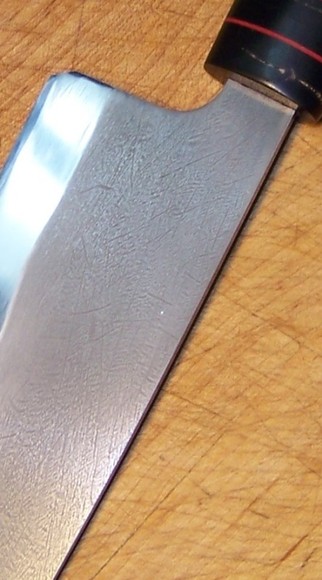
This is a piece of Admiral ATS-34. It has a strange patterning that showed up at about 220 grit pre-heat treat and just got brighter and brighter up to 600 grit post heat treat. What's the deal?

I was horrified at first, thinking that I got bad run of steel, but it hardened up well enough, so I figured that I'd make lemonade... and accentuated the pattern with a ferric chloride etch.
m170718408.jpg


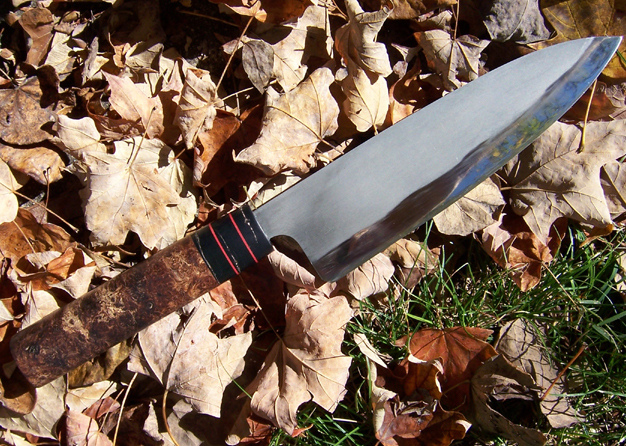
Here's a photo of the finished knife.
Admiral ATS-34 7" blade 12" OAL
Stabilized Redwood Burl Handle
Stacked Water Buffalo Horn Bolster with Red Spacers
w170364345.jpg


thanks,

Mark
 
Careful or fluffy might sue! >_<

Looks very nice. I assume that's alloy banding in the steel, and not carbide banding, but the visual effect is similar. There used to be chapters in older books on how to avoid alloy banding when heat treating steels as it was considered undesirable. That said, it's visually appealing in a knife
 
Hope there's someone else who can tell you what the deal is with the pattern you brought out with the etch of the ATS=34. ;) Great lookin' knife, I hope you can duplicate that finish. I think your lemonade is going to be real popular. :D
 
Mete or Kevin I ain't.
But I have seen this on a few of the blades I hardened and didn't soak long enough at temp. I now soak all my 154 and ats-34 for at least 40 min.and don't see it much anymore.
Stan
 
mete or Kevin will know better than I, but I have had this happen before with ATS-34. I believe it is caused by using extra coarse structured abrasive belts (50-60 grit cubic, eg. Blaze and others) and really laying into them in preforming. You probably don't realize how many different directions you grind the steel in in the initial shaping. The large surfaces of the grits, plus the special shape of the grit, burnish and work harden these lines into the steel. The resulting pattern is due to the difference in hardness of theburnished lines from the rest of the surface.They don't show up until you get the surface smooth enough to see the shiny lines against the matte surface - around 220-320. They seem impossible to polish out, no matter how much you sand and buff. After a proper ramp and full soak in HT and quench, they either disappear in the final finishing, or are greatly diminished.

The above theory might be wrong, but it appears to hold up to experimentation. I have annealed a blade or two and re-ground it, using 100 grit to start with and keeping the lines straight. It eliminated the crazy pattern.
Stacy
 
Stacy you are on the right track. Alloy banding will tend to be parallel lines in the direction of rolling. The criss-cross pattern is not typical of alloy banding." burnish and work harden " Those grinding belts are meant to grind not polish or work harden . Do not become emotionally attached to the belts .When worn replace them !! A worn belt can even smear the matrix of a tool steel .
 
hmm. I did grind the intial 60 grit belt to death, but at that time all of the grinding was perpendicular to the spine.

I have some other blanks cut from the same stock, and will post progress images after each grit to see if you'all can help me figure out where my error is.

thanks,

Mark
 
That looks like dendritic segregation in as-cast material. I don't know enough about how Admiral's ATS 34 is processed post-ingot, but I was just doing some microscopy on as-cast nickel-titanium alloys, and there were similar structures evident in some of the non-homogenized product. I may be completely off-base on this, but that's my guess. It would be interesting to do a high polish and a nitol etch.

Kevin?

-Page
 
Page , you could tell immediately looking in a microscope if it had dendrites.But there are lines in the photo ,they are definitely not dendrites !
 
Page , you could tell immediately looking in a microscope if it had dendrites.But there are lines in the photo ,they are definitely not dendrites !
helps to look at it on a real monitor:o Thanks Mete

-Page
 
I don't know the proper verbage, but I think it's in the steel.

I've seen this in ATS-34 blades that I etched in Ferric Chloride. They had been surface ground in ascending grits, and I know it wasn't something left over from coarse grit belts.
 
Mark, do you have some stock left?. May be you can very carefully sand with sharp belts and etch to see if this appears again. And if happens again, you may anneal it and see if it is there ....
Emre


edit:
Oh sorry I didnt notice your post...
hmm. I did grind the intial 60 grit belt to death, but at that time all of the grinding was perpendicular to the spine.

I have some other blanks cut from the same stock, and will post progress images after each grit to see if you'all can help me figure out where my error is.

thanks,

Mark
 
Back
Top