
-
The BladeForums.com 2024 Traditional Knife is available! Price is $250 ea (shipped within CONUS).
Order here: https://www.bladeforums.com/help/2024-traditional/
You are using an out of date browser. It may not display this or other websites correctly.
You should upgrade or use an alternative browser.
You should upgrade or use an alternative browser.
What's going on in your shop? Show us whats going on, and talk a bit about your work!
- Thread starter WillSwift
- Start date


ScarFoot
Knifemaker / Craftsman / Service Provider
- Joined
- Sep 16, 2021
- Messages
- 1,071
When I see knives like this I don’t know whether to quit making knives altogether or keep going.Finished this one right before Christmas.
Bill Poor feather, primo Sambar and 416 integral liners and bolsters scratched up by Alice Carter.
View attachment 3077585

- Joined
- Jul 13, 2023
- Messages
- 1,261
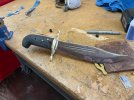
Trying to restore this old case bowie knife- 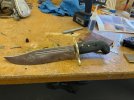

jfk1110
Gold Member
- Joined
- Mar 9, 2013
- Messages
- 29,224
But both will be equally gratifying when you're finished....Messing around with different sub-hilt construction techniques, both are equally a pain to execute.
View attachment 3078012View attachment 3078013View attachment 3078014
 ........LOOKING GOOD..
- Joined
- Mar 23, 2023
- Messages
- 122
Messing around with different sub-hilt construction techniques, both are equally a pain to execute.
As always, you will turn out phenomenal knives.
ScarFoot
Knifemaker / Craftsman / Service Provider
- Joined
- Sep 16, 2021
- Messages
- 1,071
Looking forward to seeing the finished product!Messing around with different sub-hilt construction techniques, both are equally a pain to execute.
View attachment 3078012View attachment 3078013View attachment 3078014
Also, newer knife makers reading through this need to take note of the grid pattern and layout lines you have scribed on the guard to grind to. Use that on guards, handles, plunge lines, etc… Everything will be way more even if you use a grid and layout lines than if you eyeball it.
I’ve learned a lot over the years just looking at the pictures of how you and other makers lay everything out.

- Joined
- Apr 15, 2018
- Messages
- 1,543
But both will be equally gratifying when you're finished....
As always, you will turn out phenomenal knives.
Thank you guys for the kind words, I really appreciate it!Looking forward to seeing the finished product!
Also, newer knife makers reading through this need to take note of the grid pattern and layout lines you have scribed on the guard to grind to. Use that on guards, handles, plunge lines, etc… Everything will be way more even if you use a grid and layout lines than if you eyeball it.
I’ve learned a lot over the years just looking at the pictures of how you and other makers lay everything out.
Grids are indeed the way to achieve symmetry. While some makers are really good eyeballing stuff, the grid can show inconsistencies that otherwise would go unnoticed.
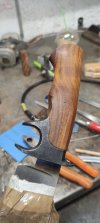
To keep the theme of the thread, I made some progress on the sub hilt.
Contrary to popular belief, I use grids and hand sand my fittings even when I plan to antique them.
Still lots of work but so far so good.
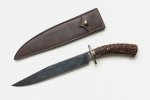
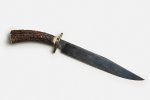
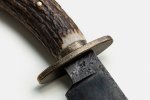
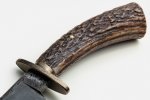
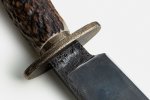
This blade is my last of 2025. A Bill Bagwell inspired fighter with an antiqued overall finish.

SBuzek
Basic Member
- Joined
- Dec 7, 2006
- Messages
- 3,617
Man keep going. You're doing good work.When I see knives like this I don’t know whether to quit making knives altogether or keep going.
I've been at this for 25 years this April.
There are folks on here that can attest I've made way more ugly ones than pretty ones

jfk1110
Gold Member
- Joined
- Mar 9, 2013
- Messages
- 29,224
Where are the ugly ones??????Man keep going. You're doing good work.
I've been at this for 25 years this April.
There are folks on here that can attest I've made way more ugly ones than pretty ones

Cliff Carter Knives
Knifemaker / Craftsman / Service Provider
- Joined
- May 30, 2011
- Messages
- 776
Trying to get back to being productive after the holidays. The last 2 out the door:
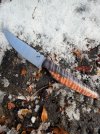
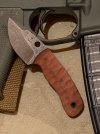

- Joined
- Mar 4, 2013
- Messages
- 3,681
This one has a long and interesting back story. I was stationed in Japan back in the late 90's and that was when I started making knives...or, more accurately, knife like objects. This one was the only "traditional" Japanese style tanto I tried at the time. It was cut out of plate D2 bought from the Tokyu Hands store with a hacksaw, and hand filed to shape, the bevels were not even and overly convexed. I sent it to Rob Simonich for heat treat in 1998/99. Got it back and realized I was a bit over my head, so it went in a box with some other materials.
Recently I found the box in a Pelican case. Now, 27ish years later, I have decided to finish it. Primary grinds are done, bevels are (mostly) polished and the habaki is shaped/soldered. Still a long way to go.


Recently I found the box in a Pelican case. Now, 27ish years later, I have decided to finish it. Primary grinds are done, bevels are (mostly) polished and the habaki is shaped/soldered. Still a long way to go.

Stacy E. Apelt - Bladesmith
ilmarinen - MODERATOR
Moderator
Knifemaker / Craftsman / Service Provider
- Joined
- Aug 20, 2004
- Messages
- 38,587
Excellent fit on the habaki. The only suggestion is to taper it down a bit more toward the machi to aid insertion into the saya.
Image for clarity:
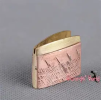
Image for clarity:
ScarFoot
Knifemaker / Craftsman / Service Provider
- Joined
- Sep 16, 2021
- Messages
- 1,071
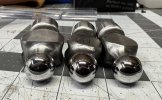
One of the knife making books I’ve been reading recommended polishing the faces of your peening hammers to help the pin material flow. Hopefully this is good enough… I went with a 600 grit satin finish everywhere else except the markings. Surely that will help with aerodynamics or something. These are all undoubtedly older than me. Two 4 oz heads and one that is now a 5 oz.
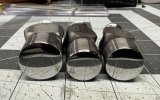

ScarFoot
Knifemaker / Craftsman / Service Provider
- Joined
- Sep 16, 2021
- Messages
- 1,071
It’s amazing what happens if you rub it long enough…I envy your shiny peen

Nate’s Knives
Gold Member
- Joined
- Jan 7, 2026
- Messages
- 449
How long did it take to polish just one surface on one head?One of the knife making books I’ve been reading recommended polishing the faces of your peening hammers to help the pin material flow. Hopefully this is good enough… I went with a 600 grit satin finish everywhere else except the markings. Surely that will help with aerodynamics or something. These are all undoubtedly older than me. Two 4 oz heads and one that is now a 5 oz.
View attachment 3080704View attachment 3080705
ScarFoot
Knifemaker / Craftsman / Service Provider
- Joined
- Sep 16, 2021
- Messages
- 1,071
Probably 10-15 minutes tops after I removed the pitting. I took the flats up to 600 grit on the 2x72 then went up to 2500 grit just rubbing them on paper laying on a piece of rubber. For the ball ends I just chucked the heads in a mini 3 jaw chuck I have for my drill press and worked through the grits then used some simichrome. After that I buffed everything with green compound on a loose wheel.How long did it take to polish just one surface on one head?
You want to be careful cleaning up old hammer heads. They’re not always hardened very deeply so you don’t want to take much off the striking surfaces. Those three just had some very minor pitting and dings on the faces.
Stacy E. Apelt - Bladesmith
ilmarinen - MODERATOR
Moderator
Knifemaker / Craftsman / Service Provider
- Joined
- Aug 20, 2004
- Messages
- 38,587
The biggest advantage of polishing the faces on a peen is it will leave much smoother marks. It displaces the metal evenly, too.
Japanese smiths will cut marks into a peen or hammer face to leave a specific mark, like hashmarks.
I have a peen that leaves an impression of my kanji mark in each dent. Used to put kurouchi in a blade it leaves hundreds of tiny characters.
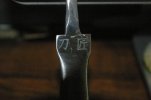
The image below is my" Bladesmith" mark kun'yomi to .... (craftsman/artisan of sword blades).
The blade shows it engraved. I'll have to look for the marking hammer and make some strikes to show the textured effect.

Japanese smiths will cut marks into a peen or hammer face to leave a specific mark, like hashmarks.
I have a peen that leaves an impression of my kanji mark in each dent. Used to put kurouchi in a blade it leaves hundreds of tiny characters.
The image below is my" Bladesmith" mark kun'yomi to .... (craftsman/artisan of sword blades).
The blade shows it engraved. I'll have to look for the marking hammer and make some strikes to show the textured effect.
Last edited:

- Joined
- Aug 2, 2009
- Messages
- 236
One of the knife making books I’ve been reading recommended polishing the faces of your peening hammers to help the pin material flow. Hopefully this is good enough… I went with a 600 grit satin finish everywhere else except the markings. Surely that will help with aerodynamics or something. These are all undoubtedly older than me. Two 4 oz heads and one that is now a 5 oz.
View attachment 3080704
I can almost see myself