whats the big deal about lock strength?

Better to have and not need
Then to need and not have

I get what you're saying though, for using a (folding) knife in its intended applications, ie. light to medium cutting with minimal pressure, for most normal people's daily tasks (boxes, packages, ribbon, rope, etc.), any well made knife, liner lock included, will 99.9%+ of the time be adequately strong enough to get you through the day no problem...

I prefer framelocks over liner locks, but I also have a fixed blade with me most of the time for any heavy duty tasks I may encounter, so I don't shy away from quality linerlocks either. Coupled with aa small fixed blade I actually prefer liner/frame locks for regular EDC carry because of the sheer convenience and ease of one handed use, (because I rarely if ever have to "hard" use 'em, thanks to the fixed blade)... When planning a trip to the woods, or doing actual work around the house though, I do typically opt for a lockback design because it'stronger and safer, and will more then likely see some hard(er) use including twisting and such... One of the #1 issues I've witnessed with liner (and frame) locks rather then actual "lock failure" is users themselves unintentionally deactivating the lock themselves through hard use while twisting, even slightly, with a firm grip...
 
To me I'm more concerned with lock function than I am theoretical strength.

That's why I avoid liner and framelocks and all their bastard-named offspring, because I am much more comfortable with a symmetric locking system that doesn't require any fingers in the blade's flight path.

The Axis lock is by far my favorite for those reasons, as well as fun factor. The fact that it's the toughest lock system vs accidental forces on the spine makes me happier, but I mostly appreciate the balance of features present in the lock.

I recently got a Cara Cara 2, and now Clipit-lockback Spydies with a choil are all over my radar for the same reason.

On balance they are quick, safe and simple to operate one-handed, and the lock itself is a good match strength-wise for the knife itself.

I used to think folders were ok to thrust with.

I had a liner lock that disagreed
 
my spyderco tenacious you can press hard against the back of the blade and you can watch the lock slowly be pushed aside and the knife will close. Before doing this test, I was cutting some bundles loose and the knife closed on my hand and cut me. I thought maybe my set screw was too loose, so I tightened it, and it still does the same thing. I no longer carry the tenacious which sucks because it was one of my favorite knives to carry
 
I've never once had a lock fail on me, even when piercing things. When piercing resistant material it's often possible to orient the point in such a way that lock strain is kept to a minimum, and I usually hold the knife by the flats of the scales so that if the lock somehow did fail my fingers wouldn't be in the way. Any time you do something with a tool that puts strain on it, it's important to "listen" to the tool to identify when it's approaching its working limits. If you can feel the knife responding in a way that indicates strain, either get a better tool for the job or modify your technique to reduce that strain as much as possible while planning for how to respond to potential failure.

^yep. This.
 
my spyderco tenacious you can press hard against the back of the blade and you can watch the lock slowly be pushed aside and the knife will close. Before doing this test, I was cutting some bundles loose and the knife closed on my hand and cut me. I thought maybe my set screw was too loose, so I tightened it, and it still does the same thing. I no longer carry the tenacious which sucks because it was one of my favorite knives to carry
If you haven't disassembled it before then you should send it back to Spyderco for warranty. I think everyone here would agree that it shouldn't be doing that - I know mine doesn't.
 
As a few have already commented, the danger is in piercing, not cutting. Try piercing something, very carefully with a traditional and you'll get the picture. That said, I'm careful with any folding knife when piercing. Best left to a fixed blade. Also, I have a lightly used Maxam (qualifies as cheap flea market knife) that features a linerr lock that puts up less resistance than my beloved case peanut.
 
Treat every folding knife as if it has no lock.

This advise may sound corny but it's sound.

I started carrying folders with no locks just so that I could not only gain the experience but to hold it in a manner so as to minimize potential damage. I have a new appreciation for folders with no locks while knowing that all locks are prone to failure. Even fixed blades are prone to failure. Some locks are stronger than others BUT in practical everyday use most are sufficiently capable. Your habits and usage may vary that to quite an extent.
 
There's one lock that I treat like there was no lock at all: Benchmade's Nak-Lok. I love the little gentleman's folders with that lock and for light cutting tasks they're fine. However, caveat emptor! They DO fail.
 
I've had blades close on my fingers before. It's not a fun time. Granted, it was entirely my fault and I wasn't respecting the knives the way I should have been; I've since learned my lesson.

For general EDC use (which is what most BF members are going to be putting their knives up to as far as I know), you don't need an ultra strong lock or even any lock at all. When you're cutting, the pressure is on the edge, not the spine of the blade. Still, accidents happen, and anyone who's going to be using their knives harder than that is going to appreciate a good lock that they know won't disengage or break when it counts.

No folding knife is as strong as a fixed blade, though. I always carry one and I always recommend everyone else who legally can do the same.

What Rev said is smart; heed their advice.
 
Liner locks are pretty much my favorite, but I also love my triads, and my slippies. Dudes just want a strong lock.
 
Even though you have never had or seen a lock fail, it is bound to happen eventually. Especially if you are rough on your knife or careless, but even just with normal use.

You might want to test your lock's ability to do its job in various conditions, because it is not always direct pressure on the blade that causes it to fail. Like someone else in here pointed out, you should (while wearing gloves, unless you are made of steel) whack it a few times on the spine of the blade, and also on the flipper if it has one. If it does not have a flipper, hit it on a table where it would be, just under the joint.

I like to make sure my folders pass these tests before putting them through any utility work, otherwise they just go as a backup EDC or something.
 
The big deal about lock strength is that if a knife has a lock it better be reliable. The more resistant to (admitted) abuse, the more resistant to "normal" use it should be (insert here CS videos with crazy spine whacking, weight hanging, etc.). But, at the end of the day, the fact is no mechanism is immune to failure... so don't trust blindly your uber secure locking mechanism and act with reason and common sense. No folder will ever be as "safe" as a fixed blade. Use your tool with a grain of salt. That's where "safety" is. You will keep all of your fingers (very important) and discover that a friction folder (just an example) can do (almost) all of your everyday cutting tasks with total safety.
 
well you must not be abusing your folders correctly;) I've had em all fail on me luckily not been cut too bad.
I actually trust a well made liner lock more then a frame lock. A frame lock that is twisted the right way will disengage the lock very easily, its also possible with a liner lock but less likely.
 
More than once I have had pocket knives with no lock close on me when using a piercing and twisting motion but fortunately I was never cut. This was back in the day before the availability of locking blades and one of the reasons I was never cut was because I was not forcing the knife and was mostly in control. Of course the fact that the knife closed on me says I was not in total control. Anyway, my point is I was aware of the danger and not using excessive force but in twisting the blade I applied negative pressure to the blade and it closed. Now using blades with locks, regardless of the type of lock, I don't worry about the blade closing on me but again I don't use excessive pressure. I believe someone earlier in the thread said "it's the fool not the tool" and though I would never say it that way there is some merit to the statement. If you are having to force any blade it's time to stop and determine if you have the right tool for the job. Most folders are not designed for heavy duty work so the user needs to use some common sense and put the folder away and get out the fixed blade when the work gets too heavy.
 
Do you want to have a knife close on your fingers? It's not fun let me tell you. Treat every folding knife as if it has no lock.


This.

One reason I keep a large Sodbuster in my rotation. Like in Wargames, the only way to win is to not play.

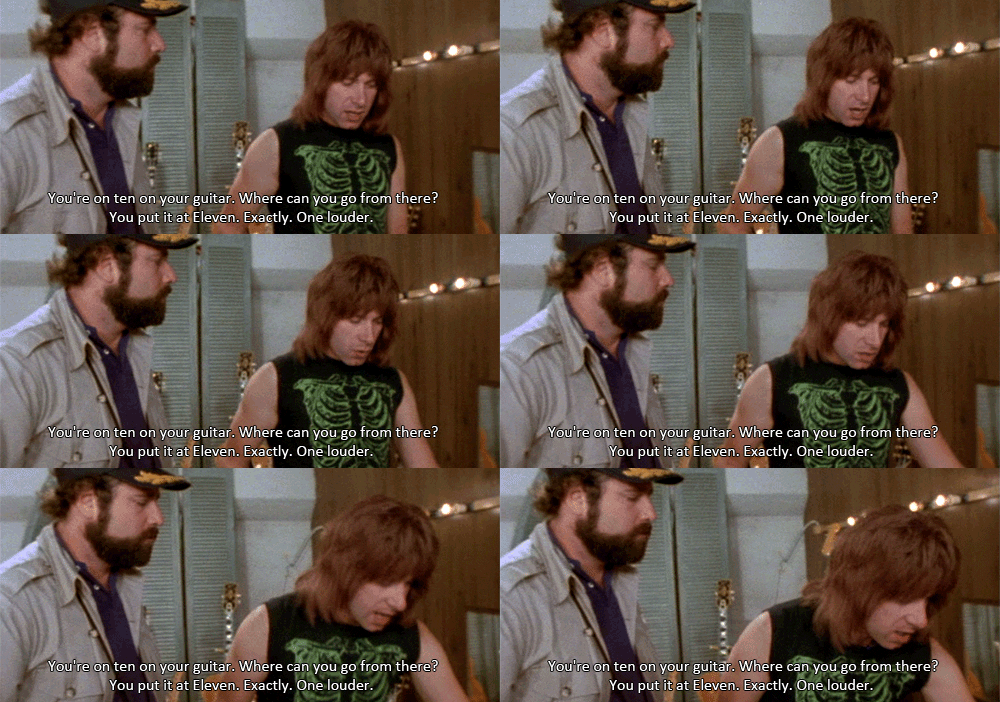
Beyond this though... people just love "features" that can be compared so they know they own the very best. Lock strength is like amp volume in this way.

giphy.gif
 
For me a folder is a cutting tool and should be treated as such,
i would never try to dig a trench or stabbing a running racoon with a Sebenza so i do not really understand the question? :)

And the advice from RevDevil is spot on, "treat every folding knife as if it has no lock" :thumbup:
 
Back
Top