
-
The BladeForums.com 2024 Traditional Knife is available! Price is $250 ea (shipped within CONUS).
Order here: https://www.bladeforums.com/help/2024-traditional/
You are using an out of date browser. It may not display this or other websites correctly.
You should upgrade or use an alternative browser.
You should upgrade or use an alternative browser.
What's the point of a spey blade on a Trapper?
- Thread starter T. Erdelyi
- Start date


- Joined
- Jun 29, 1999
- Messages
- 10,173
The spey blade is also handy for carving -- spoons, for example.

Horsewright
Knifemaker / Craftsman / Service Provider
- Joined
- Oct 4, 2011
- Messages
- 14,097
The Spey is a river in Scotland, I use to live within sight of it. Spey is also the correct English spelling of the Americanized word spay. I have skinned many a critter even hogs and cattle with nothing more than the spey blade on a trapper. Works very well indeed. The trapper is the "the" cowboy knife and is seen in branding pens all over. Interestingly, at least around here it is the opposite of what some one mentioned. The clip blade is used for castrating not the spey blade. Some areas the calf is confined and restrained either in a squeeze chute or on a calf table then you will see a blunt nose knife win favor. There is even a fixed blade style called a castrator or colloquially a "nutter". Reason for this is its often kinda done by feel and sometimes the left hand might get kicked back into the point of the knife a bad thing. Here we rope em. Done correctly very easy on the cattle and a guy can see what he's doing when cutting, also his hand is not gonna get kicked into the knife.
Here is a link that pretty much covers it. A post I did about helping the neighbors at one of there brandings. Trapper knives are featured prominently in real world use. Most will find it interesting:
https://www.bladeforums.com/threads/helping-the-neighbors-traditionals-in-use.1470750/
Here is a link that pretty much covers it. A post I did about helping the neighbors at one of there brandings. Trapper knives are featured prominently in real world use. Most will find it interesting:
https://www.bladeforums.com/threads/helping-the-neighbors-traditionals-in-use.1470750/

Horsewright
Knifemaker / Craftsman / Service Provider
- Joined
- Oct 4, 2011
- Messages
- 14,097
Thats a smell ya never forget! For sure
 skyhorse
. Interesting cause I have an old Moore Maker trapper where the clip blade is sharpened down from use to almost an icepick. I keep that for that very job. Call it my "docotoring" knife. We get a lot of foxtails here and sometimes they will cause that when the cattle eat them. We like that thin very pointy blade to lance and then cut out a small circle about the size of a quarter so it can drain over time.
skyhorse
. Interesting cause I have an old Moore Maker trapper where the clip blade is sharpened down from use to almost an icepick. I keep that for that very job. Call it my "docotoring" knife. We get a lot of foxtails here and sometimes they will cause that when the cattle eat them. We like that thin very pointy blade to lance and then cut out a small circle about the size of a quarter so it can drain over time.
skyhorse
. Interesting cause I have an old Moore Maker trapper where the clip blade is sharpened down from use to almost an icepick. I keep that for that very job. Call it my "docotoring" knife. We get a lot of foxtails here and sometimes they will cause that when the cattle eat them. We like that thin very pointy blade to lance and then cut out a small circle about the size of a quarter so it can drain over time.
NJBillK
Custom Leather and Fixed Blade modifications.
- Joined
- Mar 27, 2014
- Messages
- 9,594
 T. Erdelyi
Ask Benchmade, their 810 and 940 both have spey blades. For some reason they call them both a "Reverse Tanto"...


- Joined
- Sep 20, 2015
- Messages
- 8,213
Oh I don't know . . . in this day and age seems like fairly "normal" behavior. At least less harmful to the general society than some nutters I could name.why would you neuter a dead squirrel?
Trust me there will come a time, sooner than you think, when dead squirrel neutering will seem like the good old days of sanity and grace.
It just feels great in my hands, all this for $17, probably one of Schrades last and nicest production knives.
The Trapper has been a favorite user for me since I started in on this hobby in recent years.
All kidding aside it is one of the more functional blade styles.
For a city slicker I have been trying to find a use for the blade and on most all of my trappers I just remove the blade (dremel . . . I'm not a pinned knife mechanic . . . yet).
Why keep it? The use of it for spreading peanut butter etc. was suggested.
Of late I tried keeping the blade on the knife and just cutting away that part of the blade spine that messes with my grip (when closed) for harder work while using the clipped blade.
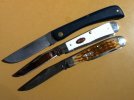
In the first photo you can see on the white knife the offending blade spine in the way of the grip near the pivot. The advantage of the Sod Buster is a clean grip there. (slim single blade trappers are too slim for me) The amber bone Tapper shows the improved grip area with the spey blade still in place.
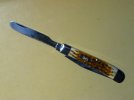
The second photo shows how it turned out. Frail for sure.
I have been using that blade as a steak knife. Works well and when cutting on a cast iron serving platter the edge actually stays surprisingly sharp.
I may have reach copaceticasity.
Last edited:
my best guess would, as has been said, for skinning.
I do trap, but all my skinning is done back at home base, with specific knives and tools for each part of the job - mostly with fixed blades that are "skinner" shaped.
I've reached out to some in the trapping community to see what their thoughts are and if they actually use one.
i see a lot of crossover in the livestock and trapping communities, in that many that have cattle or sheep, also trap as a method of controlling predation. I'm thinking there might be a reason that something that was originally meant for making mountain oysters has found use for undressing furry critters.
I do trap, but all my skinning is done back at home base, with specific knives and tools for each part of the job - mostly with fixed blades that are "skinner" shaped.
I've reached out to some in the trapping community to see what their thoughts are and if they actually use one.
i see a lot of crossover in the livestock and trapping communities, in that many that have cattle or sheep, also trap as a method of controlling predation. I'm thinking there might be a reason that something that was originally meant for making mountain oysters has found use for undressing furry critters.

- Joined
- Nov 20, 2005
- Messages
- 19,385
I used to use the term "trapper" for any two-bladed jack knife and are essentially my favorite traditional knife pattern as such. The Case Trapper defines the classic trapper with the clip and spey blades. Honestly, if I never saw another spey type blade on a knife, it would be fine with me.

- Joined
- Jul 27, 2015
- Messages
- 4,666
Spey is a river in Scotland. Spay is the act of neutering.
That’s one way to keep those pesky teenagers out of the river!
I wouldnt jump into any water that sounded anything like “spay,” regardless of spelling.
Horsewright
Knifemaker / Craftsman / Service Provider
- Joined
- Oct 4, 2011
- Messages
- 14,097
- Joined
- Jul 27, 2015
- Messages
- 4,666
Plus too many great Single Malts use that water, too valuable for swimming!19-3ben
Now this is a man who has his priorities straight...
Horsewright
Knifemaker / Craftsman / Service Provider
- Joined
- Oct 4, 2011
- Messages
- 14,097


- Joined
- Nov 28, 2012
- Messages
- 8,853
Exactly! It is an acronym for "spreads peanutbutter evenly, yum!Come on guys! The spy was designed for spreading peanut butter. It works great for it too.
Horsewright
Knifemaker / Craftsman / Service Provider
- Joined
- Oct 4, 2011
- Messages
- 14,097
Sorry guys just had to, here's a "nutter" butter peanut butter sandwich cookie to be spread with a spey blade:
