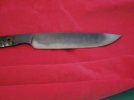
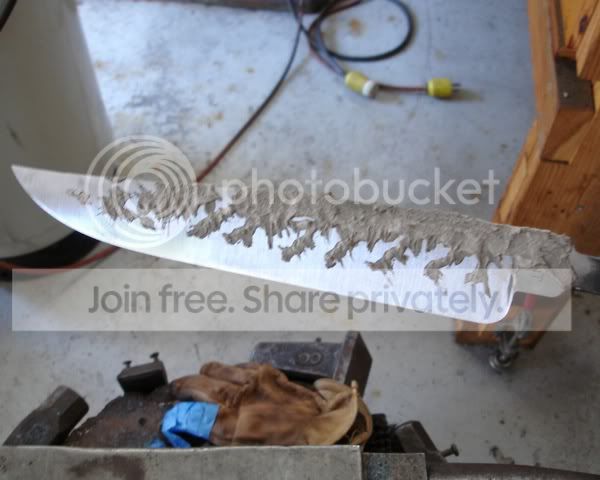
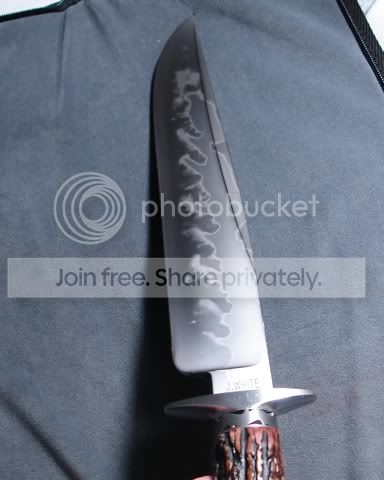
Whats wrong with this hamon?

Joined
Feb 24, 2000
Messages
1,949
The blade steel is Aldo's W-2. It was forged, normalized, heated to 1450 degrees for 6 minutes and quenched in room temperature Parks 50. Then tempered twice at 450 degrees for two hours.
The blade was completely covered with a very thin layer of satanite, then as you can see in the first picture some more satanite was added to the back and side of the blade.
The blade was etched in FeCl 1-3 mixture with water for five , five minute etches. ]
The blade was polished with Flitz.
As you can see from the finished blade the hamon is muddied, and not very clear at all.
Any ideas as to what I need to do?
 

Attachments

  • 001 (640x480).jpg
    001 (640x480).jpg
    53.7 KB · Views: 197
  • 004 (640x480).jpg
    004 (640x480).jpg
    26.7 KB · Views: 276
I have no idea what the problem is but I think it's pretty :)
It has an almost ghostlike sense to it.
 
I think if you used different polishes above and below the hamon it will help bring it out, also etching on one side or the other might help as well. I would try a high grit sanding on the edge side first and then just a vinegar etch on the spine side. I can see some hints of activity in there!


-Xander
 
Tom,

First off, the steel prep , hardening and tempering worked well. There's a lot of activity there. It's not too well defined, ie "muddy" as you say.

Here's a couple of suggestions.

To bring out the hamon you have, in better detail, try etching for 6-7 seconds, multiple times, polishing off the oxides between each etch with flitz. The five minute etches cut too deeply into the steel and blur surface features.

After the multiple shallow etches, try either polishing for an hour or so with 1500 grit powder in an oil slurry, followed by 15 or so minutes with flitz, or just polish for about an hour with flitz.

You may have to sand back to bright , up to 1200 grit, before etching, since it's etched so deeply already.

Another suggestion is to make your clay application more defined. This will give sharper edges to the transition zones.

Here are a couple of pics of a clayed blade, polished as above.

766ec561.jpg


4a4a2563.jpg


Hope the suggestions help,

John
 
I don't know how much you took the blade down post-HT, but I would sand by hand a good bit more and then work on developing the hamon. The activity is in there, but there is a dark layer of decarbed steel veiling it. I would be willing to bet that it will look a lot better when a few thousandths are taken off the blade surface.
 
Tom,

Let me second Stacy's suggestion. I had not considered how far you might have taken off post-HT. I usually leave the edge a bit thick, around 20-30 thou, and clean up with sharp 50,120,and 220 belts before hand sanding to 1200.

As Stacy says, several thousandths need to come off, post hardening.

John
 
Hey John, what tips do you have for getting consistent layout on both sides with that style of claying?
 
Thanks everyone for the help. I will try to follow your advice.
Before heat treat, I stoped with 220 grit. After heat treat, I used a 400 grit belt then hand sanded with 220, up to 2000 grit.
I had heard that removing steel after heat treat would also remove some of the hamon. So, I removed as little as possible.
Thanks again.
 
Thanks everyone for the help. I will try to follow your advice.
Before heat treat, I stoped with 220 grit. After heat treat, I used a 400 grit belt then hand sanded with 220, up to 2000 grit.
I had heard that removing steel after heat treat would also remove some of the hamon. So, I removed as little as possible.
Thanks again.

Leave the edge .030-.040" thick and go back to the grinder after heat treating. You don't want to grind a bunch of steel off after Hting, but you need to grind some off.
 
I was re-reading your post.

I saw that you etched in 1:3 FeCl for five 5 min etches.
That may over etch and darken the steel, hiding the hamon. I use 1:10 FeCl and do many short etches....etch,rub,etch,rub, etch,rub......
An etchant that works well for getting out the finer details is 1:100 nitric acid and a Q-tip.
 
Back
Top