
-
The BladeForums.com 2024 Traditional Knife is available! Price is $250 ea (shipped within CONUS).
Order here: https://www.bladeforums.com/help/2024-traditional/
You are using an out of date browser. It may not display this or other websites correctly.
You should upgrade or use an alternative browser.
You should upgrade or use an alternative browser.
When Did buck start using 420hc
- Thread starter jth250
- Start date

- Joined
- Oct 25, 2009
- Messages
- 801
I thought it was 1992, or a little earlier on some models.
Harold
Harold


David Martin
Moderator
- Joined
- Apr 7, 2008
- Messages
- 19,520
Buck began phasing in that steel in 1992. DM

- Joined
- Sep 26, 2008
- Messages
- 8,160
According to my notes, Joe Housers data sheet and Larry Oden's recent article in Blade, the year was 1992.
This is from the data sheet posted as a sticky in the forum by Joe Houser.
"Knives with date code mark of 1994 (\) can be found with either Macassar ebony or Obeechee wood inlays. Obeechee is more prevalent though.
Blade steel was changed in 1992 from 425mod to 420hc."
This is from Larry's article:
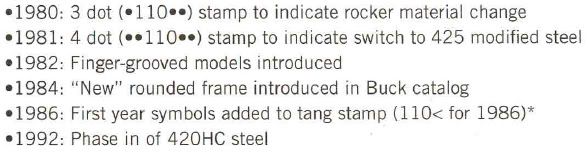
This is from the data sheet posted as a sticky in the forum by Joe Houser.
"Knives with date code mark of 1994 (\) can be found with either Macassar ebony or Obeechee wood inlays. Obeechee is more prevalent though.
Blade steel was changed in 1992 from 425mod to 420hc."
This is from Larry's article:
David Martin
Moderator
- Joined
- Apr 7, 2008
- Messages
- 19,520
Thanks, Plumber. This question keeps coming up and the answers are all over the map. Unlike the 440C blade steel question as many here are solid on that one..?? So, I don't know. DM

BG42EDGE
BANNED
- Joined
- Nov 6, 2009
- Messages
- 7,593
The problem is because other sources have said 420HC blades started PRODUCTION in 1993.
Exactly what "phase in" meant, how it was done and exactly when actual production of 420HC blades began is vague and you hear differing opinions.
I'm sticking with phasing in during 1992 and actual serious production really getting going in 1993 (again, as I said before--give some margin because none of these changes was ever so precise as to start on 1 January of the new year).
That's about the best we can do.
Exactly what "phase in" meant, how it was done and exactly when actual production of 420HC blades began is vague and you hear differing opinions.
I'm sticking with phasing in during 1992 and actual serious production really getting going in 1993 (again, as I said before--give some margin because none of these changes was ever so precise as to start on 1 January of the new year).
That's about the best we can do.
- Joined
- Sep 26, 2008
- Messages
- 8,160
Here are my thoughts on the subject of dating changes. We have respected, published sources that give dates based on actual research using real records and not speculations or rumors put forth by un-named “other sources”.
I believe that 99.9% of us will have to agree that “our” research is done by researching other researcher’s research.
When someone asks when some change occurred, I’m comfortable with giving the info provided by respected sources, but I’m not comfortable with muddying the waters with rumors, speculations or possibilities. What’s the point? There’s no way to document those.
If someone says “I have a knife made in 1992, what steel is it?”, I’m comfortable and confident in telling them that it could be either 425M or 420HC. Joe Houser made the statement here on the forum in the not too distant past, that it’s possible that knives made in December of one year MAY have the date stamp for the following year. Even given that, should someone say “I have a knife stamped 110+” I’ll tell them it was made in 1991 and not muddy the waters by saying it could also have been made in late 1990. After all, there’s no way to prove it and no way to tell the difference.
At the risk of being too verbose, some of the “other sources” are relying on memory which all of us older folks know is a fragile and fleeting thing. Case in point, I just purchased a three line three spacer 119 new in the box complete with all the paperwork and original purchase receipt. The original owner was specific in that he bought the knife in 1982, but the receipt was dated in June of 1983 as was the warranty paperwork that was filled out but not mailed in.
Just my rambling thoughts at 4AM or so.
I believe that 99.9% of us will have to agree that “our” research is done by researching other researcher’s research.
When someone asks when some change occurred, I’m comfortable with giving the info provided by respected sources, but I’m not comfortable with muddying the waters with rumors, speculations or possibilities. What’s the point? There’s no way to document those.
If someone says “I have a knife made in 1992, what steel is it?”, I’m comfortable and confident in telling them that it could be either 425M or 420HC. Joe Houser made the statement here on the forum in the not too distant past, that it’s possible that knives made in December of one year MAY have the date stamp for the following year. Even given that, should someone say “I have a knife stamped 110+” I’ll tell them it was made in 1991 and not muddy the waters by saying it could also have been made in late 1990. After all, there’s no way to prove it and no way to tell the difference.
At the risk of being too verbose, some of the “other sources” are relying on memory which all of us older folks know is a fragile and fleeting thing. Case in point, I just purchased a three line three spacer 119 new in the box complete with all the paperwork and original purchase receipt. The original owner was specific in that he bought the knife in 1982, but the receipt was dated in June of 1983 as was the warranty paperwork that was filled out but not mailed in.
Just my rambling thoughts at 4AM or so.
David Martin
Moderator
- Joined
- Apr 7, 2008
- Messages
- 19,520
Plumber, Well stated. This is what I speak of, trying to depart from memory and state that which can be verified, "from a well researched souce, published by a Respected long term collector". Who aquired their data from much reading and study or visits with company employees which can be verified. Mindful, there will be those nuances of company operating procedures as with any business. Still, if it has a 1990 blade stamp I'll not argue when it was made. DM
I would think that the caveats of dating issues is pretty well understood from car collecting (and bike collecting). Model years and actual date of manufacture can vary significantly. IMO, date codes and serial numbers can pin down model years, not actual date of manufacture in the strictest of senses. A Buck marked with a 1990 date is is a 1990 Buck. Beyond that, people will need to define exactly where in the process the knife was considered "manufactured". When it passed QA inspection and placed in its packaging? When it was recorded and completed inventory? When it was shipped? I personally don't find those questions helpful or interesting. It's a 1990 Buck (model year) and that's enough for me.
In terms of materials use, I find knives trickier than vintage bikes. With bikes, the practice (was) to clearly label the kind of steel used in the frame (it matters as much to cyclists and blade steel does to knife enthusiasts). Lacking clear marking, the only thing that matters to me is documented published specifications from the manufacturer, or other written evidence. This cuts both ways. The fact that Buck changed to 420HC for the 110 in a certain year implies but does not, by itself, establish that Buck switched other models the same year. For me, I would like to see catalogs or other such documentation. Raleigh of England was notorious (in the 70s) for switching frame materials in the middle of production runs due to shortages. Schrade, it seems, had a similar low regard to sticking with published specification. When I look at an old Buck (or any other vintage item), I feel safer saying "The specification for this knife was...." compared to "This knife is....". With written records, I can feel confident about the first. I would need to be a metallurgist to say the second.
In terms of materials use, I find knives trickier than vintage bikes. With bikes, the practice (was) to clearly label the kind of steel used in the frame (it matters as much to cyclists and blade steel does to knife enthusiasts). Lacking clear marking, the only thing that matters to me is documented published specifications from the manufacturer, or other written evidence. This cuts both ways. The fact that Buck changed to 420HC for the 110 in a certain year implies but does not, by itself, establish that Buck switched other models the same year. For me, I would like to see catalogs or other such documentation. Raleigh of England was notorious (in the 70s) for switching frame materials in the middle of production runs due to shortages. Schrade, it seems, had a similar low regard to sticking with published specification. When I look at an old Buck (or any other vintage item), I feel safer saying "The specification for this knife was...." compared to "This knife is....". With written records, I can feel confident about the first. I would need to be a metallurgist to say the second.
- Joined
- Sep 26, 2008
- Messages
- 8,160
Wouldn't it have been terrific if Buck had used a serial number system on all the knives and kept records like is and was done with guns? They could be traced back to their birthdate with accuracy.
On second thought, what fun would that be? It would certainly cut down on the fun that we have here on the forum, rehashing and arguing over the same subject over and over.
On second thought, what fun would that be? It would certainly cut down on the fun that we have here on the forum, rehashing and arguing over the same subject over and over.
Sure, as long as we keep it "fun". One man's fun is another's "speculation" though. Would hate to see such "fun" spin-off an entirely new forum, as what happened in the earlier version of the BF Schrade sub-forum. 
Buck has produced catalogs, no? An on-line library of catalog scans would be a massive undertaking but incredible resource.
Google for schrades r us and check out their collection of Schrade catalogs.
Buck has produced catalogs, no? An on-line library of catalog scans would be a massive undertaking but incredible resource.
Google for schrades r us and check out their collection of Schrade catalogs.
- Joined
- Sep 26, 2008
- Messages
- 8,160
Sure, as long as we keep it "fun". One man's fun is another's "speculation" though. Would hate to see such "fun" spin-off an entirely new forum, as what happened in the earlier version of the BF Schrade sub-forum.
Buck has produced catalogs, no? An on-line library of catalog scans would be a massive undertaking but incredible resource.
Google for schrades r us and check out their collection of Schrade catalogs.
It's been done already. The catalogs, along with the price lists, are available for viewing or downloading on the Buck Collector's Club web site. Also there are historys of many models posted. I'm a bit surprised that you didn't know that.
It's been done already. The catalogs, along with the price lists, are available for viewing or downloading on the Buck Collector's Club web site. Also there are historys of many models posted. I'm a bit surprised that you didn't know that.
Ah... Instead of "online", I should have said, "publicly available online".
Glad to know catalogs are available to members.
David Martin
Moderator
- Joined
- Apr 7, 2008
- Messages
- 19,520
Guess he's not a member. Yet, even the catalog idea isn't vault tight as Joe and other employees/ collectors have stated, Buck used the same photos for several catalogs. Even if there was a change in a model. Now, should a new model come out they would put a new photo in that catalog. DM