Thank you, gentlemen, for all the interesting posts. I enjoy reading about all the different techniques and tests.
I didn't get seriously interested in knives till just a few years ago, and I began with beveled knives, mainly Spydercos. My first sharpener was a Sharpmaker, and I still like it very much and use it daily for touch ups. I got the ultra-fine rods for it, and they are great for a final step, or final before stropping. I then got some coarser stones from Congress Tools, which I would attach with binder clips to the Sharpmaker rods. They made reprofiling jobs manageable.
But then I got bitten by the Bark River bug (and am still bitten!), so I started learning convex sharpening. I acquired some good leather-on-wood hones, on which I used Bark River black and green compounds. Of course, a full array of sandpaper was also necessary---from 100 grit all the way up to 3000.
I was learning a lot, and making progress. But, as Duncan described, I was inconsistent. Some knives I had very good luck with, and others were pure frustration.
A real breakthrough came for me when I decided to try the WorkSharp knife sharpener, which is a miniature belt sander (there are a couple of long threads on it over in the sharpening subforum). I got a bunch of additional belts for it in a good progression of grits, and got going. There is a learning curve, and I managed to round some tips, create a few involuntary recurves, and make other mistakes at first. In fact, I'm still learning, but at least I've gotten a lot more careful because, as with any powered system, you can remove a lot of metal fast! The WS is especially good at taking the drudgery out of reprofiling or setting your original edge. And a key thing for me is that I can use it successfully on all my knives, convex or beveled. With my Bark Rivers, which are relatively thick blades with full convex grinds, the belts do an excellent job of maintaining a sharp convex edge. With my beveled knives, which means all my small but growing group of traditionals, the belts create a shallow convex edge, which can be touched up either with the SM UF rods, or the hones, or both.
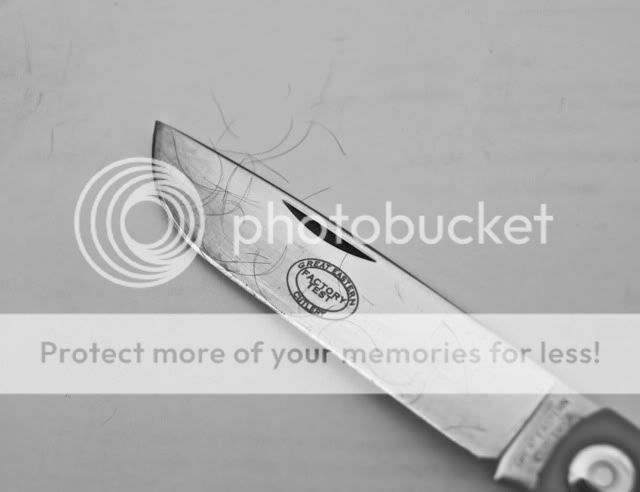
Finally, I also agree with sappyg and Kevin about patina being an easy substitute for the "Sharpie trick". The pic below shows this, in an exaggerated way, since I thinned out the edge a bit as well after the patina started.
As for sharpness tests, I use the same ones that everyone has mentioned---thumbnail test, slicing printer paper and then on to phone book paper or newsprint, shaving hair, etc. But I know I've still got so much to learn and hope I can get to the next level of sharpening. While, as a practical matter, it's not necessary, and I don't have the skill or patience to ever master the art, I'd like to go a little farther, just to see if I can.
Thanks again for all the great posts.
Andrew