When to Scrap a Knife Project?

Joined
Oct 10, 2013
Messages
12
After setting aside my first knife making project about 5 years ago (ouch!) I decided to dive back in.

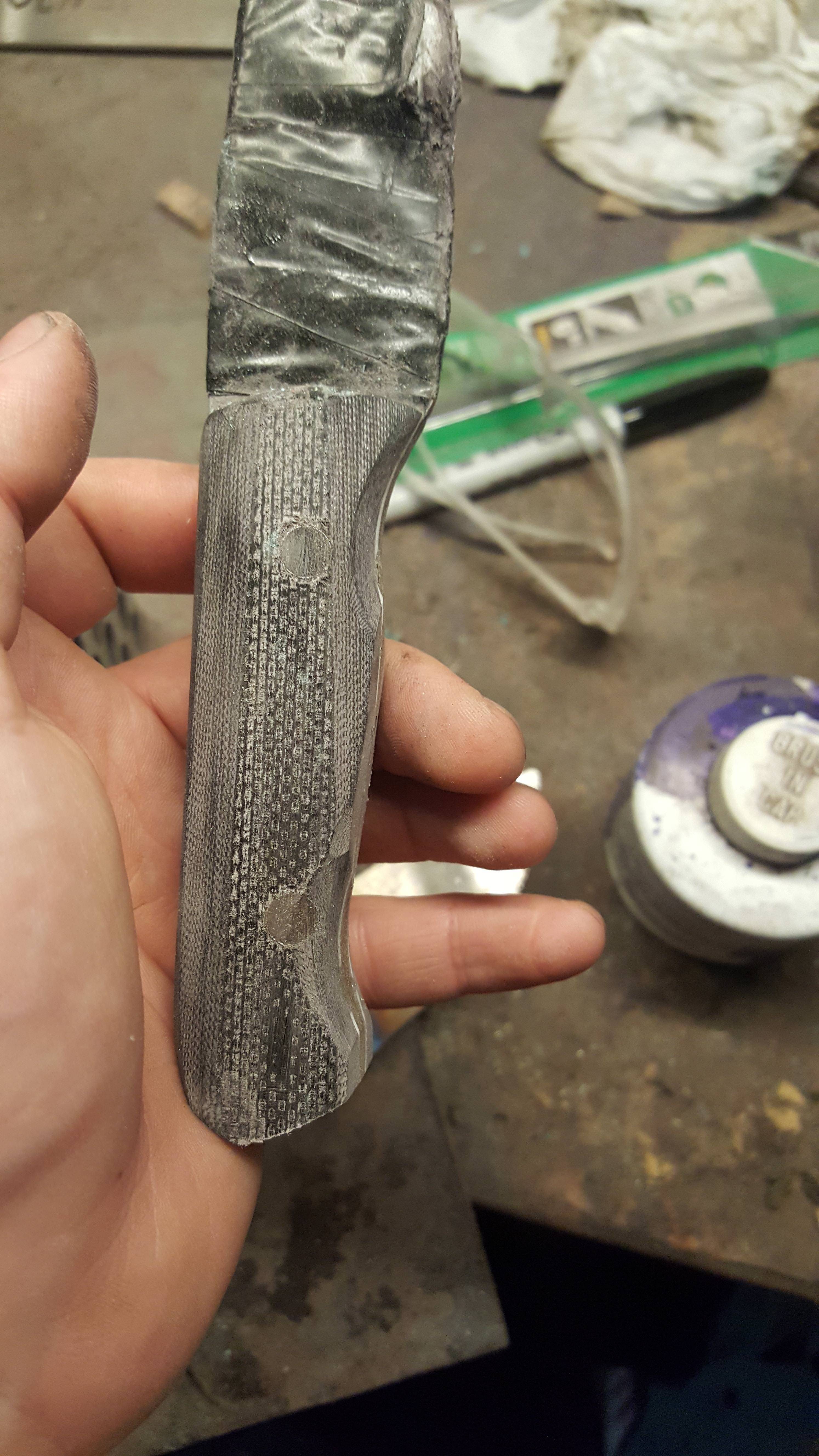
To make a long story short, I've completely messed up the handle profile in two ways, through my own ineptitude with an angle grinder.

1) Relief cut that hardened the steel AND went too deep. Now my file skates across it.

2) Grinded a gouge in the flat side of the handle.

Five years later, the design itself no longer speaks to me anyway, so I'm considering setting it aside and starting with something fresh.

When do you set aside a project and start over/move on? Any advice?
 
Glue it to a board, as-is, and nail it on the shop wall. Put the date you started it on the board. It will give you something to look back on.
 
Never! Just wait until you get another idea. Practice your modification skills. Re handle it, re grind it, whatever.
 
Thanks guys! I'm going to put it on the wall for the time being. In the future, I'll either have the skill to salvage it or I can keep it as a testament to my (lack of) skill. I can imagine myself, in the future, having a tough time with something, then looking up at the hack job and feeling better about myself hahaha.
 
I don't hesitate to scrap something I am working on if it is bad. But it must also be said that sometimes, even if the knife seems a mess, to finish to the end and learn the whole process from your mistakes through the whole thing.
 
e9f08e935
a>
G8MCfL

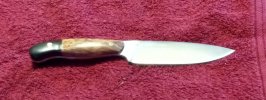
In the beginning I put several aside. As my skills improved I went back and fixed some of them. Here is one I fixed. If you get frustrated with one, put it aside and go back to it another time.
p2668161333-5.jpg
p2668159859-4.jpg
b82dz9
 
Last edited:
When in doubt, throw it out. Ive scrapped more blades than I can count. I keep most of them as shop knives to cut sand paper and stuff. Its a good way to test steel.
 
The biggest fear of a newer knifemaker is not being willing to break/grind the handle off a bad blade and going back to fix it right. The handle is only a piece of wood. When doing a large batch of knives, I scrap at least one handle every time. If the shape it isn't right, or I grind into the inner epoxy filled recess ( yes, we all do that), I just remove the handle, clean up the blade, and re-do it right.


Here are several places newer ( and some older) makers often decide it is hopeless. In all these cases, taking the handle off and fixing the problem will usually end with a perfect knife:
Handle not aligned with blade after the epoxy sets up. Happens more often than one would think.
Blade gets nicked or badly scratched in handle grinding. Covering blade with several layers of tape while working handle can decrease this risk.
A flaw, inclusion, or crack shows up in the wood while grinding it. This is common with burl wood.
You over-buff a handle and the wood crazes ( tiny cracks all over it). This is a big problem with ebony and ivories.
Blade/handle shape not pleasing once finished. Never say, "Oh, well, it's good enough", go back and fix it right ... even if that means going back to step one.
 
I look in my scrap bin and if there's too much in there already, I'll find a way to make it work as a junker. I use my scrap pieces to try things out on. I went through about a dozen scrapped blades working on swedges recently.
 
IMG_20171210_140656.jpg
This one started as a full thuya burl. There was an "accident" as I was pinning the rear pin (epoxy already applied), which split the wood just forward of the rear pin. I wasn't going to lose that piece of thuya, so I let it set up and used a fretboard saw and cut on both sides forward of the crack down to the tang and removed the cracked area and drilled another hole just behind the first old hole and started fitting the piece of ebony in place. Looks like I meant it to be that way now. That's my hanging piece now to remind me to salvage all I can.
 
I'm a very new maker and I try and take alot of pride in what I do. I've lost count of the number of feet of steel I have scraped. Just recently I was finishing a knife I was sure I was going to be very proud of. It was my first time using g10 and everything was going great. As I was grinding the handle profile small voids popped up through the g10.
ONoVc6y.jpg

As j was chasing them back I re checked the handle and realized I had ground too much material.
ZQqbY4H.jpg

Now the pins are off centered. And the handle is no where near what it's supposed to look like. That one hurt to toss. I put alot if time and effort into it. But if rather swallow my pride and set it aside than have my name on it floating around looking like doo doo.
Sorry for the ramble lol
 
It is very true that as you gain experience and skill, pieces you once thought were trash become salvageable. New makers don't always realize how much meat there is on the bone and how much correction can be done with a blade. But there are definitely instances where a blade or knife just isn't worth the time. Sure, you will learn lessons from attempting to fix knives that went horribly wrong. But you don't always need to fix the problem on that knife to learn the lesson. We often forget that the materials aren't the greatest investment we have in the knife. It is our time that is the greatest investment. We can get more materials, time we cannot. Learn to assess which mistakes are worth fixing and which are not. Make mental, or better yet, physical notes about lessons learned and apply those lessons to new knives. If a knife is worth fixing, by all means, do fix it.
 
I'm a relatively knew knife maker - there have been a few projects that i have messed up pretty badly. My two cents is that; if i do mess something up... severely, set it aside and work on something else, or start an entirely new project - i find that when you spend a week/month away from a project, you come back to it with a fresh new perspective.
I have something like 4-5 unfinished projects at this moment. 50% of the time during the entire process of making a knife i will usually screw something up that will set me back a step or two; like having to remove a handle, or resand a blade by hand because i scratched it, or even stupidly dropping a blade and having to reshape a completely ruined tip... No worries, just take a deep breath, and pick up something else to work on.
Stepping away from a project is an important thing imo. I have learnt in my short time making knives that when something isn't going your way, it will often lead to impatience. Another very important lesson i have learnt is that impatience is a craftsmens number 1 worst enemy... because it often leads to screw-ups. If something isn't going right, just put down whatever it is you're working on and try again later with a refreshed frame of mind. Switching to a different project i find puts me into a fresh frame of mind, and all the impatience i had worked up not just a minute ago melts away. Sometimes i have days when things just absolutely don't go my way... No worries, start fresh tomorrow.

Virtually everything is salvageable... within reason. Sometimes the question is if its worth the time. The only non salvageable screw ups i have made are blades i have cracked when quenching, and even then sometimes they can be cut down to a smaller blade - sometimes it might even crack at the ricasso which is virtually a death sentence for that blade. A good case being a wakizashi i water quenched and (you guessed it) had cracked all along the blade 11 times (my best record to date hehe). I try to think of these as a lessons rather than screw ups. Im sure the blade can be salvaged and used for Damascus, but i don't have the infrastructure to do this (yet).
 
Last edited:
Thanks everyone for the replies!

Last night I performed some delicate surgery on the blade in question with an angle grinder. For me, as a total newbie, it was a bit of "getting back on the horse". I'm happy to say I removed the "burnt" spots and spent some time filing. I came to the realization that as my first blade, I'd much rather see it to the finish line, warts and all, than strive for perfection. I figure that will come with repetition.

I found the filing last night to be very relaxing and enjoyable! I'm also starting to see the value in having multiple projects going at once, in order to suit my mood at the time.

Here's a pic of it on my filing jig. I'm thinking of reprofiling the handle to remove that odd looking curve and I started messing around on the bevel, just to see how it would go.

25348696_951555164998149_5870394638181658_n.jpg
 
Back
Top