Where to find end cut canvas micarta?

Just to be clear, micarta laminates are just layers of resin and cloth. Epoxy forms a perfect bond with those chemically similar phenolics, and the resulting joined piece is pretty much as strong as a piece of micarta made in a factory.

Umm no. Its not the same continuous bond when you laminate it as it is with the already made micarta.
 
Umm no. Its not the same continuous bond when you laminate it as it is with the already made micarta.

I work in the bike industry. If what you just said had any practical application, all of those carbon fiber bikes that rely on bonding fresh epoxy to cured carbon matrix tubing are in big trouble.

I have also spoken to epoxy companies, who have told me that the phenolic to epoxy bond is about as good as it gets.


And I've personally made many knife handle that rely on bonding pieces or micarta together.


So, from what experience are you speaking? We are talking about end grain micarta - which isn't very strong anyway. Why would sanded micarta, where the epoxy absorbs into the exposed threads, be weak?
 
I work in the bike industry. If what you just said had any practical application, all of those carbon fiber bikes that rely on bonding fresh epoxy to cured carbon matrix tubing are in big trouble.

I have also spoken to epoxy companies, who have told me that the phenolic to epoxy bond is about as good as it gets.


And I've personally made many knife handle that rely on bonding pieces or micarta together.


So, from what experience are you speaking? We are talking about end grain micarta - which isn't very strong anyway. Why would sanded micarta, where the epoxy absorbs into the exposed threads, be weak?

Nowhere did I say it wouldn't be acceptable for any application. You said laminating two pieces totether its "pretty much the same" as a continuous piece. That is false so I said it was.

Glue up a piece and grab a chisel. See if its "pretty much the same". I've done it.
 
Guys, I have a customer requesting either black burlap micarta or end cut canvas micarta. I need two pieces about 1"x3 1/2". The end cut micarta looks like the fibers are vertical on the tang. I've seen pieces cut from blocks where the pieces were cut from the side and make the micarta look like wood, which is cool but not the look I'm after in this instance.

If anyone has a lead on either end cut black canvas micarta or black burlap scales, let me know. I can order a whole sheet of burlap from Shadetree, but I don't need $100 worth of black burlap scales right this minute!

Thanks all.

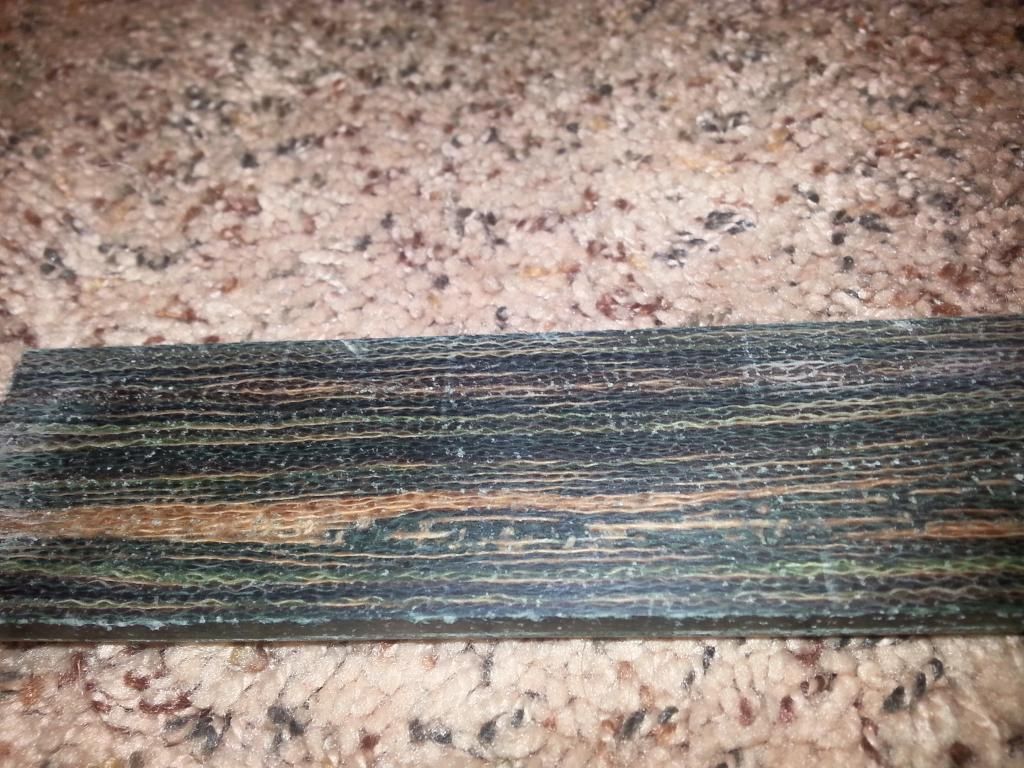
Not sure if this would work for you Brian. . .not black but our new thick camo. We can cut to any thickness you may need.

20150129_195616.jpg
 
Nowhere did I say it wouldn't be acceptable for any application. You said laminating two pieces totether its "pretty much the same" as a continuous piece. That is false so I said it was.

Glue up a piece and grab a chisel. See if its "pretty much the same". I've done it.

For THIS application, it is "pretty much the same", which is what my answer was based on. Not building micarta anvils.

To be very specific, if Brian epoxies together several layers of sanded micarta, cuts them into scales and then epoxies them to a tang or folder liner, it will be more durable than most wood scales. The joins will be very strong, completely stable and unlikely to separate, even if someone was did something dumb like take a chisel to them.

See this:
DSC00893_zps7bc7e135.jpg

That one piece scale is three layers of micarta, sanded and epoxied together as I've described. After curing I grabbed the front two ends and lightly pried them apart, levering the two joins. Despite 3" of leverage, the scales flexed and the two half inch joins didn't even crack.

I don't know what your standard for strength is, but my joins after sanding appear to be a large percentage of the strength of the micarta itself. Certainly strong enough to make a scale out of.


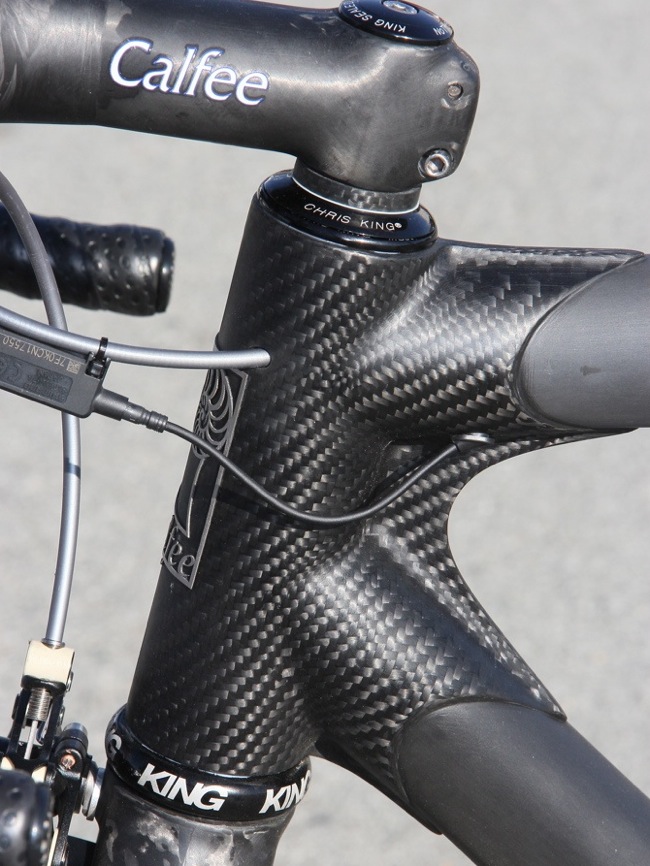
This is exactly the same principle that keeps these "carbon micarta" tubes from torquing their way out of the carbon fiber lug sockets on this bicycle. These are just slip fit together - no pressure or clamping.

Calfee5.jpg
 
Last edited:
Again im not arguing that it wont work on your bikes. I dont really care about your bikes man.
Its like trying to compare a strong folder to a fixed blade. Yeah its probably not gonna fail, but if it does you know exactly where and why it will. Your opinion on how it is strong enough has no bearing on the difference in limits of both of them

Im done cluttering up Brian's thread. Head on over to W&C if you want to argue:)
 
The example with the bike frame is invalid, in that it is a joint designed to perform well with epoxy only. Much different than a joint found in a knife handle as discussed. With a plain lap joint between two phenolic surfaces, the joint will only ever be as strong as the epoxy between the mating surfaces. Phenolic laminate sheet is much stronger than cured common epoxy alone, on paper (it can be looked up easily) and in real life. Furthermore, the thermosetting resins used in these laminates are stronger and more suited to the purpose than the epoxies commonly used by knifemakers.

Think of micarta as concrete- a grid of reinforcing material (cloth, rebar) suspended in a hardened, cured matrix (phenolic resin, cement/aggregate.)

You would never pour a wall on top of a footing without rebar or at least epoxied bolts reinforcing the joint- the shear strength of such a "cold joint" would be poor. That's like gluing two pieces of phenolic together without reinforcing the joint in any other way. Mechanical fastening helps, and being supported by a tang helps.

I've had to hammer mortised micarta slabs off of hidden tangs before- they tend to come apart at the seams, and not due to poor gluing technique.

All that, to say that I'd tend to go with Josh and especially Stacy on this one.

To the OP, I know what you mean with the grain orientation you asked about, and I find it unlikely that you'll find a solid piece of micarta that thick, especially on a budget. This is the type of situation where educating the customer in the realities of knifemaking will help you both settle on another option.
 
There are places that sell it in rod form. That isn't to say they were formed round. But you could definitely get it grained the right way I would guess
 
The example with the bike frame is invalid, in that it is a joint designed to perform well with epoxy only. Much different than a joint found in a knife handle as discussed. With a plain lap joint between two phenolic surfaces, the joint will only ever be as strong as the epoxy between the mating surfaces. Phenolic laminate sheet is much stronger than cured common epoxy alone, on paper (it can be looked up easily) and in real life. Furthermore, the thermosetting resins used in these laminates are stronger and more suited to the purpose than the epoxies commonly used by knifemakers.

Think of micarta as concrete- a grid of reinforcing material (cloth, rebar) suspended in a hardened, cured matrix (phenolic resin, cement/aggregate.)

You would never pour a wall on top of a footing without rebar or at least epoxied bolts reinforcing the joint- the shear strength of such a "cold joint" would be poor. That's like gluing two pieces of phenolic together without reinforcing the joint in any other way. Mechanical fastening helps, and being supported by a tang helps.

I've had to hammer mortised micarta slabs off of hidden tangs before- they tend to come apart at the seams, and not due to poor gluing technique.

All that, to say that I'd tend to go with Josh and especially Stacy on this one.

To the OP, I know what you mean with the grain orientation you asked about, and I find it unlikely that you'll find a solid piece of micarta that thick, especially on a budget. This is the type of situation where educating the customer in the realities of knifemaking will help you both settle on another option.

I don't think some of you are processing this reasonably:

End grain micarta arranged with the grain perpendicular to the tang IS weak. None of the strong qualities of the micarta are present when we are talking about a 1x3/16" thick piece. The strength is only going to come from the fact that the material is impact resistant AND glued directly to the tang. If this was a removable scale, like on a Becker, perpendicular end grain micarta would crack when you tightened the screws or gave it a wack.

That said, there are no 3.5" thick pieces of micarta out there to make this handle out of. My suggestion how to do it relies on the fact that epoxy bonds BETWEEN two phenolics are much stronger than epoxying something to metal, as in your tang example, Salem. It is a known property that composite designers use all the time, as in my example. It is the difference between a cohesive and adhesive shear failure. The shear strength of such a bond is simply higher because the epoxy bonds not only with the resin matrix but soaks into cotton threads as well.

Along with the bond to the tang, the additional bonds to form such a scale aren't going to be weak compared to the rest of the material.

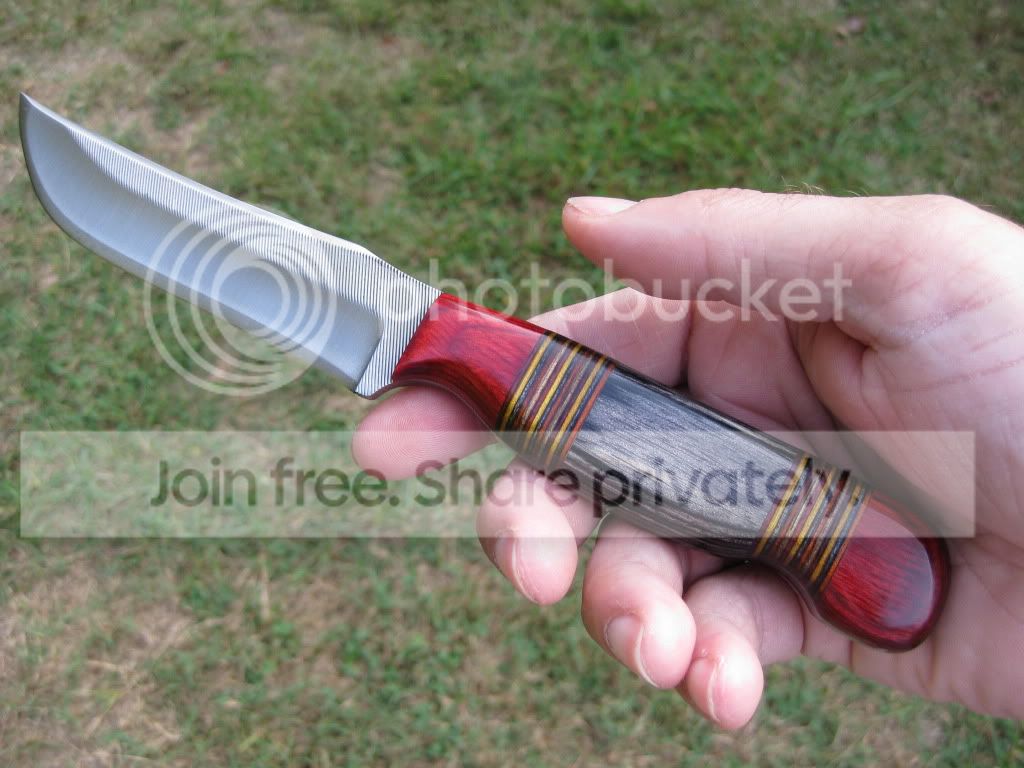
Anyway, this isn't some wacky experimental idea of mine. Anza has been doing it with phenolic wood for years. Not the narrow pieces with the grain running the wrong way, just like the OP's micarta:

b8f04340.jpg
 
At some point, the discussion became not necessarily about whether the material would be serviceable on a handle, but about if such an epoxy joint would be as strong as the surrounding phenolic.
The fact that this material would be glued and mechanically fastened onto a full tang makes it about the only instance in which I'd deem it sound enough to use. Without metal supporting it, an epoxy joint like that could just shear easily enough.
Micarta will soak liquid up to a very small extent, but given the viscosity of epoxy and the time frame involved, I'd be astounded if any wicking into the fibers would be more than negligible. Indeed "cohesion" would appear to be out of the picture; it would apply only if the lap joint in question was bonded at the same time as the surrounding resins in the laminate. What you're left with would be a purely adhesive bond.
I guarantee that if I went into the shop tomorrow and made up a sample of the glue joint discussed, waited until full cure and destruction tested it against a monolithic sample of the same grain orientation and cross sectional dimensions, the glued up sample would easily fail first.
Oh, and no insult meant to Anza Knives, but I wouldn't consider the handle or the blade of that knife to be a first class example of what I'd call durable.
 
At some point, the discussion became not necessarily about whether the material would be serviceable on a handle, but about if such an epoxy joint would be as strong as the surrounding phenolic.
The fact that this material would be glued and mechanically fastened onto a full tang makes it about the only instance in which I'd deem it sound enough to use. Without metal supporting it, an epoxy joint like that could just shear easily enough.
Micarta will soak liquid up to a very small extent, but given the viscosity of epoxy and the time frame involved, I'd be astounded if any wicking into the fibers would be more than negligible. Indeed "cohesion" would appear to be out of the picture; it would apply only if the lap joint in question was bonded at the same time as the surrounding resins in the laminate. What you're left with would be a purely adhesive bond.
I guarantee that if I went into the shop tomorrow and made up a sample of the glue joint discussed, waited until full cure and destruction tested it against a monolithic sample of the same grain orientation and cross sectional dimensions, the glued up sample would easily fail first.
Oh, and no insult meant to Anza Knives, but I wouldn't consider the handle or the blade of that knife to be a first class example of what I'd call durable.

I think you're making a theoretical argument about something I do with composites pretty commonly. As I said earlier, phenolics and epoxies chemically bond to each other in a way that is not "adhesion". That's coming right from CS folks at a large phenolic supply house. It also jives with my experience building the one piece handle I posted about earlier.

And if you can stand to hear about bicycles some more, the type of lugged joint I posted a picture of earlier are always much longer with more overlap if the lug or tubing is metal. That's because (again) composite matrixes bond to epoxy through cohesion, while they merely adhere to metal.

Also, I'm not sure why you are saying "not as strong". I never said that either. I said it would be "plenty strong" compared to the rest of the material as it is going to be used. If the materials being bonded where blocks of straight resin, I'd say a proper epoxy join between them would be about 90% or more as strong as the resin itself. End grain micarta as described, maybe 60-75% as strong. Two chunks of metal bonded that way - less than 10%.

I'm not sure why you're bagging on Anza. Have you ever heard of any of their handles coming apart?


I really don't know where all this knowledge is coming from.
 
Last edited:
First, yes I have heard of Anza handles coming apart (when dropped). If you care to google it, you'll find examples, too. I have personally seen delamination in pakkawood and resin wood handles, along the joints, on several occasions.

Any full-tang handle should have at least pins in addition to epoxy. That's common knowledge in knifemaking; especially with a knife like that pictured, which is ostensibly an outdoors "user type" of knife.

Also, I'm not sure why you are saying "not as strong". I never said that either.

Here:
Epoxy forms a perfect bond with those chemically similar phenolics, and the resulting joined piece is pretty much as strong as a piece of micarta made in a factory.

I guess you did hedge just a little bit on that... but not by much.

And if you can stand to hear about bicycles some more, the type of lugged joint I posted a picture of earlier are always much longer with more overlap if the lug or tubing is metal.

First of all, that type of joint that you posted a picture of is a tube in socket with a LOT of surface area for epoxy, much different and stronger than a simple butt or lap joint. Second of all, no I can't stand to hear about bicycles some more. Third, you've misunderstood my reference to a metal tang serving as reinforcement. I don't care to generate the wall of text it would probably take to fully spell it out to you.
I really don't know where all this knowledge is coming from.

Well, I'm a knifemaker, and I epoxy wood, metals, phenolics, and other materials together on the regular, and sometimes have occasion to observe what fails when such a joint is destroyed. Perhaps you'd care to look at my body of work- I've been doing this for ten years now. Are you a knifemaker? Perhaps we could look at your portfolio, if you are. Otherwise, what, you're a bike builder? I acknowledge that our two pursuits have overlapping technical arenas, but don't come ask me an insulting question like that in a knifemaker forum.

In fact, I believe I detect from your tone that you have to be right about this, and are growing agitated. I will then respectfully step away from this discussion and bid you a good evening.

My apologies to the OP. Good luck with your project!

 
First, yes I have heard of Anza handles coming apart (when dropped). If you care to google it, you'll find examples, too. I have personally seen delamination in pakkawood and resin wood handles, along the joints, on several occasions.

Any full-tang handle should have at least pins in addition to epoxy. That's common knowledge in knifemaking; especially with a knife like that pictured, which is ostensibly an outdoors "user type" of knife.


Here:


I guess you did hedge just a little bit on that... but not by much.


First of all, that type of joint that you posted a picture of is a tube in socket with a LOT of surface area for epoxy, much different and stronger than a simple butt or lap joint. Second of all, no I can't stand to hear about bicycles some more. Third, you've misunderstood my reference to a metal tang serving as reinforcement. I don't care to generate the wall of text it would probably take to fully spell it out to you.


Well, I'm a knifemaker, and I epoxy wood, metals, phenolics, and other materials together on the regular, and sometimes have occasion to observe what fails when such a joint is destroyed. Perhaps you'd care to look at my body of work- I've been doing this for ten years now. Are you a knifemaker? Perhaps we could look at your portfolio, if you are. Otherwise, what, you're a bike builder? I acknowledge that our two pursuits have overlapping technical arenas, but don't come ask me an insulting question like that in a knifemaker forum.

In fact, I believe I detect from your tone that you have to be right about this, and are growing agitated. I will then respectfully step away from this discussion and bid you a good evening.

My apologies to the OP. Good luck with your project!

Yes, I'm a non-professional knife maker. I started in 2005.

Yes, I also do composite work that involves the bike industry. I was also a military pilot that ran a maintenance shop that deal with airframe composites on a daily basis.


What actually bothers me with all this is that the OP asked for something that he cannot buy, I made the only reasonable suggestion how something like that could be constructed - based on my own ACTUAL experience - and everyone comes out of the woodwork to let it be known that I coudn't possibly know what I'm talking about.

My little suggestion would cost about $8 to try. And if anyone had even been interested in discussing it, rather than denouncing it, we would have gotten around to how bonding two layers of canvas backing to the scale when it is bonded to the tang would add even more strength.


I actually have looked for broken Anza handles and couldn't find any, but I'm sure they have a similar failure rate to all handles - including the pinned ones. The main difference is that files have 3-4 times the bonding surface area as flat metal, which is why Anza "gets away with it" without the incredibly poor reputation you're implying they should have. The company is 35 years old, and the owner, Charlie Davis, has been making knives longer than either you or I combined, since he was a production manager with Buck in the '70s. Yet, no pins. Hmmm.
 
Last edited:
Actually, I apologize first of all for being grumpy. Especially about a non-issue. Since you're a maker too, you'll know that we get all persnickety about particulars sometimes.

I don't mean to imply that Anza should have a poor reputation per se, but blades made from files are full of stress risers for one thing. For another, I did look at his site and watched a video with him explaining why he uses files and how he heat treats them, and it was overly simplistic, misleading in places, and didn't impress me at all. We've all discussed why knives from files aren't the best 'till we're blue in the face around here...
There are plenty of folks who have been making poor knives for longer than I've even been alive... again, I only mean to address your remarks, not overly trash a company with whose knives I have no personal experience.

I mean the best, let's go back out and talk about cool stuff instead like RA in D2, etc.
 
Actually, I apologize first of all for being grumpy. Especially about a non-issue. Since you're a maker too, you'll know that we get all persnickety about particulars sometimes.

I don't mean to imply that Anza should have a poor reputation per se, but blades made from files are full of stress risers for one thing. For another, I did look at his site and watched a video with him explaining why he uses files and how he heat treats them, and it was overly simplistic, misleading in places, and didn't impress me at all. We've all discussed why knives from files aren't the best 'till we're blue in the face around here...
There are plenty of folks who have been making poor knives for longer than I've even been alive... again, I only mean to address your remarks, not overly trash a company with whose knives I have no personal experience.

I mean the best, let's go back out and talk about cool stuff instead like RA in D2, etc.

I've personally asked about their heat treat method, and they consider it proprietary. So if it sounded non-technical, that was probably on purpose. I don't know if they just re-temper them, or anneal and re-HT from scratch. And Anza won't say.

They are not fine knives, but they have an excellent reputation with people who own and use them. The couple I own have been extremely durable in every way.
 
There was a gentleman on Fleabay that was selling 2x2x6 blocks of tan canvas micarta that were cut from a 6" thick plate of Westinghouse Micarta. He said that it was used as the base for some industrial power supply before it was reclaimed. The "end grain" was oriented vertically across the 2" direction, rather than along the length of the piece. Interesting variation - and some awfully thick blocks of Micarta...

TedP
 
Back
Top