
-
The BladeForums.com 2024 Traditional Knife is available! Price is $250 ea (shipped within CONUS).
Order here: https://www.bladeforums.com/help/2024-traditional/
You are using an out of date browser. It may not display this or other websites correctly.
You should upgrade or use an alternative browser.
You should upgrade or use an alternative browser.
Which bowie for a fighting knife?
- Thread starter Monoceros
- Start date

- Joined
- Oct 28, 2006
- Messages
- 3,910
If SHTF and I have run out of ammo and have no chioce but to fight with a knife I would choose a CS Trailmaster or a SOG Tigershark.

- Joined
- Oct 28, 2005
- Messages
- 1,121
I'm going to suggest the Busse Bluegrass Bowie. Of course, there is only one, and there won't ever be another. Still, I think it's an interesting knife with a unique grind. I asked a knifemaker to use that as inspiration for a bowie for me. It's still in the works.
The Randall Confederate is pure dynamite. I love that thing.
The Randall Confederate is pure dynamite. I love that thing.

- Joined
- Apr 9, 2004
- Messages
- 9,439
You could get something like a Trail Master and put a custom handle on it.

Scott

- Joined
- Apr 27, 1999
- Messages
- 6,117
- Joined
- Apr 27, 1999
- Messages
- 6,117
There is always a balance between knife mass and speed. If you aren't fast enough to hit your target (or if your target hits you first) it doesn't matter that your knife has devastating chopping ability. On the other hand it is bad if your blade is too short to penetrate to vital organs or worse yet is to short to get to your uncooperative target. If your blade is badly designed or too light to make disabling cuts it increases the likelihood that you will lose control of your combat.
So I favor a long (10-12 inch) blade that is a little lighter (and faster) than some common mega-chopper bowies. To offset that lightness I want a full width blade grind for optimum cutting ability. I also want a blade with the point somewhat back towards the spine of the blade rather than an extreme clipped point. This is to maximize the belly curve of the edge right in front of the tip. My experiments indicate that a lot of the time your primary slashing effect comes from the belly portion of the edge. Getting fancy with blade grind and sharpened clip points is counter-productive if it sacrifices that belly. You want a back curve on that belly to produce the best slashing effect. That is why sabers are back curved. If the belly is sharp and the point is back near the spine you don't need a sharpened clip point.
Ideally I want enough weight in the blade so that I could break the radius bone of a wrist with a snap cut. Beyond that I expect all the cutting work to be against soft tissue rather than planning to break through bones. The through bones part might come on a thrust. For that I want a really solid handle. I like the slightly hourglassed shape of the Trail Master. It prevents slippage fore or aft. Knife handles get slippery in action.
Another reason to favor moderate weight is so that you can reasonably carry the knife. An extremely heavy chopper is likely to get left behind when you head for the hills.
So I favor a long (10-12 inch) blade that is a little lighter (and faster) than some common mega-chopper bowies. To offset that lightness I want a full width blade grind for optimum cutting ability. I also want a blade with the point somewhat back towards the spine of the blade rather than an extreme clipped point. This is to maximize the belly curve of the edge right in front of the tip. My experiments indicate that a lot of the time your primary slashing effect comes from the belly portion of the edge. Getting fancy with blade grind and sharpened clip points is counter-productive if it sacrifices that belly. You want a back curve on that belly to produce the best slashing effect. That is why sabers are back curved. If the belly is sharp and the point is back near the spine you don't need a sharpened clip point.
Ideally I want enough weight in the blade so that I could break the radius bone of a wrist with a snap cut. Beyond that I expect all the cutting work to be against soft tissue rather than planning to break through bones. The through bones part might come on a thrust. For that I want a really solid handle. I like the slightly hourglassed shape of the Trail Master. It prevents slippage fore or aft. Knife handles get slippery in action.
Another reason to favor moderate weight is so that you can reasonably carry the knife. An extremely heavy chopper is likely to get left behind when you head for the hills.
- Joined
- Apr 27, 1999
- Messages
- 6,117
PS. If you haven't seen it, you can find a full print of John Styer's Cold Steel knife fighting book on the internet. It may not be the best, but it shows the concepts well.
http://www.vrazvedka.ru/main/learning/ruk-b/styers.html
http://www.vrazvedka.ru/main/learning/ruk-b/styers.html
Rudy Ruana's Mexican Bowie is prolly the most PURE of the true fightin' knives. The classic Bowie fer' loppin' heads if I've ever seen one....soft enough to keep from breakin' and hard enough where it needs to be. The last one listed on Ebay got no bids at 1100 frogskins, but that wasn't 'cause it wasn't worth it. I think it was the initial bid that scared everyone away.
- Joined
- Apr 27, 1999
- Messages
- 6,117
The best designed fighting knives that I know of are made/designed by Jerry Hossom. They aren't expensive as some customs. I would suggest ordering knives made with CPM-3V. The Dualist is a very sophisticated choice.
http://www.hossom.com/index_page0003.htm

http://www.hossom.com/index_page0003.htm
- Joined
- Jul 31, 2002
- Messages
- 2,959
Thanks for sharing your thoughts, Jeff.
I've shared my thoughts on this subject in the past, and will spare you guys the full dissertation. But suffice to say my thoughts on the subject may or may not necessarily agree with the mainstream "wisdom" on the subject of balance for "fighting" blades. Speed and power (from mass) don't necessarily have to be at odds with each other. But in the end I pretty much agree that there will be some amount of compromise involved, based on idividual strengths and preferences.
I have gravitated towards a slightly different philosophy on this part. I appreciate some curving belly on the edge towards the point, but at the same time I'm not willing to compromise too far on thrusting potential. And I see an upswept edge and high point line to negatively affect thrusting more than I like. So I don't want the point all the way up in line with the spine, etc. Especially the smaller/shorter you go, the less cutting/slashing power the knife has anyway, so I'd lean more towards thrusting, thus having a narrower point centered or below center. It's also kindof a paradox that the bigger the blade gets, with more accompanying cutting power, the less it needs that curving belly to make slashes effective.
At any rate, if you want effective slashing potential, get that edge sharp. It needs proper geometry and polish level/aggresiveness matched to your target. Anything less than perfect sharpness will make a bigger difference than profile shape when slashing against soft tissue.
When cutting bones, (especially those in the limbs) edge geometry is more important than sharpness since they generally aren't cut, but cleaved. When thrusting through, that's where the geometry stuff I mentioned above becomes important. I've seen a huge difference in the way different point shapes can get through bone. (and skin)
I'm not understanding you here. What do you mean by "back curved"? Are you talking about a recurved edge, or are you referring to a spine that curves upwards?
There is always a balance between knife mass and speed.
I've shared my thoughts on this subject in the past, and will spare you guys the full dissertation. But suffice to say my thoughts on the subject may or may not necessarily agree with the mainstream "wisdom" on the subject of balance for "fighting" blades. Speed and power (from mass) don't necessarily have to be at odds with each other. But in the end I pretty much agree that there will be some amount of compromise involved, based on idividual strengths and preferences.
I also want a blade with the point somewhat back towards the spine of the blade rather than an extreme clipped point. This is to maximize the belly curve of the edge right in front of the tip. My experiments indicate that a lot of the time your primary slashing effect comes from the belly portion of the edge. Getting fancy with blade grind and sharpened clip points is counter-productive if it sacrifices that belly. ...If the belly is sharp and the point is back near the spine you don't need a sharpened clip point.
I have gravitated towards a slightly different philosophy on this part. I appreciate some curving belly on the edge towards the point, but at the same time I'm not willing to compromise too far on thrusting potential. And I see an upswept edge and high point line to negatively affect thrusting more than I like. So I don't want the point all the way up in line with the spine, etc. Especially the smaller/shorter you go, the less cutting/slashing power the knife has anyway, so I'd lean more towards thrusting, thus having a narrower point centered or below center. It's also kindof a paradox that the bigger the blade gets, with more accompanying cutting power, the less it needs that curving belly to make slashes effective.
Ideally I want enough weight in the blade so that I could break the radius bone of a wrist with a snap cut. Beyond that I expect all the cutting work to be against soft tissue rather than planning to break through bones. The through bones part might come on a thrust.
At any rate, if you want effective slashing potential, get that edge sharp. It needs proper geometry and polish level/aggresiveness matched to your target. Anything less than perfect sharpness will make a bigger difference than profile shape when slashing against soft tissue.
When cutting bones, (especially those in the limbs) edge geometry is more important than sharpness since they generally aren't cut, but cleaved. When thrusting through, that's where the geometry stuff I mentioned above becomes important. I've seen a huge difference in the way different point shapes can get through bone. (and skin)
You want a back curve on that belly to produce the best slashing effect. That is why sabers are back curved.
I'm not understanding you here. What do you mean by "back curved"? Are you talking about a recurved edge, or are you referring to a spine that curves upwards?
Get the Hell's Belle from ontario. In a fighting bowie, the steel does not matter. All steel will cut flesh the same. Bill Bagwell definitely knows what he is talking about when it comes to bowies and his are the best. If you really want to go all out, get a custom from Bagwell. If you don't, an ontario Hell's Belle will do just fine.
- Joined
- Apr 27, 1999
- Messages
- 6,117
By back-curved I mean that the cutting edge sweeps back towards the back of the blade (or even past it like a saber or trailing point skinner).

By the way you are wrong if you think that a short or light blade cannot slash effectively. The key is to have that long belly so that you automatically get high pressure and transverse slicing action when you slash. There is a reason that sabers and scimitars were given the curve. It allows lighter blades to cut effectively.
By the way you are wrong if you think that a short or light blade cannot slash effectively. The key is to have that long belly so that you automatically get high pressure and transverse slicing action when you slash. There is a reason that sabers and scimitars were given the curve. It allows lighter blades to cut effectively.
- Joined
- Jul 31, 2002
- Messages
- 2,959
By the way you are wrong if you think that a short or light blade cannot slash effectively. The key is to have that long belly so that you automatically get high pressure and transverse slicing action when you slash. There is a reason that sabers and scimitars were given the curve. It allows lighter blades to cut effectively.
I wouldn't have written it if I thought I was "wrong".
 Rather, I think we're probably just coming at this from different perspectives. I certainly would not want to receive a slash from any blade; short or not.
 I've typed and deleted several wordy thoughts here... will try the scattergun effect...
I specifically chose to say short rather than light.
"Effective" is relative. With folders, I usually get a slash maybe an inch or two long and half as deep. (against critters) Maybe a bit more with a 6" or 7" blade. But they all suck compared to much larger blades.
The long belly makes no difference if you're slashing with the blade cocked back lagging behind your hand.
There was a reason lots of European swords were not curved, for centuries, as well. I'm not qualified to settle a debate that's been discussed for generations, though.
As I said, even if that sweeping belly at the point makes difference when slashing, I'd probably still not want it because I don't like what it does for my thrusting ability. I prefer a general "cut & thrust" design, rather than designs that emphasize either one over the other.
- Joined
- Oct 28, 2006
- Messages
- 3,910
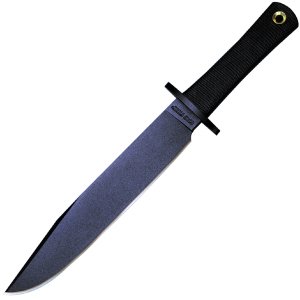
I still stand by these two they both have a good cost to effectiveness ratio.

- Joined
- Jul 31, 2002
- Messages
- 2,959
I think there should be a distinction... because a properly done trailing clip-point on a properly done Bowie knife elevates the knife's combat effectiveness by, at least, an order of magnitude when in the hands of a Bowie player over pretty much any other knife design, while a straight clip-point blade, however well sharpened, offers nothing other than the ability to do the simplest back-cut and back-slash.
I have used back cuts against critters many times, and have never seen one do anywhere near as much damage as the main edge can. It may well make sense from the standpoint of fighting tactics, but so far I percieve statements about the massive destructive potential of back cuts as hype.
Something that most most martial artists don't know unless they're thoroughly schooled in Western blade use, and something that the overwhelming majority of even the best custom knifemakers don't know (or don't care about) is that a truly functional Bowie blade doesn't end in a point. It ends in a tiny little radius, and the blade is sharpened around that radius. ...A blade that ends in a pointy tip is not nearly as effective at the same range as it will merely deliver a scratch.
An acute point is also sharpened around the radius; it's just on a much smaller (microscopic) scale. This is one thing I'm actually very particular about when it comes to thrusting. I want the very tip to end in a needle sharp point, and I give this area extra attention on the stones to keep it that way after use.
When it comes to Bowies, lighter is better, period. Given similar dimensions, materials, heat-treatment, and edges sharpened at equal angles, a lighter knife will out-cut a heavier one any day of the week.
I can agree that a bowie must be light enough for you to move very quickly, but as this statement is written above, I say hogwash. Show me any of your favorite designs and I can grind more steel away to make them even lighter. This doesn't necessarily make them better. If this is your position, use a fillet knife.
There is a subtle nuance in this act seldom addressed by anyone (I don't think I've ever seen anybody talk about it here, even.), and that is the "pump". Sure, you can just simply stick the blade into someone, then pull it straight out, but then you're not really taking advantage of the Bowie or centuries of Western fencing development. In the Western methods, a cut almost always occurs off of a thrust (that's the goal, anyway): the blade is inserted, then angled up or down, or twisted and canted left or right, before being withdrawn, almost like a draw-cut. The blade literally cuts it's way out through tissue. With a proper Bowie knife and some fairly basic skills, one good thrust-and-pump and it's over.
I have seen this discussed many times here in the past. I use this method on occasion, but I see it as ever so slightly slower than just a straight in & out motion. I don't spar with bowies against another person, but getting bit by an angry critter is a great motivator to move as fast as I possibly can.
2nd choice: Cold Steel Laredo.
You might want to check out this thread. The Laredo apparently only has a tang an inch or two long. The rest is just a piece of twisted steel cable to hold the butt cap on.
I really appreciate all of this information about bowies and all of the interesting responses posted. I'm wondering if the stainless steel of the Ontario is going to be a problem and if I should go for another bowie, though I don't think i want a CS. Thanks again, and keep at it.