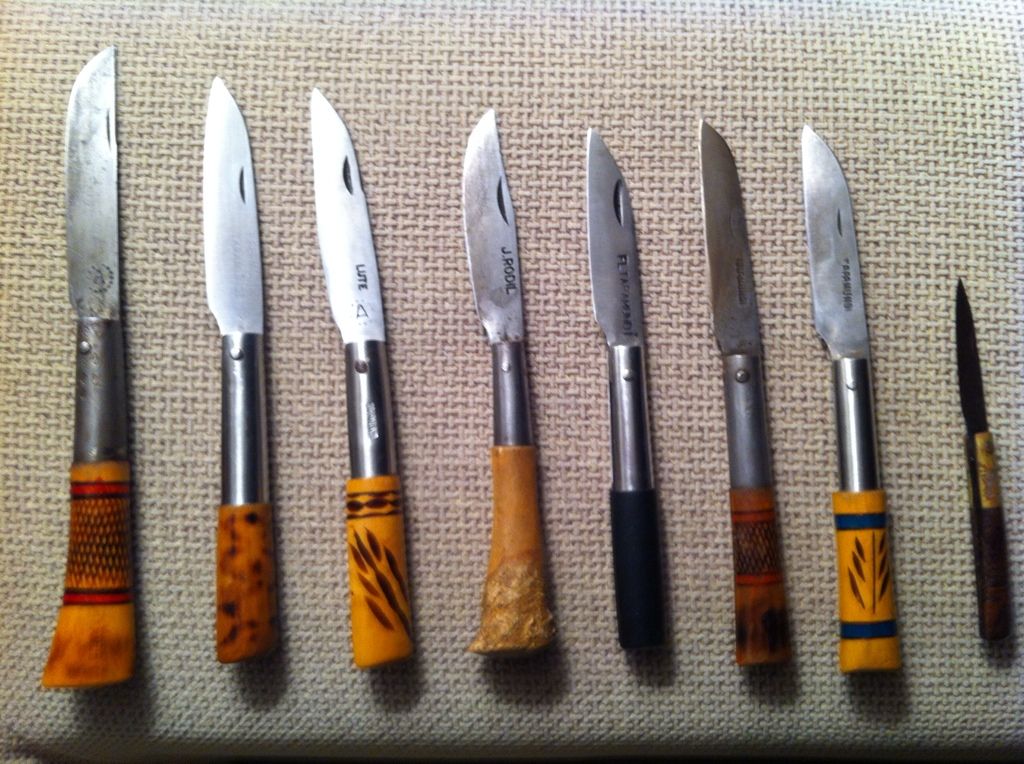
Which traditional knife company makes/made the best cutting blades?

Regarding Opinels carbon, I've been playing with putting a graduated set bevels on mine with my Lansky ( 17, 20, 25) followed by a strop. I got visible folding when I stopped at 20 and noticeably tougher edge when I added the 25 deg bevel.

Carl, where did you see the Rc numbers for their stainless. May need to try that but have feared it was mor like the Victorinox INOX.

Sandvik's own site specs the 12C27M steel up to 59 HRC. Don't know if Opinel has published what they treat it to, but based on what I've seen with mine, I wouldn't be surprised if Opinel took advantage of that. It does seem to better resist the rolling & denting that I've seen on my 'carbone' model, at similar edge angle & thickness.

( quoted from Sandvik's description of 12C27M, found here -->: http://www.smt.sandvik.com/en/produ...fe-steel/sandvik-knife-steels/sandvik-12c27m/ ):
"With a hardness range of 53-59 HRC, excellent toughness and great corrosion resistance this knife steel grade is the recommended choice for kitchen knives, high-end scissors, gardening tools, professional butcher knives and fishing knives for fresh water environments.
 
I have to agree with you guys, I own 6 case knives made before 1980 and the combination of beautifully thin grinds and the easy to sharpen steel make for an amazing cutter.
In second place I agree on the opi as well.
E1AC14BE-B974-447C-89A3-08BF174C425F-717-000000AFDDB5BDC4.jpg

These are not bad also
d236bd24.jpg


Mateo
 
I enthuse over Opinel stainless in food slicing. Salami, cheeses, garlic in ultra thin transluscent slices, apples in thin slices for a pie. I turn to the Opinel for this kind of thing, not very scientific I know, but it works!
 
For current out of the box production I like Case/Bose Collaborations. Grinds, swages, and the 154CM steel makes for a pretty nice blade. If you don't mind a bit of work to re-profile, some of them, and sharpen them up, Queen D2 would be awfully hard to beat.
 
Geometry Cuts....Heat Treat tells you how long. IMO Schrades 1095 is the best combination of both.

Stan
 
David and Carl, the Blade Steel FAQ by Joe Talmedge puts 12C27M into the same rough category as Buck's 420HC, assuming a good heat treat. Is that consistent with your experience with the (newer) Opinel INOX?

Regarding Stan's comment that "geometry cuts", can anybody give examples of times where hollow grinds consistently out perform others? Meat processing?
 
All of these, Kabar from the 1930s, German Eye 1986, Opinel, Northfield and Case Trapper (SS)
Carbonsteel002_zps078d3ac9.jpg
 
David and Carl, the Blade Steel FAQ by Joe Talmedge puts 12C27M into the same rough category as Buck's 420HC, assuming a good heat treat. Is that consistent with your experience with the (newer) Opinel INOX?

Regarding Stan's comment that "geometry cuts", can anybody give examples of times where hollow grinds consistently out perform others? Meat processing?

One thing that Sandvik has going for it, that might give some additional advantage, is their process for producing the steel. Sandvik has a reputation for the purity of their steels, and their process is also known to produce very fine grain. Finer grain usually translates to finer edges, and also to increased toughness as well. In terms of the basic chemistry, they do look very similar though.

One thing sort of unique about 420HC, in my mind, is it's very predictable tendency to form burrs & wires. Not such a big deal, it's fixable; and they're more easily cleaned up on Buck's blades (higher RC) than on Case knives. But, I haven't noticed nearly as much of the burr-forming tendency in the 12C27M blades on Opinels. Maybe it has something to do with differences in size and/or even distribution of the chromium carbides (maybe finer in Sandvik's), or maybe not. I don't know, but Sandvik's manufacturing process is probably more advanced, based on reputation anyway.

Regarding hollow grinds, I've come to like them a lot for food prep. Does work well for slicing meat, and I've also noticed a peculiar advantage in slicing some fruits, like apples. Apples are kinda weird, in how they can make some blade profiles really bind up in slicing them. This has bugged me with my Opinel which, for some reason, the thin convex can really 'stick' inside the apple, which seems to grip the blade in almost a vise-like manner. A hollow grind opens up a little space between blade and fruit, so the 'vacuum' effect can't make the blade stick like it often does with flat grinds or thin convexes (like Opinel).


David
 
Last edited:
Some one already posted the Opinel.

GEC makes some very fine slicers!

I have two Queen in D2. The steel is great. But I find the grinds to be thicker. Even after taking the shoulder bevel down.
This. Geometry is what makes it cut, the steel and HT is what keeps it cutting.
 
I am a huge fan of Queen's D2. After thinning the edges down a bit for better utility value, I find that it has excellent edge holding qualities and gets sharp as the dickens. I try to buy that now over any other steel if I am in the market for a new knife.

But as a slicer... I am in agreement with an earlier post. As the weather gets cold/cool and I don't sweat through my jeans everyday, I switch back to carbon steel. I have a large CASE copperhead that I bought in '76, and it has thin, hollow ground edges and fairly soft steel. This makes an incredible slicer that is easy to sharpen and maintain.

With so many knives being flat ground/stamped these days, one forgets how effective blade geometry is at creating a slicing tool. Back in those days my CASE was considered a large folder, but isn't much compared to the brickish GEC offerings these days. Yet, it was in my pocket nearly every day for years and years and did everything I wanted it to do with no problems. Plain old 1095 and a good hollow grind. Lovely.

Robert
 
David and Carl, the Blade Steel FAQ by Joe Talmedge puts 12C27M into the same rough category as Buck's 420HC, assuming a good heat treat. Is that consistent with your experience with the (newer) Opinel INOX?

Regarding Stan's comment that "geometry cuts", can anybody give examples of times where hollow grinds consistently out perform others? Meat processing?

Another reason I like hollow grinds,the more a knife is sharpened the edge will stay thin farther up the blade.With a full flat grind(basicly a V from top to bottom) the more steel you wear away the thicker the edge.

Stan
 
Back
Top