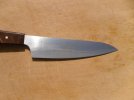
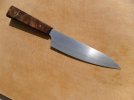
White Steel San Mai and Turkish Walnut

Joined
Dec 21, 2006
Messages
3,158
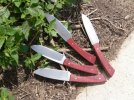
Finally got around to finishing this kitchen knife for the wife. The steel came from Dictum, the white steel/wrought iron san mai billet. The wood is Turkish walnut. It is definitly not traditional, but my take on a Japanese knife. Can't wait to sharpen it tonight. The edge is about .005", and it will be taken all the way to the 12,000 grit chinese waterstone. SAM_1281.jpgSAM_1285.jpg I thought I would throw in a pic of these four knives that are being shipped out tomorrow. 1084 and purple heart. Glad to have these done! SAM_1270.jpg Please offer your critiques!!!
 
Beautiful!!!
is it san-mai construction of 3 layers (showing also on the spine)?
I ask because i would like to try, instead, a reported edge, and i'm trying to collect info on how to do the weld setup.

cheers

Stefano
 
stezann,
I believe that what the knife is made from is a san-mai billet from Dictum, in Germany. They carry hard to get Hitachi steels and laminates. They also carry unhardened Japanese blade blanks ( not much beyond profiled) and hardened but unfinished Japanese blades. Shipping is surprisingly affordable.
http://www.mehr-als-werkzeug.de/category/Staehle-3624_3628.htm

The billet is Hitachi white/blue paper steel core with iron cheeks (low carbon side layers). The white paper core makes great Japanese blades where high edge hardness is desired ( sashimi blades).
http://www.mehr-als-werkzeug.de/pro...-Layer-Steel-Core-layer-White-Paper-Steel.htm


The blue paper core san-mai makes an even tougher kitchen blade.
http://www.mehr-als-werkzeug.de/pro...e-Layer-Steel-Core-layer-Blue-Paper-Steel.htm


Nice petty, Stuart. Handle is stunning. What type of quench did you do?
Try the blue paper core on your next order. I have switched to it on most high end kitchen blades, now. I still do sashimi ( yanagi-ba) blades in white paper.

Dictum also carries a very nice multi-layer Japanese "katana" type steel. This type billet only has the hard steel on the edge area. The rest is softer steel. It is best forged. The suminagashi with white core will make a stunning sword or knife, and the multi-layer with white or blue core will make a fantastic tanto or shoto-wakizashi.
 
Thank Stacy,
i'm also into kitchen knives, and prefer single bevel ones. The reason i want to try welded edges is to try to minimize quenching warps, reducing the hardening steel's volume.
Grinding post-quench only posticipate the warp and consider my temper is very low with slicers like yanagiba, so not so helpful for straightening.
Am i off-road? How single bevel blade should be managed with HT+post HT?
thank you.

Lot of beautiful knives on this forum!!!! great makers!!!
 
Thanks for the compliment, guys. Stefano, Stacy answered your question better than I could. You can see the white steel core when you look down the spine. Stacy, being that I didn't have my kiln at the time I made this knife (nor Parks 50), I sent it off to Brad at Peter's (as per your recommendation....I don't know if you recall.....but you steared me correctly away from heat treating white steel in a paint can forge!!!!) Next time, I will do it myself.....with Parks 50. I understand the difference between White and Blue steels....been doing a lot of research lately. I thought of ordering the Blue steel billet from Dictum (or workshopheaven), but I just received from a little known supply house in Germany a couple of bars of 1.2519, or 110WCrV5, or O-7. While not quite the carbon content of Hitachi Blue steels, the other "ingredients" are about identical.....especially in the vanadium and tungsten category!!!! The billets are only 1.6mm thick, and I wil be making a petty with a western style handle. I also ordered a 5mm bar of the same steel from a different outfit in Germany.

I sharpened the White steel last night. Good heavens what an edge. I hear the blue steel won't get quite as sharp, but still very sharp, but lasts much longer...due to the carbides present.
 
Back
Top