Who has the most Mistresses?

I'm going to hate myself for this. But.

Roughly speaking, it's the tendency of the blade to stay in motion once you've put it in motion -- both linear motion (translation) and angular motion (rotation).

It's got so much of this tendency, that you can very easily hurt yourself if you're not quite careful. You don't need to be very accurate with a small, light knife since it has little inertia. Not true with this big beast. If it's heading towards, for example, your thigh ... you might have trouble dissuading it before it's too late.

The lanyard can provide the extra force you need to overcome that inertia. Get one and use it faithfully.

I would listen to this guy. He won his high school science fair with just a paper clip, some lint, and a slide rule. There was a brief international panic while something about codes and breach came up, but they still gave him the award.
 
Yes, I noticed Noss was using a lanyard on his tests. For me they can and do catch on just about everything....but having one in your kit which can be easily attached with a karabiner would be helpful for lengthy chopping....and a good tip :thumbup:

Watching where you place your feet and how you swing is the main thing ...as with an Axe or a Machete...if a follow through swing is heading for your thigh...you have'nt quite got it right...

Here are pic's of my other Mistress...this one is a bit more pretty...but will eventually be D/C as well. I smoothed the grips for a better fit as per the top pic.

100_0333-1.jpg


100_0302-2.jpg
 
Last edited:
I'm going to hate myself for this. But.

Roughly speaking, it's the tendency of the blade to stay in motion once you've put it in motion -- both linear motion (translation) and angular motion (rotation).

It's got so much of this tendency, that you can very easily hurt yourself if you're not quite careful. You don't need to be very accurate with a small, light knife since it has little inertia. Not true with this big beast. If it's heading towards, for example, your thigh ... you might have trouble dissuading it before it's too late.

The lanyard can provide the extra force you need to overcome that inertia. Get one and use it faithfully.
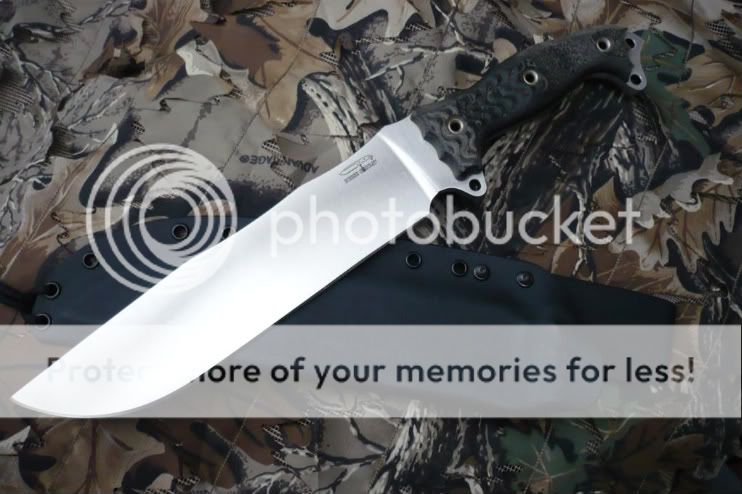
This is one often overlooked point. When I use to chop 2 chords a year, I would use as SHBM, a 15 inch Khukuri, an 18 inch Khkuri and a 22 inch khukuri. The 22 incher weighed weighed in at about 5 lbs and was 1 inch thick at the spine. The 18 incher was slightly better at 3.2 lbs. When I used them, if I missed the log, I literally had to get my shin out of the way or risk cleaving my leg, because I could not stop the blade in time. The FFBM and gives me that same feeling in full power swings. The BM-E and the SHBM are light enough that they don't do this.

Remember one thing, a big blade can take down a piece of wood very fast, but when you are there for 2 hours, you actually cut less wood, because it wears you down faster. I was actually able to chop more wood with my SHBM than with my 18 inch Khukuri, even though the Khukuri could take down a limb or a 2x4 quicker. Bigger is not always better, somewhere in the middle is usually the best place to be.
 
Last edited:
Yes I would love a SHBM exactly because it fits nicely "in the middle" but they are a bit expensive now....the Basic 9 is a close relative and a bit cheaper. I like mine for exactly the reasons Cobalt said and the Res C grip is comfortable for sustained chopping....the blade is a lot more used now...this was when I first got it.

100_0287-1.jpg


Anyone ever want to let go a cheap user SHBM let me know..;)
 
... it could even be about a person's personality. Provided that personality has considerable psychological inertia. ;)

Thank you for that incisive explanation, OP, and remember all you piglets:

Inebriation may increase the effects of inertia by several orders of magnitude, whether that inertia be linear, rotational or psychological.
 
"Anyone ever want to let go a cheap user SHBM"

Jumbo Shrimp.

Military intel, ect you get the idea.

As I remember, just a few years ago, I got a one of three hundred, user, a Limited edition number 350(also a one of three hundred) a Hood knife, number 18 out of 5 produced and a SHBM variant that looks to be the size of a Steel Heart for $5,000

Maybe about 2 years ago? I posted pictures at that time.

Recently that is about as close to a Cheap user that I have seen.

Makes three user SHBMs for me, one slotted bolt Standard and two one of three hundred.

But with the values so high I only throw one at a time now, sort of breaks my heart when I throw them and they hit each other.

I sort of remember an SHBM of some sort for just under a grand on the exchange, just keep looking.
 
I'm going to hate myself for this. But.

Roughly speaking, it's the tendency of the blade to stay in motion once you've put it in motion -- both linear motion (translation) and angular motion (rotation).

It's got so much of this tendency, that you can very easily hurt yourself if you're not quite careful. You don't need to be very accurate with a small, light knife since it has little inertia. Not true with this big beast. If it's heading towards, for example, your thigh ... you might have trouble dissuading it before it's too late.

The lanyard can provide the extra force you need to overcome that inertia. Get one and use it faithfully.

Does FBM have COP? Or is it too fat, too short for that?
 
Does FBM have COP? Or is it too fat, too short for that?

no, no FBM comes with a COP. No COPs were harmed during this post.

not sure what your asking. if you are asking about inertia, they all have it. The issue is whether you can overcome it on a full swing.
 
not sure what your asking.

He means center of percussion, I think, which is often connected to the sweet spot on a baseball bat.

It's not the same as the sweet spot, as I understand it, but rather has to do with a pivot point that produces a particular sweet spot.
 
Thank you for that incisive explanation, OP, and remember all you piglets:

Inebriation may increase the effects of inertia by several orders of magnitude, whether that inertia be linear, rotational or psychological.

But lets not confuse personality with behavior. Personality does affect behavior - but its the behavior that is the action - ergo the "inertia factor".

In fact - inertia is not the best word for change (or lack there of) in human behavior. With linear or rotational inertia the object has no choice in the matter - With human behavior the concept of choice comes into play concerning the action or behavior and change can occur often on demand :)

Such concepts however do not apply (or not as well) when it comes to scotch or INFI!! For these things concepts of behavioral choice are irrelevant and resistance is futile! Drink the Kool-Aide - Welcome to the BORG! :thumbup::D


(Requisite Battle Mistress Added)


attachment.php
 

Attachments

  • DSCF3530_edited.jpg
    DSCF3530_edited.jpg
    66.7 KB · Views: 203
Last edited:
He means center of percussion, I think, which is often connected to the sweet spot on a baseball bat.

It's not the same as the sweet spot, as I understand it, but rather has to do with a pivot point that produces a particular sweet spot.

The SHBM's center of percussion is fairly diffuse ... it extends along quite a bit of the blade, but it is there. Swing one and you shall find out! :)

The COP is the spot at which a strike does not produce unwanted vibrations throughout the body of the knife (or bat, etc.). Most young men of my age experienced this with a baseball bat. Strike too far down the shaft and you set up VERY unpleasant vibrations that made your hands sting. The same would happen if you struck too close to the hands, although the vibration was less.

A katana usually has a VERY pronounced and well defined COP. A SHBM not so much ... but it is there.
 
He means center of percussion, I think, which is often connected to the sweet spot on a baseball bat.

It's not the same as the sweet spot, as I understand it, but rather has to do with a pivot point that produces a particular sweet spot.

lol. well, there is the COM, and the balance point. Then there is the sweet spot on a knife which is not a scientific location. However, one item often ignored is that your arm adds to these data points. Basically someone with a fat arm will not notice the heavy nice as much when swinging, because when you include the arm into the swing, the COM on the knife goes back, but the overall COM of knife and arm moves up. So you still have the same problem. So for example you take TONY with an FFBM, and you take D.Brown with the same knife. Brown will have so much more mass in his swing that the knife has no choice but to hit harder. The backside to this is that if DBrown does not have the strength to slow down the extra momentum created by DBrown, he might be a few inches shorter in the end. Tony has to use more force to gather up more speed to equal Dave, but he will not likely be able to stop it, so tony will end up being 2 ft tall. So the solution for tony is to get a CGFBM, which is lighter and more controllable. Now Tony can put more speed into the knife and nearly equal Daves momentum. So they both hit with the same momentum.

Herein lies the kicker. Tony's speed is much higher with a CGFBM or an SHBM, even though he will hit with the same momentum, he will actually have much more impact energy, which is really what matters. Energy is 1/2x mass x Velocity(squared). So for every mph tony pics up over Dave, his energy increases exponentially. Good for Tony bad for Dave. That is why bigger is not always better. :D
 
Jeez, Cobalt, I was finally adding up all the increments you listed of your one-time collection of big Busse choppers--something like 90? That's got to put you in the all-time HOGHOF (Hog Hall of Fame).

As for your use of the formula to determine energy, you've managed to wake up that part of my brain that contains dusty files of ballistic statistics. Reminds me of the old argument of ft lbs of energy being the measure of a bullet's terminal performance. Problem is, the measurement is skewed to the velocity end, tending to recommend faster, lighter bullets. But in real terms the loss of energy caused by impact results in much faster DEceleration for the lighter projectile after impact and concurrent loss in penetration. So if you're cutting 1/2" branches, a speed cut with a machete is what is called for, but if you're cutting into a tree trunk you need more mass to penetrate deeper and knock out larger chunks--see Noss's video of the NMFBM going through a 4x4 as an example.

Also, the effect of the length/mass of the arm holding the knife may be offset somewhat by the balance of a longer knife blade which in turn allows for the generation at the wrist of greater rotational momentum...

So should we talk some more or just sit back with a cold one and watch Noss' NMFBM video one more time?
 
Jeez, Cobalt, I was finally adding up all the increments you listed of your one-time collection of big Busse choppers--something like 90? That's got to put you in the all-time HOGHOF (Hog Hall of Fame).

As for your use of the formula to determine energy, you've managed to wake up that part of my brain that contains dusty files of ballistic statistics. Reminds me of the old argument of ft lbs of energy being the measure of a bullet's terminal performance. Problem is, the measurement is skewed to the velocity end, tending to recommend faster, lighter bullets. But in real terms the loss of energy caused by impact results in much faster DEceleration for the lighter projectile after impact and concurrent loss in penetration. So if you're cutting 1/2" branches, a speed cut with a machete is what is called for, but if you're cutting into a tree trunk you need more mass to penetrate deeper and knock out larger chunks--see Noss's video of the NMFBM going through a 4x4 as an example.

Also, the effect of the length/mass of the arm holding the knife may be offset somewhat by the balance of a longer knife blade which in turn allows for the generation at the wrist of greater rotational momentum...

So should we talk some more or just sit back with a cold one and watch Noss' NMFBM video one more time?

Will, very true. If you remember Ross Seifried, he was a big bore proponent. I am as well. Here is the issue. KE is advantageous to lighter faster items. Momentum Favors slow and heavy. The truth is that like with anything else you need to be somewhere in the middle. . If we take this to rifles for example, you have some saying that the 6mm, 7mm are perfect, and you have the opposite side saying that 375, 416 are perfect. But what round is a round that can effectively deal with both ends of the spectrum? The .338. It is about perfect. It can take the biggest game with proper bullets and can take the smallest game without killing you. It is nearly ideal.

Same goes for blades. an SFNO, ASH and that size blade are what some swear by. Then you have the RTAK, FFBM and larger blades others swear by. Reality is that the 14" to 15" oal knife tends to be able to handle both ends of the spectrum quite nicely. Can it chop as well as an NMFBM, no, but it can do fine point work and small cutting chores that the others can't.

Another example is fighters. Small fighters tend to be more fun to watch and are lightning fast but lack the power. Big fighters tend to have power but are very slow. Middle to welter weight seems to be where the best are.

Cyclists, same story. The smallest can climb but fail at the flat terrain. The really big ones are fast on flat, but fail at climbing, the middle sizes, like Lance, Lemond, Contador and many more can do it all really well.

And on we go. The best hog catching dogs are in the 70 to 110 lb range. To small, not enough power and too big and they cannot get out of the hogs way.

And one last example. At the Busse shop you have Jerry who lumbers around saying, hey what's going on here, and he seems to miss out on all the happenings. Then you have the opposite side, Amy. She buzzes around like a humming bird, so fast, that most do not see or hear her and most of what she says goes unnoticed as well. Then you have Garth, right in the middle, he moves around at the right pace and can get everything done in time, while the other two are producing CO.

So in the middle is always the best place to be. :thumbup:
 
So in the middle is always the best place to be. :thumbup:

As soon as Jerry makes an 18" long standard machete-type blade in 3/16" or 1/4" thick INFI, putting the NMFBM in the middle, I'll be right there with you on that line of thinking pard. :D
 
Back
Top