Who likes edges done on DMT diamont stones?

I typically use AlOx or SiC waterstones to shape the edge bevels of my knives as I vastly prefer using them to diamond plates any time a number of passes are required. I do, however, frequently use my DMT EF or EEF to create and touch-up microbevels on my knives.

I prefer to use non-friable abrasives like diamond plates for that purpose since I prefer to use edge-leading passes to create and maintain micro-bevels and friable abrasives like waterstones tend to slightly round over the apex on edge-leading passes due to plowing into abrasive particles in the slurry on top of the stone.

In my own experience its possible to get an equally sharp apex off of both diamond plates and solid sintered ceramics (e.g. Spyderco stones), and I would chose which to use based on the grit finish I was looking for.

Edited to add:

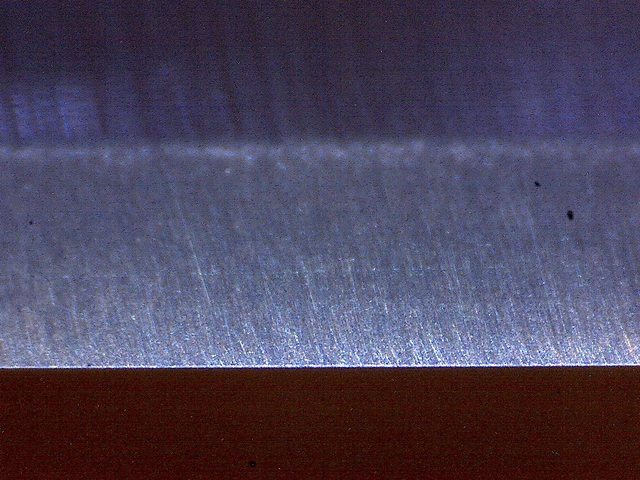
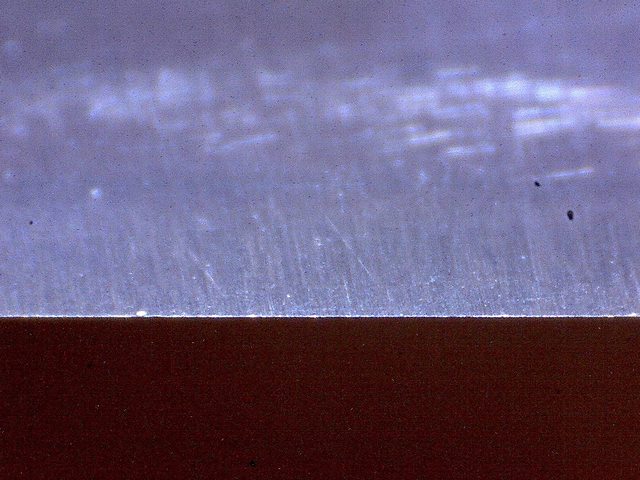
On the question of whether diamond plates produce qualitatively different results on something like carbon steel as opposed to high carbide volume, high hardness steels I offer the following microscope images (Note: each image shows approximately 2.2mm of edge length):

One of my knives sharpened on a DMT EF:
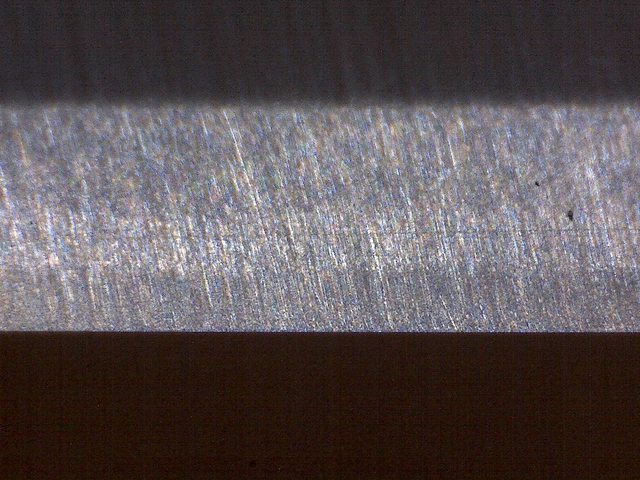


Another of my knives sharpened on a DMT EF:
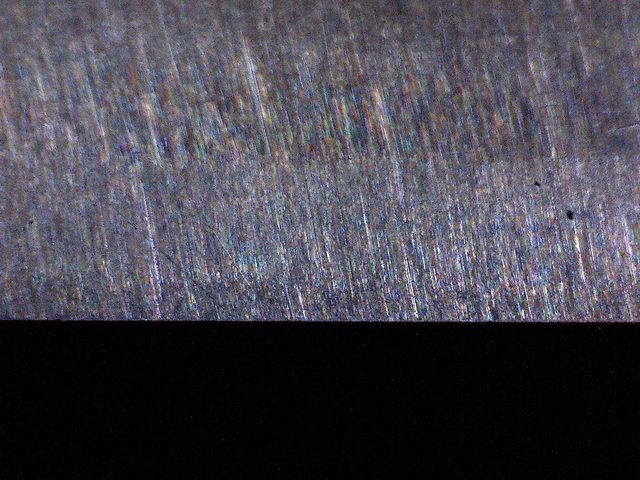


One of those is a carbon steel Mora that was reground to FFG, and the other is a Spyderco Mule Team in Maxamelt at ~68-71 HRC. To me both edges look the same under microscope examination and display identical push-cutting sharpness and slicing aggression when tested on newsprint and paper towel.
 
Last edited:
So what you are saying is the DMT are two aggressive for my ESEE 4 1080 CS ? I was getting ready to try and fix the edge on it . I have been using Arkansa stone and ended up with a convex edge .

The diamond plates will work and can make a very sharp edge but I feel I can get a better edge in much less time on my waterstones. If you like coarser edges I would also put the Norton India on the list of stones that are quick to cut steels like 1095.
 
FINALLY ! . . . I found it. My old post detailing one of my many experiences with DMT diamond plates. And a brand new diamond plate at that.

This thread was starting to sound like an advertisement for DMT.
I wanted to balance it out a little with some PAST responses not only from me but reply's to my problem.
So Here's The Thread and my post.

This about covers my whole point if you don't have the fortitude (or your evening free) to read my novella.

BEGIN QUOTE (that I wrote):
Today I planed to try sharpening it (S110V) with diamonds for the first time.
After a day or two of very light use at work, about similar to cutting a couple of ropes but I was cutting a couple of little pieces of cloth reinforced rubber and also very light use on hard rubber. The blade was not too sharp as tested on my finger nail.
I was determined to try diamonds and go toothy with those so I used the brand new 220 (DMT) mentioned above.

Used the marker as always. Put the stone in the holder / guide.
Not impressed no matter what I did :
light pressure
very light pressure
moving only one way on the plate . . . first only with / away form the edge . . . then only against the edge . . .
then free hand . . . one way then the other then circular feeling for the edge on the stone.

END QUOTE

The response I am speaking of is here.

Dmt's were pretty terrible in my experience,

well anyway . . . not all sweetness and light (and sharpness).
 
Last edited:
The diamond plates are a good bit worse when new IME. After they have worn in a bit, much better edges are produced. Still I mostly prefer waterstones as well. Especially in terms of feel and feedback when freehand sharpening - it's much easier to tell by feel where your bevel is in terms of being in flat contact with the hone with waterstones than with diamond plates - at least for me.
 
The diamond plates are a good bit worse when new IME. After they have worn in a bit, much better edges are produced. Still I mostly prefer waterstones as well. Especially in terms of feel and feedback when freehand sharpening - it's much easier to tell by feel where your bevel is in terms of being in flat contact with the hone with waterstones than with diamond plates - at least for me.

Ditto on the lack of nice feedback. I'd like to have the plated surface bonded to stabilized hardwood or something that will allow for some better tactile feedback.

As for the rest, I don't really find the diamonds any faster than my other stones until I get into high Vanadium steels. On lower end steels they not only aren't any faster, but it takes more QC to completely deburr in my experience compared to my waterstones or oil stones.

They really shine at the very high end, Jason's comment in another thread re the diamond grit waterstones - the 6k would be very nice to have (tho an 8k would be nicer), the 1k not so much.
 
I agree that the feedback is really poor on diamonds. Making angle control hit or miss when sharpening free hand. Taking back what I said earlier. It was my Lansky fine diamond that produced a nice finishing edge. My DMT medium was not that great. It has diamond clumps on its surface that snags on the blade edge when sharpening with scrubbing motion.
 
I agree that the feedback is really poor on diamonds. Making angle control hit or miss when sharpening free hand. Taking back what I said earlier. It was my Lansky fine diamond that produced a nice finishing edge. My DMT medium was not that great. It has diamond clumps on its surface that snags on the blade edge when sharpening with scrubbing motion.

Diamond hones are what I finally figured out feedback on; that taught me what to feel for in using other stones. They demand the lightest touch because they cut so much more aggressively (deeply) for the pressure used. So, if the right touch can be found for a diamond hone, it'll pay off in spades for everything else. It has for me, anyway.

I think, if one's sense of feedback has first been calibrated to stones that are more tolerant of heavier pressure, it's probably more difficult to dial that back for something demanding much lighter pressure, like diamonds. I fought diamond hones for years, because I could never make myself believe they'd actually work well with so much less pressure applied. I was always trying to use them with the same pressure I'd used on other stones (Arkansas & synthetic oilstones mainly), and I could never refine an edge well at all, used that way.

Feedback in general is hampered with guided systems, if mainly due to other sensory interference from the guide/clamp itself. I've hated the vibration generated just in the guide rods rubbing against the slots in my Lansky clamp (with accompanying, irritating squeaking noises), as well as the vibrations from DMT's Aligner guide rubbing against the tabletop (also usually squeaky), when using that system with a bench hone. For the sake of learning feedback, freehand is the better way to go, so the only friction being felt is between blade and hone.


David
 
Last edited:
Same for me: It is Dia-Sharps that taught me feedback, after 20 years of sharpening on stones...

For finer finishes I find the Dia-Sharp Extra-Fine is amazing, because it still cuts considerably even at this level of finesse, flattening slight rounding offs, or even facets, despite being at a late stage in the sharpening...

In fact I often go straight from worn Extra-Coarse to fresh Extra Fine, usually with quick and excellent results(!)...

You will have trouble on feedback if the Dia-Sharp hone is new: The feedback changes enormously when it is slightly worn: That might be what is throwing people off, because the angle feedback on diamond hones is much better once worn, and it is the Dia-Sharps that first taught me how to feel it...

The surface staying flat and true is the biggest difference. It makes everything so much more precise.

The only thing I have found still a bit hit and miss is the wire edge removal on Extra-Fine, as a fine clean stone can sometimes do it better, but the lack of precision of the stone surface means I often still use the Extra Fine Dia Sharp for that, although both can do it roughly the same.

Gaston
 
I concur with the last two posts, their is feedback with plates, you have to go light and be right on and I then think the feeling is akin to the phrase "music to my ears"...
My experience with plates really helped me with my shaptons. I use diamond plates for almost everything now except for my posh high carbon kitchen work knives and a few old high carbon camp and hunting knives.
So to answer the original query, I like edges done on DMT diamond stones...


Russ
 
I sharpen a lot with a DMT Blue 325. The DMT coarse just gives great , slightly toothy edges . Best stone I find on S30v , D2 and other HCV steels.
 
Oh there definitely is some feedback on the diamond plates, but nothing like on some of the better waterstones. They are much more gradual and communicative in terms of being almost there, right on or way off IMO. The diamond plates it seems you either get decent feel of when you're exactly right on but anything else gives pretty much nothing. This is especially prevalent in the finer diamond plates - my 8k for instance almost feels "locked in" when the bevel is of decent size and aligned perfectly with the hone. Otherwise it just skates, which I don't care for. A well worn Arkansas is very similar.

All the same, I use a lot of different stones all the time, just depends on what I feel like using.
 
Lots of good points - but I have to throw in a 'silly' question...

Some series (Diasharp) have a continuous grey surface, whereas others (like Diafold, Duosharp and Whetstone) have color dots.
Is there any difference in the result between those various DMT offerings?
 
Why the dots?
Contrary to popular opinion they are not dots but dimples, craters, veritable basins for temporary storage of swarf, or more importantly, stone slurry.

The only use I have for my extra, extra, coarse DMT is to flatten water stones on. For this it is perfect. No silly and fantastically over priced flattening plates with grooves and requiring loose disposable grit need ever apply.

Go here.
 
Last edited:
Lots of good points - but I have to throw in a 'silly' question...

Some series (Diasharp) have a continuous grey surface, whereas others (like Diafold, Duosharp and Whetstone) have color dots.
Is there any difference in the result between those various DMT offerings?

I found the ones with the dots to cut much more poorly than the Dia-Sharps. The dots simply reduce the efficiency and don't contribute anything positive from what I could see: The one advantage they have is that most of the base is in plastic instead of solid metal, so they are infinitely lighter, and can be put in the pouch of a knife without adding any significant weight: A great choice for quick field touch ups (much better than the useless brass rods ones imho)...

I found the dots also wear out faster because the exposed edges wear out first, and the dots creates hundreds of "edges" from which the diamond material wears away faster... Not only that, but the narrow spaces between the dots also get more intense friction, which also wears them away faster. To top it all, the amount of diamonds seems less dense than Dia-Sharps, or less well fixed... I still preferred my old stones to dotted diamond hones, unless the dotted hones were completely new (which didn't last very long)... Completely the reverse since I found Dia-Sharps... Except for sometimes breaking off the wire edge and maybe a very light finishing up, I almost never use any stones now... Although even the Dia-Sharps do lose efficiency and that cannot be brought back, unlike stones that have "depth" and can be brought back to "new": Dia-Sharps do need to be replaced more than stones (and are not cheap), but they still last quite some time. Dia-Sharps do lose quickly their initial extreme roughness, but I realized later that this early roughness was too much and not desirable, so they last longer than the initial large cutting loss appears to indicate...

Gaston
 
I started with DMT hones when I got my first D2 fixed blade as I heard how tough it is to keep sharp.

Since then I use them on everything. I know many have said they don't use it on carbon steels, but I find I can get just plain rediculous edges on 1095 with them. Though I do only use the extra fine on my 1095.

I have yet to have a bad experience, and everything I have touched is sharper than I had ever been able to get before. I have used them on 1095, 1055, Elmax, D2, 440c, 14c28n, 8cr13MoV, Aus-8, and my Opinel, Mora, and SAK's......

....and it takes just minutes. And a few swipes on the strop.
 
Lots of good points - but I have to throw in a 'silly' question...

Some series (Diasharp) have a continuous grey surface, whereas others (like Diafold, Duosharp and Whetstone) have color dots.
Is there any difference in the result between those various DMT offerings?

For the most part, I'd say there's really no significant difference in speed or finish left, if they're used as a diamond hone should be, with relatively light pressure. The points below might be where you'd otherwise notice some differences, or might just be worth some consideration, depending on your priorities:

  • If pressure is a bit too heavy on the interrupted surface hones (with the 'dots'), the finish left might be a little 'wavy' on your bevels; some have noted this in the past.

  • Some have also not liked the feel (feedback) of the dotted surface; the continuous surface Dia-Sharp hones can spoil one for that feedback.

  • The bench-sized interrupted surface hones (Duo-Sharp) are also spec'd and guaranteed to be within tight tolerance for flatness, which is more important for sharpening woodworking blades that demand dead-straight cutting edges and perfectly flat bevels and backs, like plane irons and chisels. For other simple cutlery, flatness to that tight a spec really doesn't matter as much.

  • The 'holes' (dots) on the interrupted surface hones are claimed to collect more swarf during heavy grinding, allegedly keeping it out of the way and minimizing clogging. But it's debatable whether that works as effectively as claimed when sharpening; it may be more beneficial if the hones are used for lapping other stones. But for normal sharpening chores, if one periodically wipes the hones every few minutes with a rag (a microfiber towel works real well), or if one uses some sort of lubrication on the hone (water, water + dish soap, or mineral oil), the hones won't be as prone to clogging anyway. In fact, I've never had any such issues on these, with a little wiping down or wetting of the hones periodically during sharpening.

  • And as previously mentioned, the interrupted surface hones are much lighter for their relative size, therefore more attractive where portability is desired.


David
 
Last edited:
When deburring with edge leading technique, there's risk of the tip caught in the dots, ruining the apex of the edge that hits the plate. So care must be taken to ensure when lifting the handle to follow belly, when reaching the tip, it's on flat area.
If only EEF is available in continuous credit card size :(
 
Use EE as a file to avoid holes. Also easier to hear & feel when edge is clean (enough ;)).
Chris "Anagarika";16694018 said:
When deburring with edge leading technique, there's risk of the tip caught in the dots, ruining the apex of the edge that hits the plate. So care must be taken to ensure when lifting the handle to follow belly, when reaching the tip, it's on flat area.
If only EEF is available in continuous credit card size :(
 
Back
Top