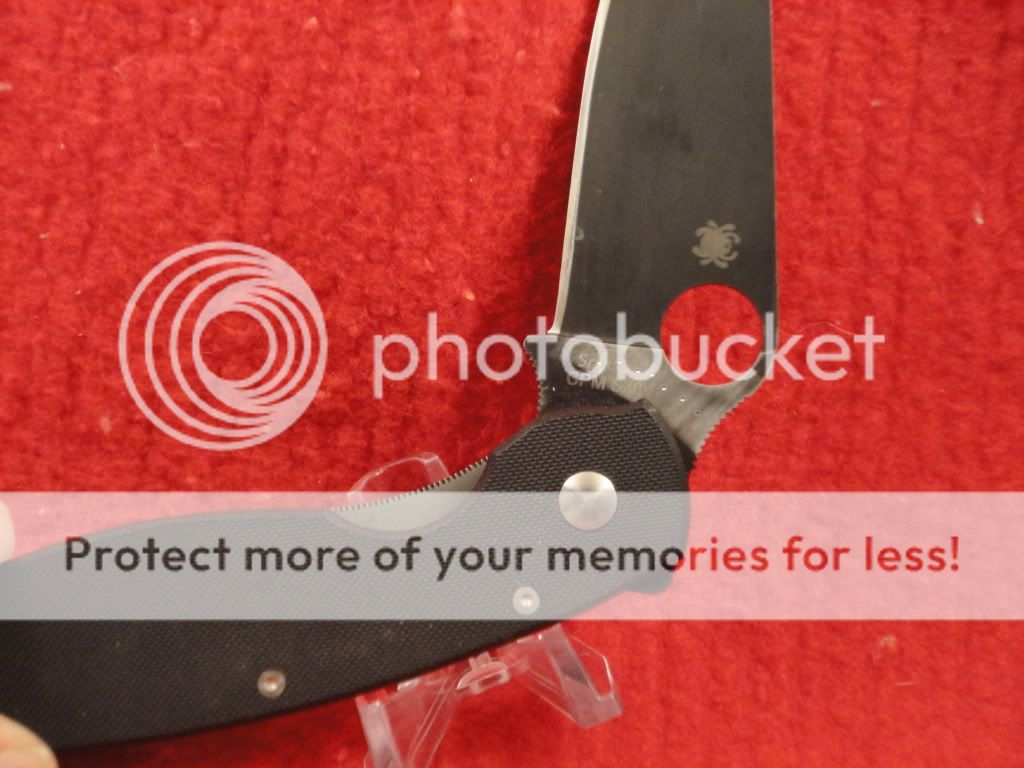
Why did my vantage pro get so much sharper than my military?

I think it will take more time with the Military becuase it's flat ground compared to the Hollow grind of the Buck. Less steel to move on the Buck.

I have both and the S30V Mili takes more passes especially if dull to get back to hair popping sharp. Just the difference in the steels and I also believe the grind thickness on my buck was a bit narrower to start with so less steel needs to be removed. If sharpening angles on both are equal you simply need to work the spydie a bit longer. I enjoy the buck vantage, but through my own sharpening I think its a bit softer than the military. As mentioned before the RC's are approx and you could have one run a bit harder. I dont think its anything to worry about though.
 
Last edited:
the millie rockwell that effer refers to was my knife. the tests were done by knarfeng [frank] a working engineer. my same millie was tested by phil wilson & he got the same hardness. the 2 millies used by ankerson were both 60 rockwell. my millie cut less than bucks vantage pro since it had a lower rockwell. mine was a black coated blade & phil,ankerson & myself attributed it to heat used in the coating process. this factor at present is conjecture but maybe another member will loan a black millie to ankerson & we can see if it runs closer to 58 than 60 [uncoated blade].
dennis
 
the millie rockwell that effer refers to was my knife. the tests were done by knarfeng [frank] a working engineer. my same millie was tested by phil wilson & he got the same hardness. the 2 millies used by ankerson were both 60 rockwell. my millie cut less than bucks vantage pro since it had a lower rockwell. mine was a black coated blade & phil,ankerson & myself attributed it to heat used in the coating process. this factor at present is conjecture but maybe another member will loan a black millie to ankerson & we can see if it runs closer to 58 than 60 [uncoated blade].
dennis

Yeah 2 points in Hardness is a huge difference for S30V when it comes to performance. It's like using 2 completely different steels.

That Para 2 in S30V showed the same pattern in cutting as the Satin Militaries at 60 RC.

I tested 3 Satin Militaries in S30V and all 3 were the same.
 
Dennis, thanks for insight. Very interesting suggestion about coating. Yet another reason for me to stay away from them :).

I have no problems accepting that Spyderco aims for 60Rc and gets there most of the time. I like my S30V from Spyderco. I would say the same about Buck. Their HT (I guess thanks to Paul Boss) is excellent. From data I found online Buck also goes for around 60 and usually gets there. Most testers agree that Buck's S30V is a great performer.
I just disagree with blanket statement that Buck is softer than Spyderco.

All that and +/- 1 Rc sure has nothing to do with blade getting significantly sharper than another.
 
Dennis, thanks for insight. Very interesting suggestion about coating. Yet another reason for me to stay away from them :).

I have no problems accepting that Spyderco aims for 60Rc and gets there most of the time. I like my S30V from Spyderco. I would say the same about Buck. Their HT (I guess thanks to Paul Boss) is excellent. From data I found online Buck also goes for around 60 and usually gets there. Most testers agree that Buck's S30V is a great performer.
I just disagree with blanket statement that Buck is softer than Spyderco.

All that and +/- 1 Rc sure has nothing to do with blade getting significantly sharper than another.

Paul Boss is retired. ;)

But Buck is Conservative in their HT as was Paul Boss, Bucks will usually run around 59 to 59.5.
 
DSC00927.jpg

this is the millie s30 used by knarfeng in the tests quoted by effer. the rockwell was confirmed on 2 different hardness testing machines. notice the multiple dimples on the tang, the coating was removed to get correct readings. maybe the mirror bevel by ankerson is slightly seeable.
dennis
 
DSC00927.jpg

this is the millie s30 used by knarfeng in the tests quoted by effer. the rockwell was confirmed on 2 different hardness testing machines. notice the multiple dimples on the tang, the coating was removed to get correct readings. maybe the mirror bevel by ankerson is slightly seeable.
dennis

I remember that knife. :D

A knife well traveled. :)
 
Interesting comparisonl Now I understand why my sanrenmu has different sharpness.

I have 710, 763 and 723. Only 710 is coated. Only 710 whengets thinned out doesn't hold up well. The edge keeps rolling. I guess it's softer.
Another 723 was also with black coated blade, same issue. Gave it away sometime back.
 
Between the Millie and the Vantage Pro, the edge geometry alone could explain the difference in perceived sharpness when cutting TP. My Vantage Pro has a significantly thinner edge than my Millie, and the thinner edge makes big difference in perceived sharpness. The actual edge sharpness could be the same, but the Millie will have more resistance when cutting. I have observed this a lot when cutting cardboard.

It seems to me that I remember Sal saying that Spyderco targets 58-59 for their S30V, so if some are testing at 60 they may have changed that.

Paul Bos told me that he targets 59.5-60 for S30V. In my personal edge testing comparisons in cardboard and sisal, I have found the Buck S30V blade that I tested to be virtually identical to the Spyderco S30V blade that I tested side by side. If anything, the Buck performed slightly better.
 
Both were done at the same angle on the edge pro, and both were taken from 220 all the way to 3000 grit. The vantage pro is WAY sharper than the military.

So what caused that? Shouldn't they be pretty much the same? Or does the difference in heat treat make that big of a difference?

Howdy,

I may have missed it, but, how were you determining the sharpness?

There could be several explanations for the perceived difference. For all it's apparent simplicity, cutting is actually a complex action and a number of factors enter into the process. Which factors you could be perceiving would depend on how you were measuring the sharpness.

(Note: It is unclear to me if the hardness of the black Spyderco Military that I measured should be taken as representative of all Spyderco S30V blades. While I have never seen a Spyderco S30V hardness spec, several fellas that I trust have reported that they measured other Spyderco S30V blades at about 60HRC. Measurements on a sample size of one can only be used to compare that individual. They cannot be used to define the entire population.)
 
I was slicing TP. The vantage pro just kind of went through it with little or no resistance, while the military had to be forced through it.


Howdy,

I may have missed it, but, how were you determining the sharpness?

There could be several explanations for the perceived difference. For all it's apparent simplicity, cutting is actually a complex action and a number of factors enter into the process. Which factors you could be perceiving would depend on how you were measuring the sharpness.

(Note: It is unclear to me if the hardness of the black Spyderco Military that I measured should be taken as representative of all Spyderco S30V blades. While I have never seen a Spyderco S30V hardness spec, several fellas that I trust have reported that they measured other Spyderco S30V blades at about 60HRC. Measurements on a sample size of one can only be used to compare that individual. They cannot be used to define the entire population.)
 
I was slicing TP. The vantage pro just kind of went through it with little or no resistance, while the military had to be forced through it.

IIRC, the Military is thicker at the top of the bevel than is the Vantage Pro. That can make a difference in the force required to cut. A thicker blade is harder to get through a thin material like toilet paper.

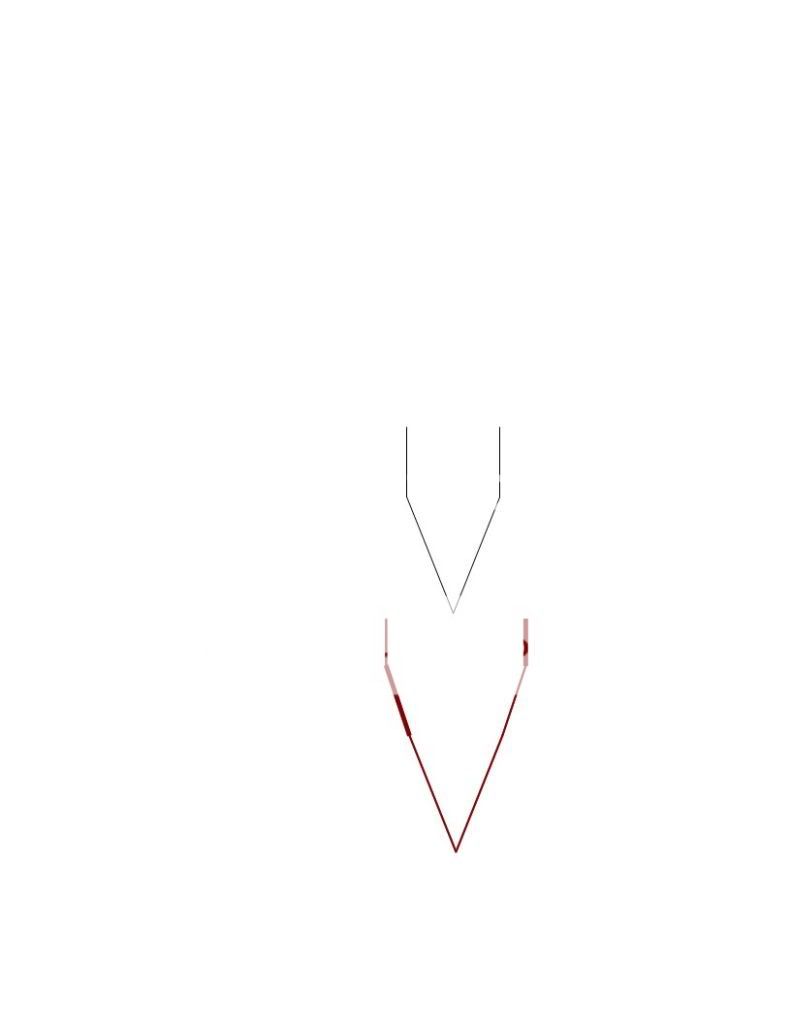
Here is a rough sketch of two blade outlines. Both have the same primary bevel angle. But the bottom one is thicker at the top of the bevel. Is there any doubt in your mind that you would have to exert more force to get that wider wedge through than it would take for the thinner one above? (This is a rough sketch, but the angles are actually exactly the same.)

When it comes to cutting effectiveness, geometry is more important than blade alloy. The Military meant for more robust service, so it has a thicker blade right above the edge. The Buck Vantage Pro is a slicer, so it is thinner at the edge.


sameangle-differentthickness.jpg
 
That makes a lot of sense. Thank you for making that sketch. It put things into perspective.

IIRC, the Military is thicker at the top of the bevel than is the Vantage Pro. That can make a difference in the force required to cut. A thicker blade is harder to get through a thin material like toilet paper.

Here is a rough sketch of two blade outlines. Both have the same primary bevel angle. But the bottom one is thicker at the top of the bevel. Is there any doubt in your mind that you would have to exert more force to get that wider wedge through than it would take for the thinner one above? (This is a rough sketch, but the angles are actually exactly the same.)

When it comes to cutting effectiveness, geometry is more important than blade alloy. The Military meant for more robust service, so it has a thicker blade right above the edge. The Buck Vantage Pro is a slicer, so it is thinner at the edge.


sameangle-differentthickness.jpg
 
Back
Top