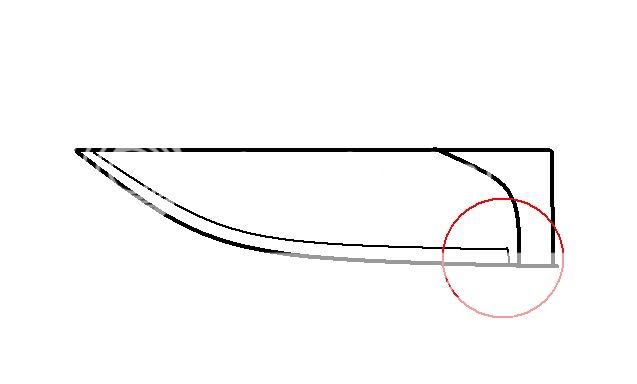
Why do some makers not sharpen the entire blade?

Joined
Dec 13, 2010
Messages
141
Why do some makers not sharpen the entire blade?


I'm not talking about an extra long ricasso like you see on Dozier knives.(although I don't get that either..it's a safety measure)

I mean why is the cutting edge, nearest the ricasso, not sharpened?

I have the handle to keep me safe....I don't need a "safety" on the blade :rolleyes:


I see this quite often on custom knives...most collectors who have reached the point where they are buying custom knives....have been handling knives for years.

Could someone provide some insight?
 
i have purchase quite afew custom knives with a not to sharp edge on them , i don't get it either.
 
I hear ya! My other pet peeve is where the edge is separated from the ricasso by what looks to be a drill-bit sized, round ground half moon hole. IMO gives a cheap look to the knife and might be disasterous if the back edge of it chipped off a bit ...
 
All conditions mentioned above are annoying for sure.

I've never purchased a custom knife where the entire blade wasn't as sharp as a razor.
It's may be more an issue of which custom knife maker is providing the knives rather than a general custom knife issue.

When I inspect a knife (especially at a show) the first thing I do is the "fingernail drag test" along the entire cutting edge. I fine it to be the best "quick" method for testing sharpness without having props in your possession.
 
What I hate more is seeing something like this on a custom knife of any type. I've seen this on some super nice knives too.

There's a nice mirror polished hollow ground blade with a neat sculpted plunge line....that is interrupted horribly by an incomplete, ugly, fat edge bevel.

xxterriblegrind.jpg
 
if the plunge line is radiussed (in the axis we can't see from the illustration), and the bevels are constant (not twisted) then this will always be a problem. We can eliminate it by varying the geometry of both bevels, reduce the problem by having a very thin edge, or just not radius the plunge (squared edge termination when looking at the blade edge on).

I'm glad other people notice this; it bugs me too and I am certainly guilty of putting knives on the table with this problem.
 
well the problem is in the plug line .if you don't put a relief in this area like a half moon or some thing .when sharping on a belt you will remove more of the blade then at the plug line area and then you will end up with a dip in the blades edge and that looks very bad. so thy blend in this area to keep the over all profile right. so to fix this you need to grind this area very thin and it will be easier to sharpen. or make the knife where the blade drops below the choil/ricasso area so the cut area is easy to sharpen. tommy
 
I hear ya! My other pet peeve is where the edge is separated from the ricasso by what looks to be a drill-bit sized, round ground half moon hole. IMO gives a cheap look to the knife and might be disasterous if the back edge of it chipped off a bit ...


I'd be willing to bet that more folks actually LIKE that half round choil area filed in, than otherwise. ;)
 
To be brutally honest, I think it's because many guys get more and more nervous the thinner their grind gets... add onto that, they worry about matching their plunges... and they end up leaving the area near the plunge too thick. This is pretty common actually. I know I used to do it when I wasn't very confident with my grinding! :o

It's "easier" to avoid if you're working with a dropped edge or a choil cut-out... but even with no dropped edge, and no choil notch, a good grind will be uniform top to bottom.

This is also why I feel it's impressive when you see a maker has perfectly matched plunges as well as a uniform and THIN edge.

Even though perfect plunges are the mark of a good maker.... if the edge is thick and not uniform... it will not be good at.... wait.... what is it again???? Oh yea!!! CUTTING stuff. ;) :)
 
I agree with what's been said here. A lot of makers leave the edge too thick at the plunge and many are too thick all along the edge. This makes it very hard to sharpen and looks like hell... First thing I notice on a quality knife, is a super thin and even edge.
 
I agree with what's been said here. A lot of makers leave the edge too thick at the plunge and many are too thick all along the edge. This makes it very hard to sharpen and looks like hell... First thing I notice on a quality knife, is a super thin and even edge.

Wisdom from Don Hanson.

Roger
 
All conditions mentioned above are annoying for sure.

I've never purchased a custom knife where the entire blade wasn't as sharp as a razor.
It's may be more an issue of which custom knife maker is providing the knives rather than a general custom knife issue.

When I inspect a knife (especially at a show) the first thing I do is the "fingernail drag test" along the entire cutting edge. I fine it to be the best "quick" method for testing sharpness without having props in your possession.


It's not one maker....it's makers.

I've seen this problem with knives in excess of 500.00

If the blade is 4" long.. I don't want a 3 1/2" cutting edge because the maker isn't skilled enough to finish the cutting edge.
 
Quote:
Originally Posted by BowieBooster
I hear ya! My other pet peeve is where the edge is separated from the ricasso by what looks to be a drill-bit sized, round ground half moon hole. IMO gives a cheap look to the knife and might be disasterous if the back edge of it chipped off a bit ...

Quote
Originally posted by Danbo
I'd be willing to bet that more folks actually LIKE that half round choil area filed in, than otherwise.


I agree Danbo, I much prefer the tiny choil.
 
I thought I was alone here. I agree with Willie and psycho, that kinda half assed taper from the ricasso to real cutting edge chaps me too. I like to sharpen on a stone and that curved start of a blade just irks me.
I don't mind a choil and think it looks good on some knives.
I've not gotten many dull customs, but I've had some that have not had much attention to the final sharpening, and the sharpening bevels on each side weren't even, but that is just "hand made" and the level of knife I'm buying probably. Dozier (not bob)
 
A radius in the plunge must be accepted in some circles because there are some pretty well established makers using it. If the radius in the plunge is large it is not possible to grind the terminal edge all the way to the ricasso, it makes the grind line at the ricasso sweep up toward the spine of the knife. I personally try to keep that radius very small and grind the edge all the way to the ricasso.

Don, how thick would you say the edge should be? I have been using a 24 inch hollow grind because I like the effect but with a shallow hollow grind it is easy to make the edge too thin.
 
It's not one maker....it's makers.

I've seen this problem with knives in excess of 500.00

If the blade is 4" long.. I don't want a 3 1/2" cutting edge because the maker isn't skilled enough to finish the cutting edge.

I agree on all three of your points.
My point is that we don't have to accept it, as there's so many makers (in all price ranges) who are providing a proper full finished edge.
 
Last edited:
Back
Top