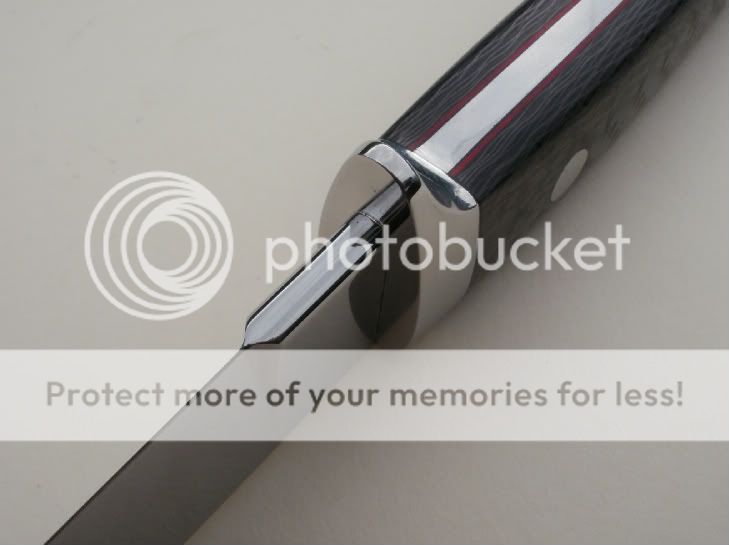
Why do some makers not sharpen the entire blade?

I sometimes build a knife and am pretty sure it will go on display and not get used. Sometimes I do not put the final razor edge on, either I’m caress, or saving time and money to sell a finished product for less if it is an under $350 final product. I also sometimes find customers who want to put their own final edge on to suit their use of the knife, or suit how they put blade on the stone or strop. I also feel on edge (pardon the pun) at art shows (maybe not a knife show) where the general public is picking up my product- children, the unsuspecting- who have never held a good knife and do not expect a razor edge and so cut themselves. It does not matter whose fault, I loose a sale and have a disruption and may get asked not to carry knives at the show anymore. There is the knowledge the knife will get dull at some point, and the owner will have to put an edge on it. There is an assumption good steel is used and a good design and not to worry, this blade will take a razor edge and I do not need to prove it. I realize the original subject is not ‘dull’ but a creation ‘flaw’ perhaps of flat out missing a spot and I agree on that part – keep the edge right on through the length of the blade.
 
Quote:
Originally Posted by BowieBooster
I hear ya! My other pet peeve is where the edge is separated from the ricasso by what looks to be a drill-bit sized, round ground half moon hole. IMO gives a cheap look to the knife and might be disasterous if the back edge of it chipped off a bit ...

Quote
Originally posted by Danbo
I'd be willing to bet that more folks actually LIKE that half round choil area filed in, than otherwise.


I agree Danbo, I much prefer the tiny choil.

Differernt strokes, I s'pose. Just seems to me to be either a shortcut or lack of skill, depending on the maker and/or situation. I do agree that they're likely easier to sharpen, but I don't use my customs (although I do prefer them razor sharp, as they are nonetheless cutting tools and should function as such, IMO).

Aside from ease of sharpening on a using knife, I'd be interested in knowing why one would prefer this on non-user custom.
 
the problem with the soft arching plunge is that by the nature of the grind you can not thin the edge withought making it look funny (be it with the grind or with the sharpening )
yes you can make a rounded top plunge that is cut sharply and thus be sharpened the whole way to the drop in of the plunge but you loose lots of the smoothness in transition

i marked in green where the plunge started to be feathered into the blade for the nice arch top (tho the hole hides the top of it ) this blade was ground on a 10 inch wheel
dsc03088sm.jpg

dsc03087sm.jpg
 
I'm assuming you mean long sweeping transitions from stock thickness to cutting edge?

To me these are very annoying and hard for people to sharpen correctly. They're ok if the edge is dropped so the edge starts off thin, but otherwise they just seem pointless to me.

Same goes for 'sharpening choils', they look ugly to my eye, and add nothing to a knife except something to get snagged up whilst cutting.

Any grind will have a small taper where the bevels are ground, but getting it fairly small isn't too difficult, hell, even I can do it....:eek::D

P4040096.jpg


Ian
 
A radius in the plunge must be accepted in some circles because there are some pretty well established makers using it. If the radius in the plunge is large it is not possible to grind the terminal edge all the way to the ricasso, it makes the grind line at the ricasso sweep up toward the spine of the knife. I personally try to keep that radius very small and grind the edge all the way to the ricasso.

Don, how thick would you say the edge should be? I have been using a 24 inch hollow grind because I like the effect but with a shallow hollow grind it is easy to make the edge too thin.
Mark, when I come off the grinder, before hand sanding, my edge is usually between .005-.010" thick. After hand sanding it is almost sharp. When I'm finished, I can sharpen the edge with a very minimal secondary bevel.

I also sharpen all of the edge. ;):cool:
 
Mark, when I come off the grinder, before hand sanding, my edge is usually between .005-.010" thick. After hand sanding it is almost sharp. When I'm finished, I can sharpen the edge with a very minimal secondary bevel.

I also sharpen all of the edge. ;):cool:

Thanks Don, Good info
 
the entire edge should be sharp, dont understand why it wouldnt.

On edge thickness, you should also consider the size of the blade and its intended use. If you are talking about a 10+ inch, 2+ inch wide chopping blade with alot of "mass" .005-.010 is on the thin side to hold up under hard chopping. If on a smaller knife, light fighter etc. it would be fine.

Not disagreeing with Don at all, just want to point out that for different applications different edge thickness and geometry should be considered.
 
yep edge to the use of the blade
thats why i have razors that are ground to sharo then honed and choppers that are much thicker

i jsut wanted to show how the grind style can make the honing of the blade to the max of the plunge hard to do
 
I sometimes build a knife and am pretty sure it will go on display and not get used. Sometimes I do not put the final razor edge on, either I’m caress, or saving time and money to sell a finished product for less if it is an under $350 final product. I also sometimes find customers who want to put their own final edge on to suit their use of the knife, or suit how they put blade on the stone or strop.

There is the knowledge the knife will get dull at some point, and the owner will have to put an edge on it. There is an assumption good steel is used and a good design and not to worry, this blade will take a razor edge and I do not need to prove it.

Ummm... what??? I think you should read your post again my friend. None of that reads well to my way of thinking. I don't intend to pick on you, but what you wrote sounds like a total cop out.

A custom knife had better come with a SCREAMING sharp edge, unless it is designed to NOT have a sharp edge, ie; Virgil Englund etc. I don't care particularly if the portion where the plunge radius meets the bevel isn't sharp right off the kick, (I like Ian's photo, that's the way it should be done) but a custom knife without the sharpest edge that can be had, given the geometry of the bevels, directly from the maker is not a knife that would capture my interest. Unfortunately it is impossible to convey sharpness through photos and lots of buyers who count on the maker to know how to put a proper edge on a knife who don't know how to do it themselves is a potential lost customer once they receive that imperfect knife.
 
Mr. Hanson is right. Even on a dropped choil knife, the edge up neqr the ricasso tend to start off a bit thicker at first. In my case, that is probably because I am being overly careful when I run up to the plunge cuts on the belt grinder. I spend what could almost be described as Nick Wheeleresque amounts of time making sure that the edge is all nice and even during he hand sanding process before I sharpen it up on the grinder and strop it.:D
Bailey Bradshaw showed me a little trick to test how fine your grain structure is, so I take it down pretty thin during hand sanding thin. He told me that when you sharpen a carbon steel blade, if you can get a fairly long wire and it flexes very easily, like cloth or paper, then you have done the grain refinement part well. Early on, I used to leave my edges too thick, which is NOT necessary with the steels that I am using.
 
Unfortunately it is impossible to convey sharpness through photos and lots of buyers who count on the maker to know how to put a proper edge on a knife who don't know how to do it themselves is a potential lost customer once they receive that imperfect knife.

Agreed. I still have in my possession a Scottish dirk I commissioned in 1994. The maker (whom I shall not name) made a beautiful walnut handle and an incredible wooden sheath, and actually didn't do "too" bad a job on the basic blade grind and jimping. However, it is obvious the man had no clue how to put an edge on a knife, as he ground it so thin and so deep to get it razor sharp that I think the edge would irreparably break if I tried on chop into a block of hardwood. You can just look at it from a foot or two away and immediately tell that it is a fragile edge. It almost looks like a first-timer trying to put an edge onto a leaf spring with a course grinding wheel, without the slightest clue as to what angle to approach from or how much material to remove.

Indeed, I never bought another from him (good thing, I guess, as I moved on to JR Cook & Jerry Fisk shortly thereafter). The only reason I still have it is that I won't pawn a knife with a screwed up edge like that onto someone else.
 
the entire edge should be sharp, dont understand why it wouldnt.

On edge thickness, you should also consider the size of the blade and its intended use. If you are talking about a 10+ inch, 2+ inch wide chopping blade with alot of "mass" .005-.010 is on the thin side to hold up under hard chopping. If on a smaller knife, light fighter etc. it would be fine.

Not disagreeing with Don at all, just want to point out that for different applications different edge thickness and geometry should be considered.
Matt, 2"+ wide and taken to a near 0 edge might be a bit thin on a big chopper... I do leave the edge a bit thicker on larger knives, but not much thicker. Do up a test blade with some of that W2, normalize real good for fine grain and take the edge down very thin after heat treating. Give it a good workout and let me know how it does.:cool:
 
I happened to be handling one of Mark Knapp's knives today, and I looked REALLY close. You could shave at 1/8" off the ricasso, and it's thin. He speaks the truth.

That, and the damn thing bit me and drew blood without me knowing. The sharpest knives do that.

Coop
 
Back
Top