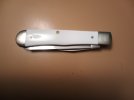
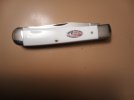
Why Does This Residue Form On My Nickel Silver While Knife Is On Storage Tray ?

Joined
Sep 20, 2015
Messages
8,219
These are Traditional Knives so I understand if you must move the thread
but
my question isn't so much about the knives but about a "chemical reaction" .

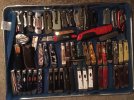
So as you can see my favorite user is the Trapper . Mostly Case but there are some Bokers in there (love the etched blades on those) . . . and a few shall we say . . . budget Trappers just to take a look at them . There are a few more in other places around the house ; there are roughly forty or so . I love 'em !

Anyway the tray is a brand new aluminum baking sheet that has ONLY been used for this purpose (I buy them in quantity and store most all my knives this way ) . . . brand new hand towel below the knives , brand new hand towel above to cover them . . . then another tray of a different brand of knife stored on top . All the towels have been washed in our home washer with very basic Arm and Hammer unscented detergent . If anything I tend to under do it with the quantity of detergent and mostly always run my loads on extra rinse.
so
invariably the nickel silver bolsters that are facing down , on each knife , develops a kind of waxy haze . . . boardering on gummy . The bolsters that are up just look normal and feel normal . I never polish or wax them . I just kind of wipe it off on my pants leg to get the haze off . They are all users and I'm not fussy about them .

It is just odd that they get this "coating" when they sit on the tray for months or more .
But just on the side that is down .

The one I carried today is the Green heavily textured Boker that is sitting on top of and perpendicular to the others . It had the coating . I know for a fact I carried it less than a year ago but it has been many months .

The climate here is pretty dry , high plains dessert of Colorado . We don't use a humidifier or anything of the sort . Keep the house pretty cool in winter.

So why does this happen and on only one side ? It's kind of grose .
I may experiment with putting down a square of green felt to see if it still happens to the knives that are on the felt .

Any thoughts ?
1776654736019.jpeg
 
Last edited:
nickel silver is a lot like brass in how it patinas/stains etc...I call it white brass cause it basically is that. I can polish nickel silver and get it shiny and let it sit on a plastic stand no fingerprints or anything to create any stain or patina and it will lose its shininess and start to change color and patina over time just from sitting in 45 to 50%rh 75 - 78f conditioned air. not as fast as yellow brass but it does.

I cant tell from the pic what youre seeing....they seem pretty shiny.....

can ya take a pic of the gummy residue side your seeing up close for us? thanks
 
Last edited:
Even if the towel is clean and dry, it can still draw and hold moisture from the air. Sitting in an enclosed space allows moisture to be retained longer. I'd bet its just the nickel silver being in contact with the towel causing an oxide layer to form. The wet/gummy feel is just from whatever moisture has accumulated under the knife. Could also be residue from the detergent too.
 
nickel silver is a lot like brass in how it patinas/stains etc...I call it white brass cause it basically is that. I can polish nickel silver and get it shiny and let it sit on a plastic stand no fingerprints or anything to create any stain or patina and it will lose its shininess and start to change color and patina over time just from sitting in 45 to 50%rh 75 - 78f conditioned air. not as fast as yellow brass but it does.

I cant tell from the pic what youre seeing....they seem pretty shiny.....

can ya take a pic of the gummy residue side your seeing up close for us? thanks
Thank You !
Sorry , I am operating with a very basic camera in my Kindle . I've sworn off high dollar iPhones etc and phone service I don't use it enough to warrant the cost. Just a land line .

This is the gummy side . . . no tarnish / darkening just a translucent coating.
1776662587552.jpeg

Here is the top side ; just looks normal like out of the box .
1776662661096.jpeg
 
Could also be residue from the detergent too.
That's what I am thinking but , I have a towel on top and a towel on bottom of EVERY tray . A fair amount of weight on both sides because the trays are stacked four or five deep .
maybe it's just "magic" . I like science better though; has been bugging me for years . 🥴😣🤔
PS: not in a closed cabinet ; just out on a shelf .
 
That's what I am thinking but , I have a towel on top and a towel on bottom of EVERY tray . A fair amount of weight on both sides because the trays are stacked four or five deep .
maybe it's just "magic" . I like science better though; has been bugging me for years . 🥴😣🤔
PS: not in a closed cabinet ; just out on a shelf .
quadruple 0 steel wool shines nickle silver very well! (OOOO steel wool). I use them for nickel silver guitar frets and that kinda dead gray patina that forms gets buffed off to a mirror shine again.
 
I'm also inclined to believe it's got something to do with the towel. Maybe also the weight of the knives pressing into the fabric is influencing the more obvious reaction on the underside, maybe trapping something reactive against the metal.

And with any brand-new fabrics, I'm also inclined to believe they'll hold excess dyes until they've been laundered a few times. That might be what's reacting with the nickel silver. I also notice that fabrics retain some of the laundry detergent as well, after laundering. I keep reducing the amount of detergent I use in each laundry load so that I don't feel it or smell it or see residual suds coming out when I use items like wash cloths with water after laundering. I've had issues with contact dermatitis on my skin in the past, from laundry detergents or fabric softeners I've used for my clothes.

An afterthought... If you use dryer sheets for minimizing static cling or fabric softening, they'll leave some residue on fabrics. They also feel kind of waxy when I've handled them. Maybe that's playing into it as well.
 
Last edited:
Out of curiosity, I queried Google for "Will residue from laundry detergent react with copper?", being that nickel silver is a copper alloy.

The AI Overview replied with the text quoted below:

"Yes, residue from laundry detergent can react with copper, potentially causing tarnishing, discoloration, or corrosion over time. While mild soap is fine, detergent residues—especially those containing bleach, ammonia, or high alkaline levels—can degrade the metal surface.
www.worldcoppersmith.com +4
Key Considerations for Copper and Detergents:
  • Reaction Mechanism: Laundry detergents are often alkaline, which can react with copper. Ingredients like chlorides, sulfates, and ammonia compounds are particularly aggressive towards copper.
  • Corrosion Risks: Residues from bleach (often found in laundry products) are highly corrosive to copper, causing tarnishing and green patina.
  • Cleaning Precautions: When cleaning copper items (like mugs or pots), it is recommended to use gentle, mild soap, or specialized cleaners. Avoid strong detergent residue, as it can cause long-term damage.
  • Hard Water Interactions: Laundry detergent often includes chelators to manage metal ions, but if copper piping is involved, the interaction between detergent and copper in water can lead to increased metal degradation.
    Reddit +7
For optimal care of copper items, rinse thoroughly to remove all soap residue, as leaving detergent on the surface can cause it to react with the metal, particularly in warm or humid conditions.
www.worldcoppersmith.com"


*** Edited to add: I'm aware that corrosion apparently isn't an issue here. But I did wonder if there was some sort of chemical reaction or attraction, between laundry detergents and copper alloys.
 
Last edited:
Another AI Overview quoted below from Google, when queried with "will residue from dryer sheets react with copper?"

"
Yes, the residue from dryer sheets can interact with copper components in a dryer, primarily by creating a waxy buildup that can affect performance rather than causing a direct, corrosive chemical reaction with the metal itself.
Key Findings:
  • Waxy Buildup: Dryer sheets contain stearic acid and other softening agents that melt, leaving a waxy,, sticky film on clothes and dryer parts.
  • Moisture Sensors: This residue frequently coats the metal moisture sensors (often made of copper or stainless steel) located in the dryer drum. This coating acts as an insulator, preventing the sensors from accurately detecting moisture, which causes the dryer to under-dry or run excessively long.
  • Lint Filter Blockage: The residue builds up on the mesh screen, restricting airflow, which can make the dryer run hotter and put stress on internal components.
  • Effect on Copper: While the film is not technically highly corrosive, the waxy barrier acts as an obstruction to the copper sensor's function rather than immediately dissolving it.
    YouTube +3
Maintenance:
  • It is recommended to clean your dryer's lint trap and moisture sensors with hot, soapy water and a soft brush or rubbing alcohol to remove this buildup.
"
 
hes saying no tarnish or discoloring but rather a gummy coating developing on the towel down side.....so its less about corrosion and patina and staining and more about some sort of gummy clear residue.....least thats how im reading it......
 
hes saying no tarnish or discoloring but rather a gummy coating developing on the towel down side.....so its less about corrosion and patina and staining and more about some sort of gummy clear residue.....least thats how im reading it......
Yeah, I noted that. No corrosion, but oddly something apparently attracting the residue to the nickel silver.
 
Yeah, I noted that. No corrosion, but oddly something apparently triggering or attracting the residue to the nickel silver.
I thought it was tarnish or something early on. but once I figured out what's hes saying....I got no idear whats causing that. maybe something organic like fungal or....? who knows......
 
hes saying no tarnish or discoloring but rather a gummy coating developing on the towel down side.....so its less about corrosion and patina and staining and more about some sort of gummy clear residue.....least thats how im reading it......
That sounds like dryer sheet residue, to me. I still recommend the anti-corrosion drawer liners instead of towels.
 
I thought it was tarnish or something early on. but once I figured out what's hes saying....I got no idear whats causing that. maybe something organic like fungal or....? who knows......
Yes, he initially asked if there was some sort of chemical reaction going on, which is what spurred my queries on Google about detergents and/or dryer sheet residue being attracted to, or reacting in some way, to copper or copper alloys.

I am inclined to think that trying something other than those particular towels would likely make a difference.
 
Yes, he initially asked if there was some sort of chemical reaction going on, which is what spurred my queries on Google about detergents and/or dryer sheet residue being attracted to, or reacting in some way, to copper or copper alloys.

I am inclined to think that trying something other than those particular towels would likely make a difference.
couldnt hurt. probably best place to start and see what happens.....
 
Back
Top