Why get a flipper?

I don't think they offer any particular advantage in terms of speed, ease of use, keeping finger safe beyond what many non-flippers do, but a good flipper is tons of fun which, in a hobby like this, can be really important to a lot of people.

That about sums it up for me.
 
I used to hate flippers.
Then I got some nice knives with them.
Now I just see it as another way to open a knife, and if the knife I want has one, that's okay.

If the knife I want doesn't have a flipper, that's okay too. :)
This. +1
 
Picture cutting an apple with a 3-3.5" blade (legal length in many areas and what I consider perfect EDC length) using a classic four-slice technique. A lot of times, if you got a good size apple you end up wanting to use the whole blade. If you have a thumb stud you either lose some blade length or have to push the stud all the way through the apple. Strider/Hinderer style studs that tuck up near the handle are decent at avoiding this. A spydie hole let you use the whole blade but you end up getting apple guck in the whole that you have to clean out. With a flipper you get a clean blade of which you can use 100%. Also a good flipper can be easier to use in your non-dominant hand if the need arises, such as if you happen to be holding a line in your dominant hand and want to cut it without losing tension.

Very good points that are too rarely made.

The gunk in the hole is a relatively small issue though, as it is not hard to clean, and you have to clean the blade anyway...

The Spyder hole is superior to studs in offering less blade clutter. On the other hand, having had Spyderholes long before I bought any thumb stud knife, it immediately struck me how most thumb studs have an obvious, if not quite overwhelming, reach and opening effort/complexity advantage, because the stud adds to the limited "arc of movement" of the thumb, while the Spyderhole substracts from that reach.

Not only that, but the stud adds a slight leverage advantage to defeat the detent (or spring closure pressure in the case of lockbacks), which means that, for the same strength of detent, the knife opens faster and easier.

Spyderco makes this somewhat worse by "humping" most of its blade designs, which further increases the required thumb travel arc, especially nearing the end of the arc.

Because of this, I found that, in hurried openings, the stud is usually (depending on the slickness of the stud design, the Sebenza's stud looking way too slick to my eyes) quite a bit more secure (less travel, more reach and more leverage), as sometimes the extra reach of the Spyderco "hump" makes the thumb slip out of the "regular" small Spyderholes before locking. Not a big issue, but the faster you go, the more likely it is to happen.

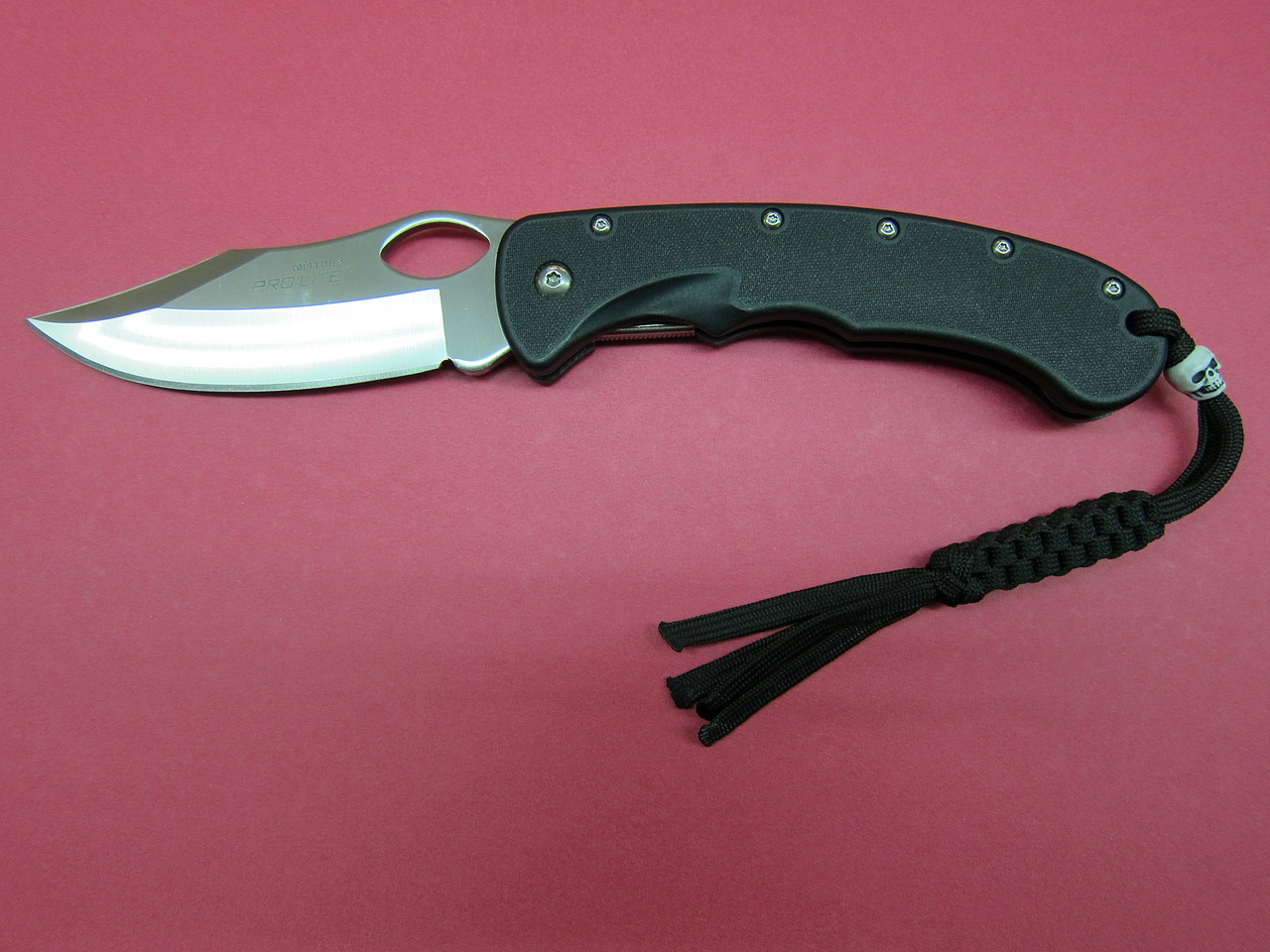
A better variant of the hole was a large (but shallow) oval hole with only a small "hump", found on the excellent (and for me much missed) Cold Steel Pro-Lite. Try this knife besides any of the "humped" Spyderco designs, and the less demanding bio-mechanicals of an un-raised oval hole reach is immediately apparent.

Even the liner's thumb rest design was outstanding imho.

18500C90F7264F9A7ED52A4F9A7D4D.jpg


A flipper really solves all these minor issues, but, strangely enough, a lot of them tend to have funky designs that don't appeal to me.

Gaston

 
Last edited:
Very good points that are too rarely made.

The gunk in the hole is a relatively small issue though, as it is not hard to clean, and you have to clean the blade anyway...

The Spyder hole is superior to studs in offering less blade clutter. On the other hand, having had Spyderholes long before I bought any thumb stud knife, it immediately struck me how most thumb studs have an obvious, if not quite overwhelming, reach and opening effort/complexity advantage, because the stud adds to the limited "arc of movement" of the thumb, while the Spyderhole substracts from that reach.

Not only that, but the stud adds a slight leverage advantage to defeat the detent (or spring closure pressure in the case of lockbacks), which means that, for the same strength of detent, the knife opens faster and easier.

Spyderco makes this somewhat worse by "humping" most of its blade designs, which further increases the required thumb travel arc, especially nearing the end of the arc.

Because of this, I found that, in hurried openings, the stud is usually (depending on the slickness of the stud design, the Sebenza's stud looking way too slick to my eyes) quite a bit more secure (less travel, more reach and more leverage), as sometimes the extra reach of the Spyderco "hump" makes the thumb slip out of the "regular" small Spyderholes before locking. Not a big issue, but the faster you go, the more likely it is to happen.

A better variant of the hole was a large (but shallow) oval hole with only a small "hump", found on the excellent (and for me much missed) Cold Steel Pro-Lite. Try this knife besides any of the "humped" Spyderco designs, and the less demanding bio-mechanicals of an un-raised oval hole reach is immediately apparent.

Even the liner's thumb rest design was outstanding imho.

18500C90F7264F9A7ED52A4F9A7D4D.jpg


A flipper really solves all these minor issues, but, strangely enough, a lot of them tend to have funky designs that don't appeal to me.

Gaston

I agree with your notion that the thumb hole adds to the arc your thumb must travel to open. However I've found that in hurried openings slipping off a thumbstud (especially my Sebenza) posed a much more real obstacle to me than a wider arc to open a thumb hole. And when I really want to open a knife quickly I generally flick it open with my thumbnail.

:D
 
I have two ZT's. A 0562 & a 0801, and I like them a lot. They're both well made & operate smoothly. If I'm taking them from my pocket & flipping them open, they may open slightly faster than, say my BMs or Spydercos. If I already have those knives out & in my hand, I see very little difference in opening speed.

The thing with flippers is that there's really only one reliable way (for me, at least), to open them, & that's using the index finger on the flipper. With the BMs or Spydy's there are usually several ways. You can casually open them with the stud or hole, a fast flick with the thumb, Spydy drop, or pull back on the Axis or compression lock & use gravity with a wrist flick.

It's nice to have choices.
 
I only care if a knife is one hand open and close. I mostly have flippers, they are easy for me to use, but also have BM axis autos, one manual BM axis, four Spydercos, and a few manual customs. For the way my hands work, manual flippers have always been the most ease of use knives.
 
I think that old school is the best. Benchmades from ~1998 with liner lock and teflon washers.
 
Back
Top