
-
The BladeForums.com 2024 Traditional Knife is available! Price is $250 ea (shipped within CONUS).
Order here: https://www.bladeforums.com/help/2024-traditional/
You are using an out of date browser. It may not display this or other websites correctly.
You should upgrade or use an alternative browser.
You should upgrade or use an alternative browser.
Why so littles talk about bedding
- Thread starter zach225a
- Start date

- Joined
- Jan 1, 2006
- Messages
- 1,649
I would say the reason it doesn't come up is because it's a pretty mundane topic, not glamorous like fire making. I know Les Stroud stresses bedding, and it is very important to prevent heat loss through conduction. A survival bed is very simple though, a bunch of leaves, moss, branches from a tree, weeds really anything to seperate your body from the ground itself will work.

- Joined
- Dec 15, 2007
- Messages
- 1,435
The key to bedding is inches of insulation. Like gruntinhusaybah points out anything works as long as you add inches between you and the ground. At the least, a close cell foam pad if you want to bring something.
As for me, unless I'm caught out for an unplanned overnight, I'll sleep in my nice cozy camper van with a fat memory foam pad.
As for me, unless I'm caught out for an unplanned overnight, I'll sleep in my nice cozy camper van with a fat memory foam pad.

- Joined
- Mar 22, 2006
- Messages
- 5,944
allot of survival books I've read speak in detail about bedding, it's a pretty important topic, especially if you are out without a sleeping pad or similar equipment.
Actually the OP makes a valid point regarding the discussion of bedding in outdoor settings. There are various situations where one ends up and needs to make a bed, if one has'nt been carried. If the weather isn't below say 50'F I'd rig a hammock out of rope and fabric if available, as this will provide both, a decent night's sleep and insulation from ground sucking cold. If there is any kind of windchill present then build a windbreak for the hammock, failing that construct the hammock only 3ft off the ground tautly. Once you climb in you'll still be a few inches above the ground, and lower than most of the ambient wind speed that is higher above ground.
Ground beds can be constructed of various materials found locally, but beware those harboring insects and other potential pests such as ticks. If the weather is cold then insects usually are'nt a problem, neither are other critters like scorpions and snakes. The density of the bedding has the importance of making the insulating layer of air so don't skimp!
Ground beds can be constructed of various materials found locally, but beware those harboring insects and other potential pests such as ticks. If the weather is cold then insects usually are'nt a problem, neither are other critters like scorpions and snakes. The density of the bedding has the importance of making the insulating layer of air so don't skimp!

- Joined
- Jan 6, 2005
- Messages
- 9,680
Proper insulation from the ground is more important than the stuff on top!
You lose heat 25% from the top and 75% from the ground so by rights your insulation from the ground should be three times as much as your cover. You have to take into consideration compression too... an if you toss and turn at night, you're digging yourself down further. Everybody makes that mistake!! You can spend a night out in sub-zero temperature if you're properly insulated from the cold ground. A few pointers on natural bedding insulation....
-box up your bed with logs if you can to minimize spreading out your debris.
-don't worry about finding the most supple pinebows... if its thick enough even large diameter sticks will be comfortable... plus they add airspace.
-don't use snowy/damp/frozen leaf litter... of you'll wake up frozen to the ground... lol.
-tying or bundling your insulation really helps when using grasses and reeds.. also laying them in a criss-cross patern keeps you off the ground.
-if you are in a situation where you can't get enough insulation under you to be comfortable, lay on your stomach to protect your kidneys and spine from the cold... you will be better off in the morning.
One of my favorite tricks is to fill a poncho with grasses, reeds, leaf litter... fill it until its ready to pop! .... its like heaven on a cold night plus the ponch keeps any moisture from the litter off of you...
This was AFTER spending a cold night on them.... they were round when we turned in.
Rick
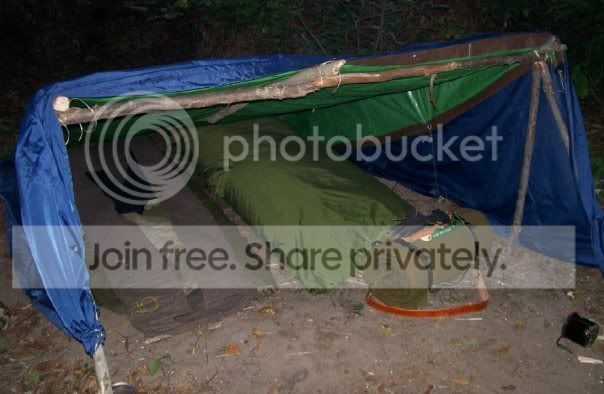
You lose heat 25% from the top and 75% from the ground so by rights your insulation from the ground should be three times as much as your cover. You have to take into consideration compression too... an if you toss and turn at night, you're digging yourself down further. Everybody makes that mistake!! You can spend a night out in sub-zero temperature if you're properly insulated from the cold ground. A few pointers on natural bedding insulation....
-box up your bed with logs if you can to minimize spreading out your debris.
-don't worry about finding the most supple pinebows... if its thick enough even large diameter sticks will be comfortable... plus they add airspace.
-don't use snowy/damp/frozen leaf litter... of you'll wake up frozen to the ground... lol.
-tying or bundling your insulation really helps when using grasses and reeds.. also laying them in a criss-cross patern keeps you off the ground.
-if you are in a situation where you can't get enough insulation under you to be comfortable, lay on your stomach to protect your kidneys and spine from the cold... you will be better off in the morning.
One of my favorite tricks is to fill a poncho with grasses, reeds, leaf litter... fill it until its ready to pop! .... its like heaven on a cold night plus the ponch keeps any moisture from the litter off of you...
This was AFTER spending a cold night on them.... they were round when we turned in.
Rick

- Joined
- Jun 29, 1999
- Messages
- 10,200
A good rest is absolutely essential when out in the bush. Coldest I ever camped out was when we were hunting caribou up in the Tombstone Valley in the Yukon, -45 C. and windy. We had a 12 x 12 Cabella's wall tent with an airtight stove, and a rug, but once we bedded down the heat leaked out pretty fast. I had a couple of 1/4" foam pads and a Therm-a-Rest inflatable pad underneath for ground insulation, and a synthetic mummy bag rated to 0 F. tucked inside a 4-lb. down rectangular bag. I was plenty warm sleeping in polar fleece long johns and long-sleeved top and a Thinsulate toque. My buddy, in a super heavy duty Arctic bag on a cot wasn't so lucky; he needed insulation underneath so he was pretty chilly.

- Joined
- Jan 21, 2008
- Messages
- 3,346
bedding is definatly important. if you dont have somthing between you and the ground, the earth will suck up all of your thermal energy in a very short time. i read a good article on a sleeping bag that somone mad with an intigrated pouch for sruffing with leaves and pine needles to keep warm. i plan on making a modified version of it at some point.


silenthunterstudios
Slipjoint Addict
- Joined
- Feb 2, 2005
- Messages
- 20,039
At Scott Gossmans campout, one of the members of Hoodlums made a natural bed. I wish I would have paid attention, learned something. Busy talking knives and getting pretzels from the grocery store :foot:. Anyway, it is something I'd like to try out in warmer weather. My father, more out of necessity than anything else, made a lot of natural beds. Stuffed a large pillowcase with leaves etc, and wrapped up with his old sleeping blanket.

- Joined
- Dec 14, 2007
- Messages
- 1,918
Good thread.
I was thinking the other day to ask : What would you use as bedding in an area that doesn't have pine boughs? I know it seems everyone recommends pine boughs but what if you have none.
I was thinking the other day to ask : What would you use as bedding in an area that doesn't have pine boughs? I know it seems everyone recommends pine boughs but what if you have none.
- Joined
- Jan 6, 2005
- Messages
- 9,680
I don't have alot of pine where I live. My favorite next to pine is Phragmites reeds or long grasses. You can use leaves, some mosses, tree bark, even small dia sticks or vines will do. Obviously, some materials work better than others.... but you can get creative in a pinch.
Rick
Rick
- Joined
- Sep 15, 1999
- Messages
- 3,319
My daypack is a top-loader with a padded back panel. I cut down a cheap closed cell blue foam pad so that it lines the pack with a single revolution. I think its about 27" long. This gives the pack some stiffness when packed, and acts as a frame. It protects the pack from sharpish objects. Most importantly, the pad, when combined with the pack itself, insulates most of my body from the ground if I curl up tight enough. Finding pine boughs, reeds or dry leaves in a cold and wet emergency is iffy at best.
Last edited:

powernoodle
Power Member
- Joined
- Jul 21, 2004
- Messages
- 11,992
Its better to experiment with your bedding options when its not so cold, or when you have alternatives, than when its bone cold and you have no choice.
Same thing obviously with fire starting and everything else.
Same thing obviously with fire starting and everything else.
- Joined
- Dec 14, 2007
- Messages
- 1,918
Its better to experiment with your bedding options when its not so cold, or when you have alternatives, than when its bone cold and you have no choice.
Same thing obviously with fire starting and everything else.
No chance of it for awhile but hopefully spring will get here soon. :grumpy: