Why Use Nonstainless?

I can't make myself use non-stainless in the kitchen. For premium kitchen cutlery, toughness is a wash with most alloys at given hardness, and sharpening is very simple with properly thin ground blades. The wear resistance and corrosion resistance advantage with no comparable disadvantage at that point is too great, imo. For a heavy chopping blade I would take a medium carbon stainless with few carbide formers, the alloy is tough enough and the blade geometry makes it essentially unbreakable if not abused.
 
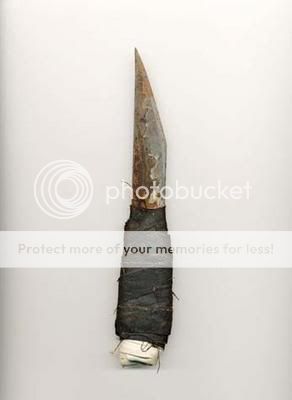
There's a certain je-ne-sais-quoi to a rusty shiv that just can't be matched by non-rusty, stainless shivs. Using stainless steel to make a shiv just takes away from the whole experience, for all parties involved.

shiv1.jpg


Carbon steel: the ONLY choice for rusty shivs since 1889. :thumbup:
 
Looks a lot better to me. I enjoy the rustic look of kitchen knives with a nice patina. Also I like a knife to be easy to sharpen. I tend to prefer carbon steel all over except for outdoor use during wetter seasons where I like VG10.
 
There is a lot more distain for carbon steel on this forum than I ever would have expected. Why? I like my carbon steel knives both in the kitchen and in the woods and have no issues with them if they are properly cared for. I also use and like my stainless blades but I do find stainless is harder to get right and carbon is hard to get wrong. But both can make great knives for anything outside of somthing like diving where stainless has a major edge. So why Carbon in the kitchen cheap knives that work great is why I got a set of Old Hicks that and my wife the edge destroyer refuses to use anything that can't be chucked in the dishwasher.
 
Maybe I'm particularly sensitive to it, but I find carbon steels always smell and occasionally affect the flavour of the food.
 
I can't make myself use non-stainless in the kitchen. For premium kitchen cutlery, toughness is a wash with most alloys at given hardness, and sharpening is very simple with properly thin ground blades. The wear resistance and corrosion resistance advantage with no comparable disadvantage at that point is too great, imo. For a heavy chopping blade I would take a medium carbon stainless with few carbide formers, the alloy is tough enough and the blade geometry makes it essentially unbreakable if not abused.

The only non stainless I use in the kitchen is my Custom K294 (A11) knife and I keep that coated with PAM so it has not darkened at all. :)
 
There's a certain je-ne-sais-quoi to a rusty shiv that just can't be matched by non-rusty, stainless shivs. Using stainless steel to make a shiv just takes away from the whole experience, for all parties involved.

shiv1.jpg


Carbon steel: the ONLY choice for rusty shivs since 1889. :thumbup:

Best post on Blade Forums right now :D
 
There's a certain je-ne-sais-quoi to a rusty shiv that just can't be matched by non-rusty, stainless shivs. Using stainless steel to make a shiv just takes away from the whole experience, for all parties involved.

shiv1.jpg


Carbon steel: the ONLY choice for rusty shivs since 1889. :thumbup:

I must admit, it has a lovely hamon. It would be very good for sticking someone in the prison kitchen.
 
I'm with the majority... other than one old Cattaraugus boning/filet knife my wife picked up for like $.75 at a thrift store and loves simply because it's really thin, all my kitchen stuff is stainless.

Some folks just plain like being able to steel their kitchen knives easily and often. And of course some love the patina. Honestly the same goes for any type of knife; if you want high toughness, great edge-holding, relative ease of sharpening, and thin, keen crisp edges, you can have that with modern stainless and tool steels. I do make knives in O1 and 1084, because people like 'em and they sell. But very few of my personal knives are "plain" carbon steels... certainly not any I've bought or made for myself in the last few years.
 
I just wanted to address the sharpenability issue. The easiest knives to sharpen in my kitchen are stainless. I destressed, and rebeveled the edge of one Im testing with 40 passes per side on a 1000 stone. This took less than 2 minutes. By rebeveled here, I mean apexed the edge and formed a very small burr. Another took a similar amount of time to sharpento the point it will slice the side out of a plastic grocery bag. Both stainless and total cost for both was less than 25 dollars.
 
I just wanted to address the sharpenability issue...

That's a good point. I find that very often when people complain about sharpening stainless, they're comparing 440C or CPM-154 at 58-60Rc to old knives in 1095 at maybe 55 or 56Rc. That's a world of difference in hardness.
 
I've seen old blackened carbon steel kitchen knives and they disgust me. I wouldn't cut my food with anything that looked like that.

My traditional folders look like that.

I have a kitchen knife I use all the time that I took vinegar and blackened the steel. I don't notice any difference from my stainless, unless I am cutting lemons or other acidic fruit.
 
There is a lot more distain for carbon steel on this forum than I ever would have expected. Why? I like my carbon steel knives both in the kitchen and in the woods and have no issues with them if they are properly cared for. I also use and like my stainless blades but I do find stainless is harder to get right and carbon is hard to get wrong. But both can make great knives for anything outside of somthing like diving where stainless has a major edge. So why Carbon in the kitchen cheap knives that work great is why I got a set of Old Hicks that and my wife the edge destroyer refuses to use anything that can't be chucked in the dishwasher.

Because the vast majority that post here are misinformed or just do not know any better :)

Stainless has its place

Kitchen

Diving

But you will not see many high performance pieces of cutlery Bowies, Swords etc being made of stainless

Some stainless's are closing the gap but there still is a gap
 
Because it works just as well and I think patinas turn a knife into a piece of art. YMMV.
 
I should point out that until I really looked into making knives for myself, and later, for a living, I was a die-hard carbon-steel snob. My early education on knives was based heavily on the writings of Bagwell and Moran... true giants in our field. It took a lot of research, testing and experience to open my mind to even considering stainless steels. Don't get me wrong, there is no question in my mind that "plain carbon steels" still have a place in the knife world, and they always will!

...I do find stainless is harder to get right and carbon is hard to get wrong...

Ummm... no. That's not true at all. I strongly disagree that "stainless is harder to get right" because with modern alloys and HT, it's actually a very straightforward process to make a truly high-performance kitchen blade. The protocols for each well-known alloy are established, proven, thoroughly tested, and easily replicated. It is more costly than firing up the BBQ... but not nearly as costly as some would have you believe... and definitely less expensive than paying a famous maker a couple hundred extra dollars for his top-secret "regimen". Can your average Joe Schmoe do it right in his garage with a torch and a bucket of old motor-oil? Absolutely not.

It's a heckuva lot easier to "get carbon steel wrong", especially when we still have so many makers, buyers and internet "experts" who insist on ignoring several decades of research and who idolize half-vast, archaic methods... most of which do not come close to bringing the steel to its highest potential. For various reasons, there's still a whole lot of baloney floating around about how to deal with low-alloy steels, and that's a crying shame. Can your average Joe Schmoe do it right in his garage with a torch and a bucket of old motor-oil? Absolutely not.

Is it easier to get simple alloys "kinda-sorta right", with a dubious heat-treat that will probably not fall apart and can take a fine edge and hold it through a meal? Yes, that's true. But it's hardly something to hold up as a standard.

 
Last edited:
I should point out that until I really looked into making knives for myself, and later, for a living, I was a die-hard carbon-steel snob. My early education on knives was based heavily on the writings of Bagwell and Moran... true giants in our field. It took a lot of research, testing and experience to open my mind to even considering stainless steels. Don't get me wrong, there is no question in my mind that "plain carbon steels" still have a place in the knife world, and they always will!


Ummm... no. That's not true at all. I strongly disagree that "stainless is harder to get right" because with modern alloys and HT, it's actually a very straightforward process to make a truly high-performance kitchen blade. The protocols for each well-known alloy are established, proven, thoroughly tested, and easily replicated. It is more costly than firing up the BBQ... but not nearly as costly as some would have you believe... and definitely less expensive than paying a famous maker a couple hundred extra dollars for his top-secret "regimen". Can your average Joe Schmoe do it right in his garage with a torch and a bucket of old motor-oil? Absolutely not.

It's a heckuva lot easier to "get carbon steel wrong", especially when we still have so many makers, buyers and internet "experts" who insist on ignoring several decades of research and who idolize half-vast, archaic methods... most of which do not come close to bringing the steel to its highest potential. For various reasons, there's still a whole lot of baloney floating around about how to deal with low-alloy steels, and that's a crying shame. Can your average Joe Schmoe do it right in his garage with a torch and a bucket of old motor-oil? Absolutely not.

Is it easier to get simple alloys "kinda-sorta right", with a dubious heat-treat that will probably not fall apart and can take a fine edge and hold it through a meal? Yes, that's true. But it's hardly something to hold up as a standard.

+1 this.
 
Back
Top