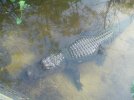
Re: American Alligator (Alligator mississippiensis)
First, I will need a copy of the map where all of us from BF will meet up to camp with y'all!

Green with envy! :thumbup:
Alligators LOVE to eat dogs. Any dog smaller than 200 pounds is in absolute jeopardy of being taken, even if it requires leaving the water to get it. I cannot over emphasize this to you or to others who bring pets to alligator land. I do not bring my 68-pound Black Lab on ANY Florida river or freshwater-brackish water trip. Period.
Do NOT underestimate alligators. Faster than a horse on dry land though not given to long distances. Game & Fish Commission cameras in Florida have shown nighttime movement that is astounding. I am a water guy and only have felt threatened once, by a 10' gator as we canoed the Waccasassa River in N.W. Central Florida. Most likely it was on a nest, but it charged us from twenty feet away. I thought it was coming into, or over, our canoe but it disappeared into the clear water, rocking the canoe & nearly fouling my shorts. Wow.

Usually you will see or hear them on your fairly silent approach; suddenly BOOM, fast movement with a big splash. Alligators in Florida kill several people a year, usually people swimming alone, although several children swimming together may have one of their numbers attacked. Do not ever swim at night! This goes for brackish saltwater too. Alligators coastal habitat, to which Bull sharks are added to the mix. Night is their domain. Do not surprise them or get between them & the water.
Conventional wisdom has it that most of the offending gators have been feed by humans & have lost much of their natural flight reaction. Your place sounds as if they will still bolt when they see you. NEVER feed them, no food scraps for photos, no fish cleaning leftovers, or to give folks a nature-photo opportunity. Rather they now associate humans with food. Trouble for you begins here.
A three-foot gator will kill a dog, a six-foot gator can kill a child younger than twelve, as well as seriously harm an adult (often deaths are by shock & drowning from the extremely violent attack). Gators larger than six feet would view a human as relatively normal size prey. Deer are taken frequently, feral hogs as well, mostly by ambush as the animals drink. Hence, view the waters edge with caution. Alligators will be below the surface for nearly all attacks, emerging violently from the water, grabbing, pulling prey into the water, then rolling violently for as long as it takes, until their prey no longer resists. Prey is then taken below the surface to a hole & stashed until decomposition has made them malleable. For such huge mouths they are surprisingly not much on chewing, but rip off chunks & swallow. Moreover, they repeat as necessary until old age sends them to the big swamp in the sky.
Twelve-foot & larger alligators are common in non-human occupied bodies of water all over Florida, top to bottom, and east to west. Do not provide any source of food for alligators, hogs, raccoons or even the f-ing squirrels & you & yours will scare them off, temporarily, with your mere presence.
A long cautionary tale for S.E. USA water visitors, however the two-legged beast is why my canoe or kayak ALWAYS has a lovely stainless revolver in a waterproof ammo box.
O.K., all that said, wheres my invitation & map!!!

Maineboatman
Maineboatman at Cox dot net
American Alligator
Alligator mississippiensis
Type: Reptile
Diet: Carnivore
Average lifespan in the wild: 35 to 50 years
Size: 10 to 15 ft (3 to 4.6 m)
Weight: 1,000 lbs (453 kg)
Group name: Congregation
Did you know? The largest American alligator ever reported was supposedly 19.8 feet (6 meters) long, although there are doubts about the claim.
Protection status: Recovered
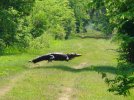
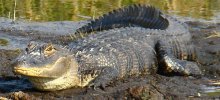
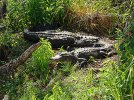
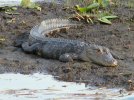
Local photos are from flickr.com/photos/greenkayak/, a talented area photographer.