Will .064 work for large chef knives?

Joined
Apr 27, 2009
Messages
991
I'm mostly working on kitchen cutlery now and I'm wanting to get thinner stock. I'm seeing a lot of people doing great things with 15N20. I'm wondering if the .064 is to thin for larger chef knives.

 
Hm. While i think it could work, i wouldn't reccomend it. Those bevels are super hard to grind and the blade is gonna warp in hest treat.

.09 and .1 are my prefered stock size for chef knives
 
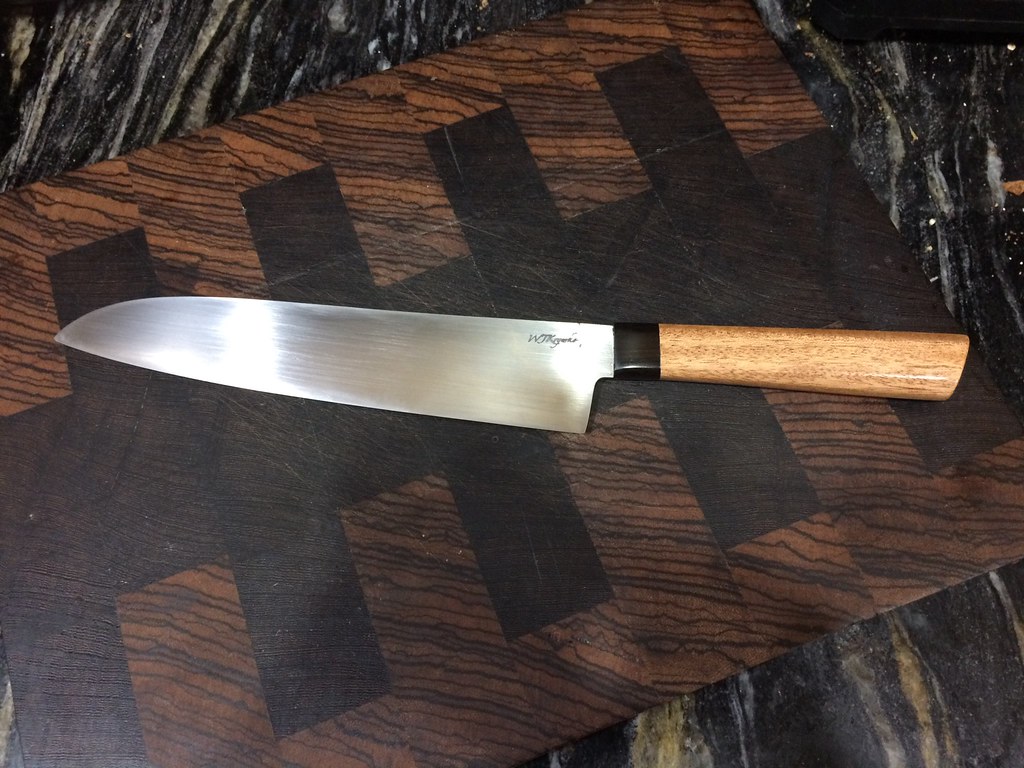
I’ve done it, and you will get a great cutting tool. Fresh belts, grind after heat treat, lighter passes and dunk every one to two passes. I’ve asked for feedback from the last one I did, as to whether it’s too flexy, and the answer was “no.”

url=https://flic.kr/p/Y1LyXJ]
36764674816_d08d98b4ca_b.jpg
[/url]IMG_1409 by Wjkrywko, on Flickr
 
Awesome performance but a pain to keep straight as mentioned. They will flex a bit at this thickness so keep that in mind especially when attaching scales. Many of my knives are this thick.
 
I don't think it's too thin. It just depends on what kind of grind you want to put on it. You're probably not going to do a full flat on both sides, but there are plenty of larger chef knives out there that start with a thin stock.
 
I do a lot of these, up to 10" bread knives for example- it can be a challenge, using all your straightening skills, but by and large if you don't do much bevel grinding pre heat treat they don't tend to warp badly.
One thing to watch is, after quench sometimes you'll check the knife and it's straight, then it can go bendy while cooling the rest of the way. Strange but true. Set it in a rack that holds it horizontal and straight.
Helps lots to have nicely prepped steel (stress relieved etc.)
 
I'm going to buy some and give it a try but I'm not buying a huge sheet. I'm going to grab some .095 as well and maybe some of that .07 aeb-l as well.
 
I'm going to buy some and give it a try but I'm not buying a huge sheet. I'm going to grab some .095 as well and maybe some of that .07 aeb-l as well.


There’s a reason a good kitchen knife costs as much as a nice bowie. Hard, wear resistant steel in thin, warp prone stock is a defined skill set. It’s doable, but take your time. You will love the results. I like a d grind myself.
 
I've been having great results with 0.72 15N20. Profile, heat treat, grind slowly with a 60 grit ceramic.
I've done 6 so far and every one had a slight bow out of the quench without any grinding done. I just clamp them to a bar during temper and they straightened right out.
 
For an 8" or 10" chefs knife I start with .10 and end up with .09 to .08 at the spine on a full flat grind. Seems to work very well.
Tim
 
iThe stresses in the steel, before you HT may very well be the problem. That thin stock is wound into a very large roll .that puts stresses into the steel and they must first be removed .Then if you don't introduce more stresses in HT it should be OK. Get used to remove stresses with a "subcritical anneal" 1200F for 2 hours .
 
I used .072" 15N20 for a couple small pairing knives and I think it's great. I normalize it twice before HT and that seems to take the bow out of it for me. After the first heat to critical; pull it out back and cool to black. Then you can see a bow in it. Then I heat and straighten it some and let it come back to black ,and if it's straight then I go back to critical and dunk it. Comes out pretty darn flat that way. After grinding off decarb, etc I end up at around .05-.055".
 
I had to double check the measurements on the last 8” gyuto I did. It was .06 at the spine and worked wonderfully. It doesn’t flex very much at all. It did take a while to grind since it was so thin, but I love it. It was Aeb-L. I think you’ll be very happy with the performance going that thin. I have one of my first chef knives in my kitchen and it was around .120 and there’s just a massive difference in cutting with the different geometry.
 
Back
Top