Will convexing help prevent this...

Joined
Nov 15, 2007
Messages
5,279
...or should I just change the grind angle when I get a sharpening kit?


I went up to the Mendocino National Forest this weekend and put my Mistress to use. I chopped some wood and lobbed it at an old dried tree a few times but noticed a small chip and some minor rolling of the edge near the tip before putting her to bed. I assume a convexed edge would be much stronger than the regular factory grind, but I don't have the tools (or talent) to do this yet. Could I get away with just changing the grind angle or do you think it would hamper cutting ability too much? Anyway...here are some pictures for your review...


BUSSEEdge001.jpg

BUSSEEdge003.jpg

BUSSEEdge006.jpg

BUSSEEdge016.jpg

BUSSEEdge017.jpg

BUSSEEdge025.jpg

BUSSEEdge026.jpg

BUSSEEdge028.jpg


The Mistress made short work of all she touched and the main edge still shaved hair when finished, but her gently curved belly was soft and rounded enough to urge me to send her to someone to get some exercise. Anyone with a belt willing to firm her up for me? I'd be happy to pay for her training/trimming.:D

As ALWAYS... I appreciate any suggestions/recommendations!!!

Stump
 
Last edited:
if you have a steel (preferably glass smooth/polished) you can move that rolled area over to make the edge straight again, then it should be a few passes with a stone.

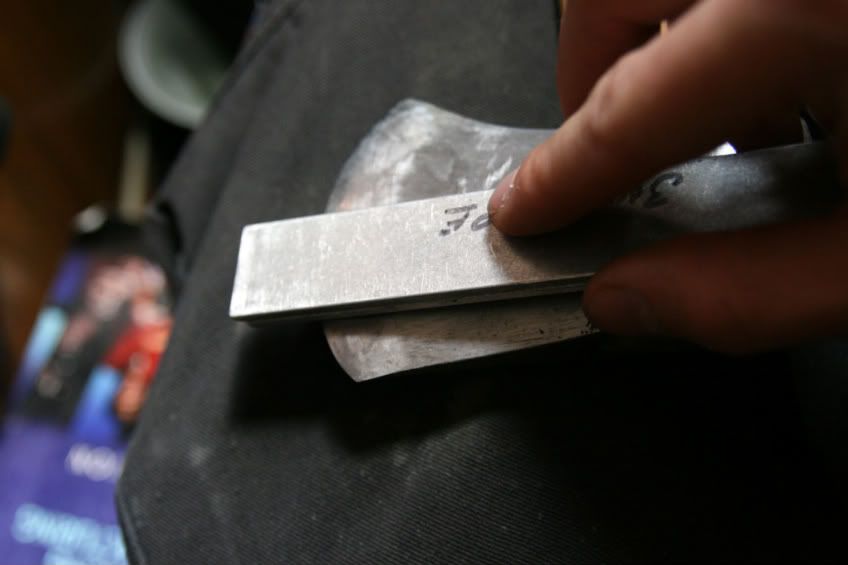
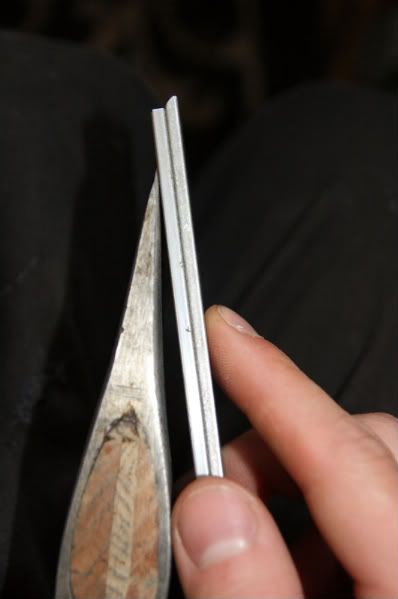
if you want to send it to someone to get sharpened you certainly could do that, but being able to sharpen your own tools is a valuable skill. while I do most of my sharpening on an edgepro apex, for the stuff that doesn't fit on the sharpeners table I use the stones like a file. I cannot hand sharpen in the normal way, I've tried for many hours and always came up failing, including the convex methods. But, I'm really good and accurate with a file, so I thought "why not use a stone like this?"

zIMG_6329.jpg

zIMG_6330.jpg


One of these days I'm going to make a belt sheath so I can carry around a 220 and 600 stone.
 
i remember Jerry saying that you can use the edge of your car window and that works great too:thumbup:... just roll it down and go to work:)
 
When removing a roll in a blade, I assume you would use edge trailing strokes against the steel like you were stropping, correct? I've always just sharpened rolls out, but it seems like a waste of steel.
 
I use an EZE-Lap round diamond rod to clean up my BM. Works great on a little rolling and slight dings. Small chips don't bother me on a chopper.
 
My experience is that INFI is stange like that- it will roll from wood sometimes, but won't show any damage after impact on metal. I punched a steel barrel with the tip of NMSFNO and only scratched the coating on the tip.
 
For what it's worth, the standard grind on my cg ash chipped a little bit on hard wood after using it all day long. I went outside, whacked a tree and had a noticeable chip. I took it inside, convexed/polished it on my sander and tested it out, nothing. I even thinned it out a little bit compared to the factory grind, still, not a dent or roll or chip. I like convexed edges.
 
for rolls and dents I take it to the smooth steel of a round screw driver. If you have a smooth butcher's steel even better. They tend not to sell those anymore. The butchers steel they sell most places actually remove metal, not realign.

A convex edge won't stop dents or rolls. Looks like you found a rock. If the edge stands up to chopping etc, just leave the angle the same it it works for you.

I convex all my edges. But if you hit one on a rock, same result (angles being the same). That said, I do think that convex edges are a bit stronger than a v grind, even with relatively close angles for comparison, because there is more metal supporting the edge.

Before I started the convex job on my FBMLE, I found a rock on my copping block of all places. Must have been stuck to one of the logs I was splitting. I took a small amount of edge damage, and it steeled right out almost completely.

Looking at that edge, it looks deformed and mashed/rolled more than chipped. You can see where it gets thicker, instead of a clean chip.


Don't sharpen it until you get the edge back in shape. You will be removing a bunch of steel un-necessarily. Once you steel the edge back to relatively good shape, then you can sharpen as normal.


I would offer to convex yours for you, but I do mine by hand (keeps the warranty in play for the edge), but honestly, it takes forever with my method. Some one could convex it with a sander in like 2 minutes. I would not feel comfortable doing it to any one else's edge, because if I ruin mine, then it is my problem.

I have a belt sander, but have never used it on infi, just other cheaper knives.
 
Last edited:
Nice pics Stump. I was up that way last week in the Wilderness Area. Looks like a roll. It probably hit a rock. Shoot me an email when you get a chance.
 
I've noticed that occasionally blades will have an edge from the factory that tends to chip easier than it should. I don't know enough about the chemistry of the various processes that happen during the manufacture of a knife, but it seems like there is sometimes a bit of weaker steel right at the edge.

What I do know is that, once you sharpen out the damage, the edge seems to hold a lot better. That's purely anecdotal evidence and not documented well enough to call it definitive, but it is a trend I have noticed, and I've spoken to others who saw similar things.

The edge geometries out of the Busse shop are about as robust and beefy as you'll ever want on a knife. A convex edge will probably increase the performance of your blade, but I would think that would be due to thinning it out a bit, and not really have anything to do with making it stronger.

The advantage of a convex is, you can get a thinner edge that's still pretty robust, compared to a v-grind where you need to keep a beefier edge profile if you want an edge that'll take abuse.

If you've just got rolls, steel them out and you'll be good. If there is actual chipping (hard to tell without a magnifying glass), then sharpen them out with whatever method you like, and your edge will probably be better for it in the long run.
 
I've noticed that occasionally blades will have an edge from the factory that tends to chip easier than it should. I don't know enough about the chemistry of the various processes that happen during the manufacture of a knife, but it seems like there is sometimes a bit of weaker steel right at the edge.

What I do know is that, once you sharpen out the damage, the edge seems to hold a lot better. That's purely anecdotal evidence and not documented well enough to call it definitive, but it is a trend I have noticed, and I've spoken to others who saw similar things.

The edge geometries out of the Busse shop are about as robust and beefy as you'll ever want on a knife. A convex edge will probably increase the performance of your blade, but I would think that would be due to thinning it out a bit, and not really have anything to do with making it stronger.

The advantage of a convex is, you can get a thinner edge that's still pretty robust, compared to a v-grind where you need to keep a beefier edge profile if you want an edge that'll take abuse.

If you've just got rolls, steel them out and you'll be good. If there is actual chipping (hard to tell without a magnifying glass), then sharpen them out with whatever method you like, and your edge will probably be better for it in the long run.


i also noticed the Phenomenon of weakness of the initial eage on the other brand !
i think it is decarburization , cause the edge is sooo thin that in the process of heat treatment , surface will loss carbon in the steel .so the thinner part nearer the edge loss more . if the there is less amount carbon in it , the edge is weaker than other part of the blade.
:D
 
Thanks for ALL the replies guys! I have a butcher's steel, but don't have any sharpening supplies/kits yet as I'm still looking at the various options before parting with the money. I didn't realize that belt sharpening may void the warranty, but it makes sense since the edge could lose its temper if done wrong. As far as traditional V grind systems go, is the "Wicked Edge" kit as good as it claims to be or a late night TV style gimmick? Has anyone used one on a blade this long? I have a couple of paper/mousepad intsruction videos bookmarked, but so far the practice I've done on cheaper blades hasn't gone well. I'll keep practicing before I tackle the Mistress.

Thanks again for the replies and here's a couple more pictures of the mountains for your enjoyment...

MNF008.jpg

FrenchRidgeandIVR001.jpg

ElkandMendoForest060.jpg


and one from my office window...
ElkandMendoForest069.jpg


Thanks Again,

Stump
 
I'd be willing to bet that the original edge was put on by some sort of belt sander or grinder. A little care and there is no overheating at all. No, a convex edge will not prevent that little chip or dent in the edge. As you know by now, that is easily smoothed out.
 
strength of a convex edge varies depending on how thick the it is, usually a fresh convex edge is always thinner, but get stronger and thicker as you gradually resharpen it.
 
I played with a wicked edge setup at BLADE atlanta, and it worked fine on a full flat grind blade.

That said, it's WAY overpriced for what it is. For the simplicity of the system, it ought to cost about 50 bucks IMHO.


If you have absolutely no skill at sharpening, the wicked edge thing might help you, but there are a lot of cheaper systems that will work with some practice.
 
I think that video is comical.

I would just sharpen it on sandpaper. It is fairly difficult to screw up.
 
Good grief, way to make a simple thing complicated. That Wicked Edge thing is ridiculous. A 99 cent ceramic rod will get a knife shaving sharp in seconds.
 
Back
Top