Wilson Custom Chef Knife-Feedback

Joined
Sep 3, 2012
Messages
3,090
Hello, I posted this in Kitchen Cutlery, but thought I would post it here as well. I just finished this set up yesterday, and am pretty pleased with it. The customer is very happy, so that's the important part, lol. But I would like some constructive criticism from some makers/users about the set.

The sheath is probably overkill, but the customer wanted something to really set it off, as it was a gift, and this is what I came up with. It will never see field use, obviously, but I made the sheath fully functional and durable. The color looks off in the photos, but it was a consistent black. Although unnecessary, as the sheath will never see field use, it is fully formed and fitted to the knives, and they lock in quite nicely. The color looks off in the photos due to the lighting, but it was a consistent black.

To be fair, I should also mention that I got the knives back from heat treat, and finished them, including the sheath, in about 36 hours. For me, that was a little difficult, so I didn't have time to stop and smell the roses on all the details.

Blade: 9" on chef, 4 1/2" on utility
Steel: 440C @ RC 60
Thickness: .108"
Max width: 2" (on chef)
Handle material: Stabilized Elder Burl
Hardware: 316 SS pins
Sheath: 8 oz leather

104_0464copy_zps1aee947b.jpg


104_0483copy_zpsdaa17ca6.jpg


104_0478copy_zpsd6aa0c44.jpg


104_0471copy_zpsfff9219a.jpg


104_0504copy_zps7a25e33d.jpg


Thank you,

Sam Wilson :thumbup:
 
Simple design, elegant, well executed. Right down my alley sir. Very nice.
I like the consistent proportions through the pair, and the sheaths compliment the knives beautifully.
Cheers.
Merry Christmas
 
Hey Sam, the quality looks pretty good and the sheaths are awesome. There are a couple of design features that are popular among kitchen knife nuts that you might want to look into.

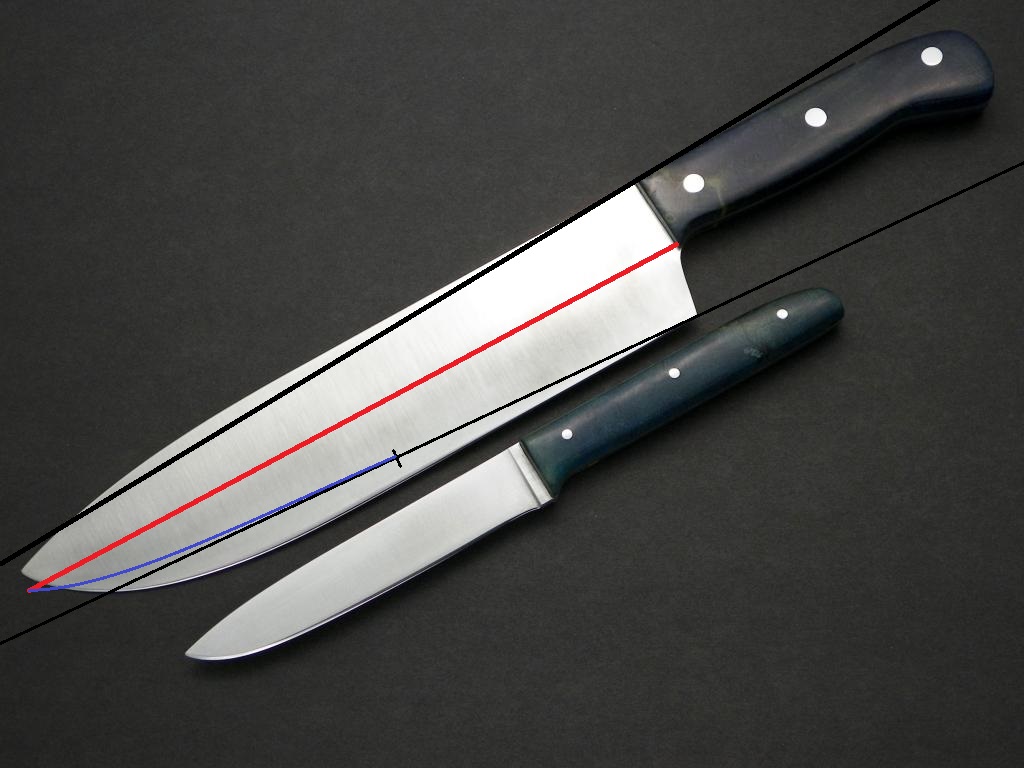
f0sz9iR.jpg


The biggest one would be a taper of the overall profile. On yours the edge and spine are parallel for the most part, but having those two lines angle towards each other is a trait you may want to consider (the two black lines). The handle, as a result, should be angled up slightly.

It varies from knife to knife, for example a Takeda has it to a less extreme, and on some maybe not even at all, which brings me to the next point, which is that the actual tip should be located at the midpoint (red line) or below. Flatter knives with less belly and less taper can get away with a really low tip.

1247335387-takeda1.JPG


Lastly, you might also consider lessening the huge belly, or at minimum having it transition more gradually. There should be a section of flat edge towards the heel, maybe 4 inches or so, but after that it can belly all over where you want.

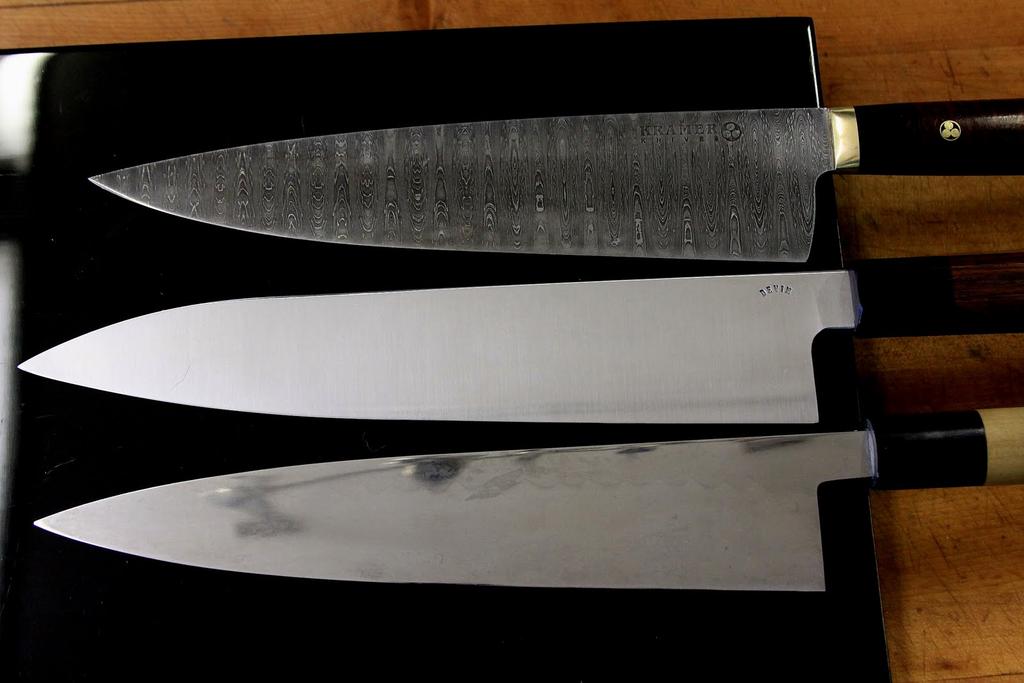
Here are some examples of some very good profiles out there: Kramer, Thomas, and Masamoto.

P5pr1YR.jpg


Just some things to consider, and it's tricky because it depends on every knife. I hope that makes sense.
 
Last edited:
Simple design, elegant, well executed. Right down my alley sir. Very nice.
I like the consistent proportions through the pair, and the sheaths compliment the knives beautifully.
Cheers.
Merry Christmas

Thank you, LucyCustomKnives. The customer is very pleased, and I am happy with the set. I had a good time learning, and to be honest, had a hard time letting the knives go. :) Thank you again.

Hey Sam, the quality looks pretty good and the sheaths are awesome. There are a couple of design features that are popular among kitchen knife nuts that you might want to look into.


The biggest one would be a taper of the overall profile. On yours the edge and spine are parallel for the most part, but having those two lines angle towards each other is a trait you may want to consider (the two black lines). The handle, as a result, should be angled up slightly.

It varies from knife to knife, for example a Takeda has it to a less extreme, and on some maybe not even at all, which brings me to the next point, which is that the actual point should be located at the midpoint (red line) or below. Flatter knives with less belly and less taper can get away with a really low point.


Lastly, you might also consider lessening the huge belly, or at minimum having it transition more gradually. There should be a section of flat edge towards the heel, maybe 4 inches or so, but after that it can belly all over where you want.

Here are some examples of some very good profiles out there: Kramer, Thomas, and Masamoto.


Just some things to consider, and it's tricky because it depends on every knife. I hope that makes sense.

Don, thank you very much for the illustrations and pictures. I believe you are very correct about the lines and belly of the knife. This is going to be my Model K1, and for this particular knife I wanted more belly, mainly because I like the way it looks and performs. :) But, that being said, I think you are right 100% about the knife. I may keep this model the same for those that like the belly and proportions, but I think I will make Model K2 much more in line with what you are suggesting.

I agree with you that more serious users tend to prefer a thinner tip, and that illustration will prove invaluable in designing my next one. Hopefully I can do another one here soon, and incorporate the good advice you have given me. Thank you again,

Sam :thumbup:
 
I agree with you that more serious users tend to prefer a thinner tip, and that illustration will prove invaluable in designing my next one.
Sam, that's a fine looking set.
To add to what Don was pointing out....

I'm a retired chef so I understand all too well what Don's illustrations were driving at.

Its not just that a thin point is nice, and it is, but the lines Don drew will create a blade with much less rocker in the belly. Less rocker in a traditional western chef's knife is a good thing. It becomes quite a chore mincing herbs with a big, full bellied knife. Your arm/hand has to haul that knife wayyyyy up, and then wayyyyy back down again just to use the full length and cutting potential of the blade. A straighter edge with less belly is just more efficient to use, is faster, consumes less energy and is more precise with each cut.

I hope that helps.

-Peter
 
Sam, that's a fine looking set.
To add to what Don was pointing out....

I'm a retired chef so I understand all too well what Don's illustrations were driving at.

Its not just that a thin point is nice, and it is, but the lines Don drew will create a blade with much less rocker in the belly. Less rocker in a traditional western chef's knife is a good thing. It becomes quite a chore mincing herbs with a big, full bellied knife. Your arm/hand has to haul that knife wayyyyy up, and then wayyyyy back down again just to use the full length and cutting potential of the blade. A straighter edge with less belly is just more efficient to use, is faster, consumes less energy and is more precise with each cut.

I hope that helps.

-Peter

Thank you, Peter, it does help. I appreciate your and Don's advice. That's exactly why I posted it here. I agree with both of you 100%. I came up with this design because I just like large knives with a lot of belly to them. That being said, I'm not much of a chef at all. I do however, want to make a truly effective knife for use in the kitchen, and Don's illustration, along with your explanation of what actually happens when you're using the knife, gives me what I needed to design a more geometrically effective knife.

Thank you for you post, and now I understand more about why the mid-line and belly placement are so important. I will make another in the next couple of weeks, and post it here for more feedback. Thank you gentleman, and I appreciate the compliments.

Sam :thumbup:
 
This really helped me too. I have one chef knife in my last batch that just looked a bit "off" to me, and seeing this explanation, it has 3/16" more belly than the nearly identical knife that looked better to me. Back to the grinder!

Thank you, Warren
 
I like my chef knife with much less rocker to it. But from there, there are a lot of variations. Great wood on both.
 
Great looking set. I love the wood. :)

Learned a lot too.

If you don't mind me asking a question?

Are there design elements to consider when making a pairing knife as well? My main questions regard steel/thickness and temper.
 
Paring knife's are pretty funky - everyone has a different variation and none of them are right or wrong. Long handles and open heels are common, but those are subjective too. I'd say that 0.095" stock is good to work with, and generally parers are more popular as stainless since they're used for sporadic jobs and left out sometimes.
 
PTDoc and Strigamort, Thank you both. Nature kind of stole the show with that wood. I agree with everyone, I have learned a lot from the input of Don and Peter on this. Thank you for the help. Going forward, I believe I have what I need to improve the design. Thank you again.

Sam
 
What Peter said about rocker.
A local chef had me make him a fairly standard chef's knife this year, but what he asked for was a little surprising: he wanted an almost straight run for a couple inches from the point toward the belly, then some curve, then almost straight again. He said it made any kind of fine work much easier.
This is why I often just give the chefs I know knives now and then- I learn so much about knife-ology by checking back in, and I get to keep in touch since I sharpen them for free.....for now :)
 
Back
Top