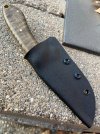
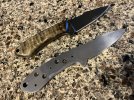
Winkler Inspired edc - Build Thread

I love the shape, and the handle is looking great. But it looks like you have some pretty heavy grit scratches still in the plunges. Are you going to sand down through those?
Those areas are proving to be difficult to work, but I do plan to work them more before heat treating. Thank you for the encouragement; this will be my first finished blade.

I found this video which will help me -
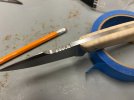
 
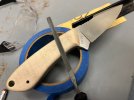
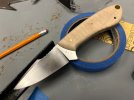
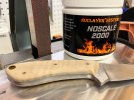
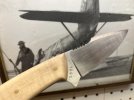
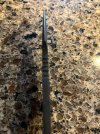
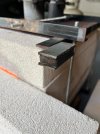
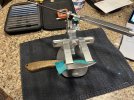
I had some time today to work on the jimping; I'm still trying to mimic the Winkler style. It is aggressive, but gives good purchase and feels right to these old leathery hands. This was done free-hand with the very small flat file shown. The Nuclayer Noscale arrived the other day so this blade is getting closer and closer to heat treating.
 

Attachments

  • IMG_7426.jpg
    IMG_7426.jpg
    154.2 KB · Views: 9
  • IMG_7427.jpg
    IMG_7427.jpg
    220.2 KB · Views: 10
  • IMG_7428.jpg
    IMG_7428.jpg
    206 KB · Views: 8
  • IMG_7430.jpg
    IMG_7430.jpg
    233.3 KB · Views: 10
  • IMG_7432.jpg
    IMG_7432.jpg
    159.8 KB · Views: 9
Last edited:
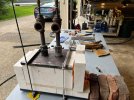
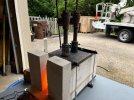
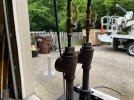
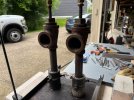
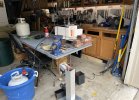
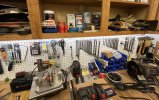
So today, me and my son are working with the forge to get reacquainted with it (it has been a while) and are putting together a set of slot jaw tongs from Ken’s Iron. Anybody happen to know where I can find a couple of 1.5” threaded air adjusters “chokes” for the venturi openings on my forge. I believe it is running too lean and need to find a way to tune it while running different gas pressures.
 

Attachments

  • IMG_7435.jpeg
    IMG_7435.jpeg
    693.8 KB · Views: 5
  • IMG_7436.jpeg
    IMG_7436.jpeg
    575 KB · Views: 5
  • IMG_7437.jpeg
    IMG_7437.jpeg
    484 KB · Views: 6
  • IMG_7438.jpeg
    IMG_7438.jpeg
    504.1 KB · Views: 6
Last edited:
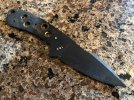
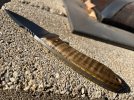
Finally got around to heat treating this blade today; here it is after tempering. It took a slight bend to the right and I suspect uneven heating from one side to the other to be the cause during the quench.

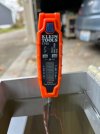
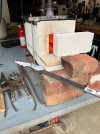
I preheated the Parks-50 to 100F and let the interior of my forge come up to temperature. Then, I heated the blank to non-magnetic and promptly quenched it. After quench, the tank temp was up around 185F.

I'm not too bothered by the slight bend and I'm moving forward as this will be my first finished blade. I intend to carry this prototype and test it thoroughly on a daily basis. Next I will clean and prepare for the Caswell finish and then glue up the scales.
 

Attachments

  • IMG_8276.jpg
    IMG_8276.jpg
    239.9 KB · Views: 6
  • IMG_8275.jpg
    IMG_8275.jpg
    415.4 KB · Views: 6
  • IMG_8274.jpg
    IMG_8274.jpg
    415.7 KB · Views: 8
  • IMG_8269.jpg
    IMG_8269.jpg
    88.2 KB · Views: 6
  • IMG_8267.jpg
    IMG_8267.jpg
    137 KB · Views: 5
  • IMG_8266.jpg
    IMG_8266.jpg
    356.4 KB · Views: 6
  • IMG_8264.jpg
    IMG_8264.jpg
    172.7 KB · Views: 5
  • IMG_8263.jpg
    IMG_8263.jpg
    208.1 KB · Views: 2
  • IMG_8261.jpg
    IMG_8261.jpg
    430.7 KB · Views: 5
  • IMG_8260.jpg
    IMG_8260.jpg
    355.9 KB · Views: 6
This is unnecessary. IIRC Parks-50 is supposed to be used at room temp up to 120F.
The shop was pretty cold yesterday morning around 40F so I warmed it up. Is 40 too cold for quenching? Thanks
 
What volume of quenchant are you using, and what is the tank diameter/depth??? A rise from 100° to 185° with just one knife blade being quenched is not normal. A rise of 10° is a lot for a regular quench tank with a couple gallons of oil.

As said by weo, #50 is used at room temp between 50°F and 100°F and is fine as long as it stays below 120°F in quenching.

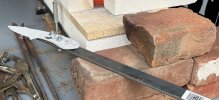
I'm not understanding photo of the blade bolted to a bar of steel. What is going on there?
 
What volume of quenchant are you using, and what is the tank diameter/depth??? A rise from 100° to 185° with just one knife blade being quenched is not normal. A rise of 10° is a lot for a regular quench tank with a couple gallons of oil.

As said by weo, #50 is used at room temp between 50°F and 100°F and is fine as long as it stays below 120°F in quenching.

I'm not understanding photo of the blade bolted to a bar of steel. What is going on there?

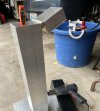
The dimensions of the tank are 4" x 4" x 30" with approximately 2 gallons of quenchant. I bolted the blade to some mild steel to use during heating/quenching.
 
Last edited:
Not a good idea. It also adds a huge amount of hot thermal mass to be cooled, thus raising the oil temp a lot. Use a pair of simple pick-up or flat-jaw tongs for quenching. The tongs should not be in the forge with the blade. Just pull it out with them when quenching.
 
I understand the additional thermal mass raising the quench temperature to be less than ideal; also that HT in a forge is less than ideal. As I understand with forge HT, the blank is to be kept moving in the forge interior to evenly distribute the heat along the blank. Hence why I choose the mild steel with the bolts to keep it moving without the possiblity of dropping it. There was a 1/2" gap between the blank and the mild steel. Other than the additional mass to be cooled, what is wrong with this method? How would one keep the blank moving and keep the tongs from heating up?
Not a good idea. It also adds a huge amount of hot thermal mass to be cooled, thus raising the oil temp a lot. Use a pair of simple pick-up or flat-jaw tongs for quenching. The tongs should not be in the forge with the blade. Just pull it out with them when quenching.
 
" .... Other than the additional mass to be cooled, what is wrong with this method? "
The additional mass isn't a minor thing. It would be the major reason not to bolt the blade to a bar of steel.

How would one keep the blank moving and keep the tongs from heating up? "
Either cool the tongs in the slack bucket before the quench, or use a fresh pair of tongs to quench the blade.
 
I get a pair of cheap vise grips, the 16" long ones from harbor freight. Tongs to move the blade in and out of the forge for most of it, then switch to the long vise grips, clamp to the tang and quench. That way I don't have to worry about dropping the blade into the quench tank.

With the oven, it's a bit easier. I use the long cheap vise grips for everything and being able to lock them is a nice feature!
 
How would one keep the blank moving and keep the tongs from heating up?
Either cool the tongs in the slack bucket before the quench, or use a fresh pair of tongs to quench the blade.
Or just grab blank by the end of the tang and don't push/keep the tongs all the way in the forge. The back end of the tang typically doesn't need to be hard (unless you are incorporating some sort of prying tool in the tang or making a full tang damascus blade and want the pattern to show between the scales).
Or don't worry about the tong jaws heating up, your tongs look like the reins are plenty long.
 
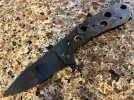
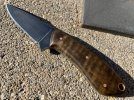
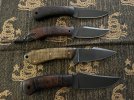
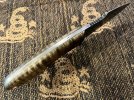
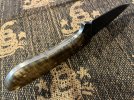
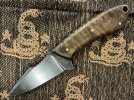
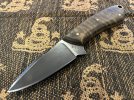
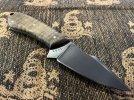
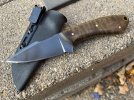
Here are the finished pictures of my Winkler tribute knife. It is shown with a few Winklers from my collection. I have named it Gar and it is the first blade I have made. This was done on a 1x30 belt sander, a cheap drill press, a home made forge, along with some small hand tools.

Thank you to all who encouraged me along the way and to those who provided answers and advice. I learned a great deal during this build and will apply that to future blades. Next up is a Kydex sheath so I can carry and test it daily.
 

Attachments

  • IMG_8304.jpg
    IMG_8304.jpg
    419.5 KB · Views: 6
  • IMG_8303.jpg
    IMG_8303.jpg
    521 KB · Views: 9
  • IMG_8302.jpg
    IMG_8302.jpg
    529.7 KB · Views: 4
  • IMG_8301.jpg
    IMG_8301.jpg
    479.7 KB · Views: 6
  • IMG_8300.jpg
    IMG_8300.jpg
    491.4 KB · Views: 5
  • IMG_8299.jpg
    IMG_8299.jpg
    611.2 KB · Views: 6
  • IMG_8298.jpg
    IMG_8298.jpg
    493.3 KB · Views: 7
  • IMG_8297.jpg
    IMG_8297.jpg
    496 KB · Views: 8
Back
Top