
WIP - Drop Point

Joined
Jan 12, 2016
Messages
192
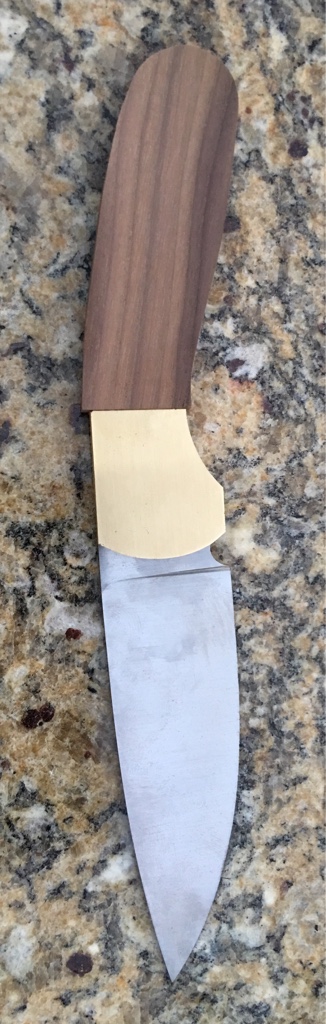
1084 .125" stock, full flat grind. Soft plunge lines. Brass bolster with walnut scales and will use .125" brass pins.
59aa66e4687c67cefa550ae97d0b8783.jpg


So I'm ready to drill the holes next and then on to heat treat etc etc.

Question is I see often people drilling multiple holes in the handle to alter the balance and aid in glue up. How does one go about it to determine the size and number of holes? Is it just trial and error?


Sent from my iPhone using Tapatalk
 
The heavier the handle material the more holes I drill. Bring that you have a bolster I would drill 4-5 1/4" holes. Maybe only 3 as non stabilized walnut is not real heavy. Drill 3 and feel it. If it needs more then drill more. Looks good so far.
 
The heavier the handle material the more holes I drill. Bring that you have a bolster I would drill 4-5 1/4" holes. Maybe only 3 as non stabilized walnut is not real heavy. Drill 3 and feel it. If it needs more then drill more. Looks good so far.

Thanks, I'll start with that then.


Sent from my iPhone using Tapatalk
 
The way I think of it is like such. If you do a full flat grind your removing just about half of the weight from the blade. This means if the blade blank was balanced befor grinding the edge bevels your going to need to remove half the steel from the tang. I do this 2 ways, I drill some holes in a line between my 2 pin holes. Keep the holes away from the edge of the tang. Next if I need more weight dropped I dish out the center of the tang with a 2" wheel on my belt grinder and then taper the tang. This gets me about perfect. I like the balancing point right where my pointer finger sits so you just play with it. Generly speaking you can't lighten a tang to much practically, especaly considering the material we use for handles. Just ALLWAYS keep in mind the structural Integrity and as you remove steel your removing strength. I generally try and remove as much weight as I can if the blade length is at or under the length of the handle. Let me see if I have a pic of a lightened tang to show you.

Here is how I drill my holes, I don't personally care for the Swiss cheese holes you see on some knives with a billion holes all over.
Photo%20Oct%2022%2C%2012%2011%2056%20AM.jpg


Here it is after tapering the tang.
Photo%20Oct%2022%2C%2012%2011%2048%20AM.jpg
 
Why no one taper the tang by the width ? Same direction or vice versa of blade. I think it's easier and more metal you will remove ?
 
The way I think of it is like such. If you do a full flat grind your removing just about half of the weight from the blade. This means if the blade blank was balanced befor grinding the edge bevels your going to need to remove half the steel from the tang. I do this 2 ways, I drill some holes in a line between my 2 pin holes. Keep the holes away from the edge of the tang. Next if I need more weight dropped I dish out the center of the tang with a 2" wheel on my belt grinder and then taper the tang. This gets me about perfect. I like the balancing point right where my pointer finger sits so you just play with it. Generly speaking you can't lighten a tang to much practically, especaly considering the material we use for handles. Just ALLWAYS keep in mind the structural Integrity and as you remove steel your removing strength. I generally try and remove as much weight as I can if the blade length is at or under the length of the handle. Let me see if I have a pic of a lightened tang to show you.

Here is how I drill my holes, I don't personally care for the Swiss cheese holes you see on some knives with a billion holes all over.
Photo%20Oct%2022%2C%2012%2011%2056%20AM.jpg


Here it is after tapering the tang.
Photo%20Oct%2022%2C%2012%2011%2048%20AM.jpg


As far away from the middle of blade you remove metal you have better balance . I would drill two-three more hole behind last pin hole. That place have not affect on structural integrity .......
 
Last edited:
Just a design comment:
The radically curved front of the bolster does not match the plunge or rest of the knife. It creates such a contrast that it draws your eye away from the other more important features. I would make it curve up from the choil as it is now, and go straight up to the spine ( no top curve). That way you get a curve in it, but it still end up parallel to the plunge and at 90° to the spine.
 
Just a design comment:
The radically curved front of the bolster does not match the plunge or rest of the knife. It creates such a contrast that it draws your eye away from the other more important features. I would make it curve up from the choil as it is now, and go straight up to the spine ( no top curve). That way you get a curve in it, but it still end up parallel to the plunge and at 90° to the spine.

I was a little skeptical of that. Wasn't sure if it should be flat or curved. I think your right and flat might look better. Thanks.


Sent from my iPhone using Tapatalk
 
Well I ruined another one. [emoji58]

I was very careful with normalizing 3 times and during first normalize it warped a bit on the spine which I straightened with light taps of the hammer. Normalized twice more and looked good. Then brought to non-mag and held for a bit and quenched. Straight out of quench I checked it and edge had a slight wobble in it. I very very lightly tapped with a hammer around the warp to try and straighten and I cracked it. [emoji34]

https://vimeo.com/188436310


Sent from my iPhone using Tapatalk
 
It looks like you went way too thin before heat treat.
Or am I mistaken and you did some grinding post heat treat?
I usually straighten a warp after the quench when the blade is still hot.
 
It looks like you went way too thin before heat treat.
Or am I mistaken and you did some grinding post heat treat?
I usually straighten a warp after the quench when the blade is still hot.

I did grind some after HT to make sure what I was seeing was a crack after all. I think the edge was around .02". I didn't measure though as I don't have calipers. Or another way is saying it was half a dime thickness it seemed.

The blade was straight of out the quench still warm when I was trying to straighten.


Sent from my iPhone using Tapatalk
 
What are you quenching the 1084 in? Warmed canola oil?
What grit are you using pre-quench?
1/2 of a dime should be fine.
 
What are you quenching the 1084 in? Warmed canola oil?
What grit are you using pre-quench?
1/2 of a dime should be fine.

Using McMaster Carr fast quench oil at room temp.

I ground this one up to about 600 grit. Then after HT I hit it with an 80 real quick just to get de-carb off and see the crack.


Sent from my iPhone using Tapatalk
 
I don't know how violent that quench oil is on the blade. Hopefully someone else can let you know if that's any good or if that's what aided in the cracked blade.
Before I had parks #50 I used the preheated canola with great results.
Your blade may have been cooled too much when you put the hammer to it. I usually use my gloved hand and bend a blade on my forge cart.
 
Well I've 5 identical blades to make so atleast my bolster and handles won't be wasted. On the next on I'll get me a set of calipers and make sure leave a .040 edge on it and see what happens.


Sent from my iPhone using Tapatalk
 
Back
Top