
-
The BladeForums.com 2024 Traditional Knife is available! Price is $250 ea (shipped within CONUS).
Order here: https://www.bladeforums.com/help/2024-traditional/
You are using an out of date browser. It may not display this or other websites correctly.
You should upgrade or use an alternative browser.
You should upgrade or use an alternative browser.
WIP-handle thickness
- Thread starter RALPH B
- Start date


- Joined
- Oct 30, 2002
- Messages
- 3,974
Comfort and purpose. If I'm making a gentleman's EDC, I'll typically go for a thinner handle scale for elegance and to decrease bulk. If I'm making a chopper/heavy use knife, handle retention is more important, so it will be thicker with more shape. I've even had customers ask specifically for thicker handles on my EDC when ordering knowing that they have big hands.
--nathan
--nathan

Bailey Knives
Knifemaker / Craftsman / Service Provider
- Joined
- Oct 18, 2004
- Messages
- 3,818
One sign of a new maker is making extra thick brick like handles. I know because I still have some of my early knives and the handles are too thick and brick like! I like to thin things down and contour them more now. Even some of my bigger choppers will have thin handles in the grip area, with a flare out at the butt to help retention. It will be thicker than my smaller knives, but still not a chunk or brick.

Nathan the Machinist
KnifeMaker / Machinist / Evil Genius
Moderator
Knifemaker / Craftsman / Service Provider
- Joined
- Feb 13, 2007
- Messages
- 18,933
Cardboard cutout and play dough is your friend. Seriously, don't waste your time making handles until you've tried this. You'll probably find yourself designing handle shapes a little differently too.

- Joined
- May 19, 2009
- Messages
- 300
I'm a big fan of balsa wood mock ups. You can buy balsa in different thicknesses just like handle material. Stick it onto your wood blade template or even a steel blade using double sided tape. It's super easy/fast to shape so you can try different thicknesses and contouring. It also gives you experience in how exactly you go about shaping a handle.
Handle thickness just depends on the size of the knife, what the knife is designed for, and the end user. It also depends on the amount of contouring you put into it. If it's fully contoured then you need to start off with thicker stock (3/8" or so); if all you're going to do is round off the corners then thick stock won't be comfortable so you might want to start with 1/4" stock. Something to keep in mind is thicker handles limit wrist movement. If you're building a machete it's temping to make the handle bigger to match but that ends up creating a slower feeling, less maneuverable tool.
Handle thickness just depends on the size of the knife, what the knife is designed for, and the end user. It also depends on the amount of contouring you put into it. If it's fully contoured then you need to start off with thicker stock (3/8" or so); if all you're going to do is round off the corners then thick stock won't be comfortable so you might want to start with 1/4" stock. Something to keep in mind is thicker handles limit wrist movement. If you're building a machete it's temping to make the handle bigger to match but that ends up creating a slower feeling, less maneuverable tool.
Last edited:

- Joined
- Aug 17, 2010
- Messages
- 883
I'm a big fan of balsa wood mock ups. You can buy balsa in different thicknesses just like handle material. Stick it onto your wood blade template or even a steel blade using double sided tape. It's super easy/fast to shape so you can try different thicknesses and contouring. It also gives you experience in how exactly you go about shaping a handle.
Handle thickness just depends on the size of the knife, what the knife is designed for, and the end user. It also depends on the amount of contouring you put into it. If it's fully contoured then you need to start off with thicker stock (3/8" or so); if all you're going to do is round off the corners then thick stock won't be comfortable so you might want to start with 1/4" stock. Something to keep in mind is thicker handles limit wrist movement. If you're building a machete it's temping to make the handle bigger to match but that ends up creating a slower feeling, less maneuverable tool.
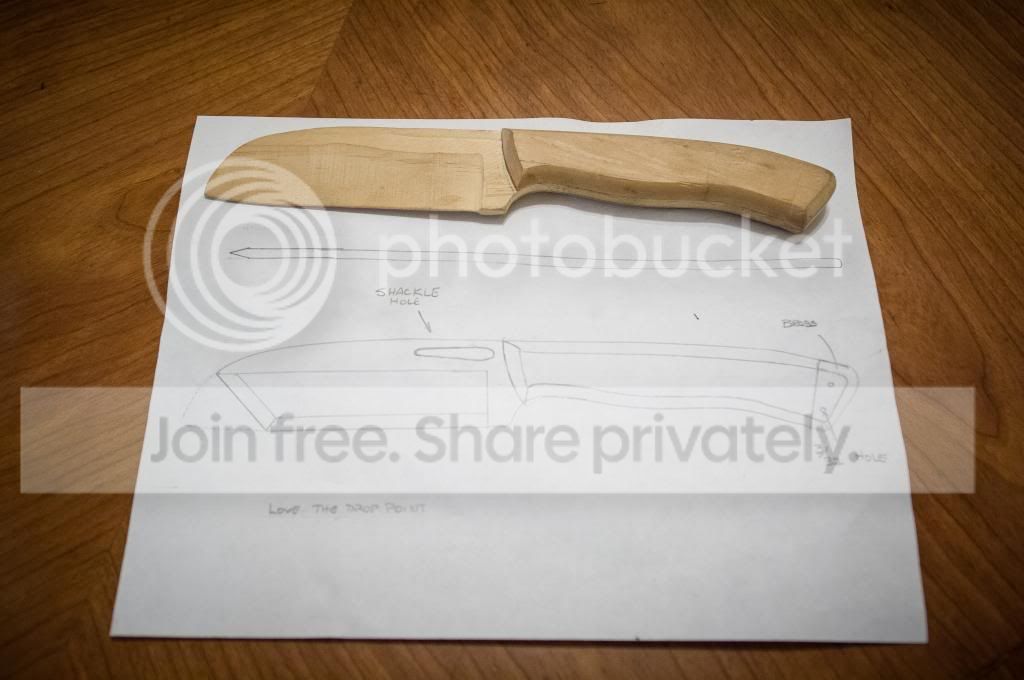
Paint sticks are also a free option. Paint stick knife below. One small and two large sticks.
- Joined
- Oct 3, 2012
- Messages
- 885
Paint sticks are also a free option. Paint stick knife below. One small and two large sticks.
I used to do that when I got bored sans the scales... it's a really good way to go get to know what you'll be making... I hadn't thought about doing the same with scales... I think the next time I do this I'll add some scales (throw some spare stain on there for good measure lol)
- Joined
- Dec 19, 2005
- Messages
- 326
Thinner scales are more refined, usually. It's always a balance with width and design though. Thinner scales make it much easier to make a leather sheath. I think why I'm good at sheaths is cause I struggled with thick handles for a long time. Thin handes are much simpler.