Wiring help for oven

Joined
Oct 13, 2005
Messages
1,236
Not as bad as it sounds! Can anyone tell me which side of the output on my solid state relay is the load side or does it matter.
My relay is a LDG from Auber and it has L1 and T1 on the output side.
Thanks for helping the electricaly challenged!

Bob
 
I say that the top two terminals L1 and T1 are the output

and the bottom are the DC Control input terminals (which is why they give you the + / polarity)

L1 is usually Line which would usually be the "in"

http://www.auberins.com/SSR Series-RS1A.pdf

RS1A40.jpg
 
Last edited:
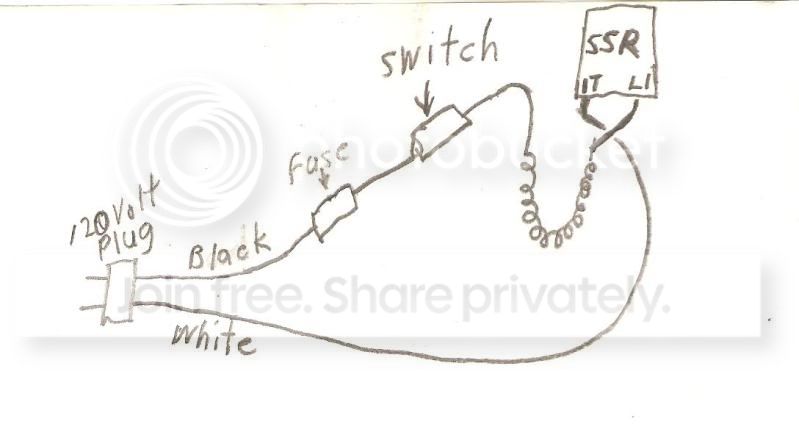
Ok i got it wired up like this is it right or am i back to the drawing board. I want to be sure before i plug it in.
The white is just passing under the black.
Thanks again
Bob
zzzzz205.jpg
 
NO!!!!!

direct short
what are you trying to do?
a relay is a remote contolled or electrically controlled switch
the L1 & T1 will switch power to a load...
applying ~5 to 32 VDC to A1/A2 will open/close the switch (ie, L1/T1)


Ok i got it wired up like this is it right or am i back to the drawing board. I want to be sure before i plug it in.
The white is just passing under the black.
Thanks again
Bob
zzzzz205.jpg
 
I am trying to add power to the element in the drawing but i want it to be switched (on-off) and fused.
No power comes fromm the ssr.
Bob
 
What kind of switch is that and wht are you usung it for?
Is that switch heavy enough to handle all the power ?

I would put a door switch on the SSR input side


I don't see the short cat does
 
I'm with numbers, I don't see the short either. I assume the switch is a failsafe turn-off for the device.
 
in the diagram the relay will never energize/close...the control coil is not wired...
I didn't realize the squiggly was a heating coil
so no short, just won't work
if the switch is a safety, not required, no better safety disconnect switch than unplugging it :D

you need DC (5-32 VDC) to operate that relay, it's rated for up to 40A and 400vac
at 120 vac ~ 4.8 kW

I can't upload yet, I paid for a subscription but not activated yet...

let me know the kW rating of the coil...you most likely don't need the relay
a 15A light switch should do...
 
Yes it is just a switch to turn off the element power and it is a 16 amp 250 volt switch. I also have a fuse and switch going to the pid on a seperate circuit. So is it going to work?
Thanks again guys !

Bob
 
Yes it is just a switch to turn off the element power and it is a 16 amp 250 volt switch. I also have a fuse and switch going to the pid on a seperate circuit. So is it going to work?
Thanks again guys !

Bob

If you are using a 16 amp switch, on a 12 or 13 amp circuit, I would use a heavier rated switch, (but that's just me)

I think you are good to go.
 
in the diagram the relay will never energize/close...the control coil is not wired...
I didn't realize the squiggly was a heating coil
so no short, just won't work
if the switch is a safety, not required, no better safety disconnect switch than unplugging it :D

you need DC (5-32 VDC) to operate that relay, it's rated for up to 40A and 400vac
at 120 vac ~ 4.8 kW

I can't upload yet, I paid for a subscription but not activated yet...

let me know the kW rating of the coil...you most likely don't need the relay
a 15A light switch should do...


You may be missing some background here

He is setting up a heat treat oven, as demoed by a poster on British blades forum.
There is a PDF WIP if you look for it and has been archived other places.

He is using a PID controller and thermocouple, which needs an SSR to handle that type of power load.

The switch can be used to cut power from the elements with the PID on so it can be programmed and such without heating.


Robert, I would still put that cut off switch on the control side of the SSR, but it will work either way.
 
You may be missing some background here

He is setting up a heat treat oven, as demoed by a poster on British blades forum.
There is a PDF WIP if you look for it and has been archived other places.

He is using a PID controller and thermocouple, which needs an SSR to handle that type of power load.

The switch can be used to cut power from the elements with the PID on so it can be programmed and such without heating.

Robert, I would still put that cut off switch on the control side of the SSR, but it will work either way.

so he's using a temperature controller to cycle the SSR...ok, that is important, lol

I wouldn't call that Proportional/Integral/Derivative control though, just on-off, 2 state thermostatic, but I get the drift...I consider PID modulating, ie, varying the current thru the heater, here it's just on-off, correct?
 
The ssr is switching the neutral the way you drew this, which is generally a no-no. Power should go fused black wire to L1 - thru ssr and out T1 - thru coil to neutral white wire.

Best,
Stevo
 
Question, what is the purpose of putting the pid controller on a separate 15 amp circuit? Most controllers are rated at .5 amp or so. I would bring power into your control box and buss/fuse it from there to the various devices (since they are both 120 vac).

Best,
Steve
 
why an electronic PID controller used rather than a line voltage t-stat with capillary sensing element?

so it can be programmed to do varying temps/times? cycling, etc.?
 
Back
Top