
Wiring question

tattooedfreak

Steel mutilater is more like it.
Joined
Mar 12, 2010
Messages
1,014
I have a 1hp motor for my grinder that I wired for 110 (yes, it used a lot of amp) but I have recently moved to a new house and the shop has a dedicated 220 outlet. Im going to rewire for 220 but I had an on/off switch for the 110, can I wire a switch to the 220? Is it as easy as using a push switch (or similar) rated for 110/220 at the middle of the wire run? ie; plug/wire -switch- wire/motor all of my other motors have been 110 and I ran them off of light switches. I just don't want to have to continually plug/unplug my grinder.
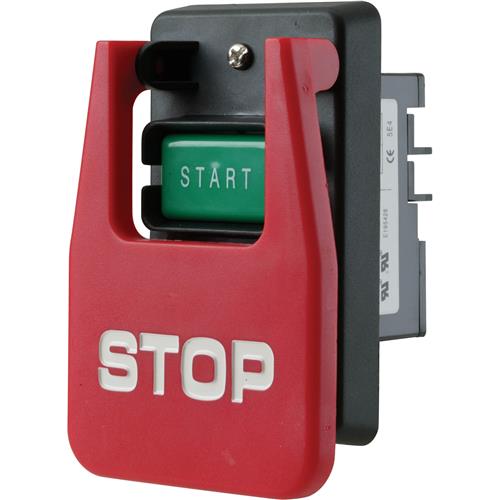
 
This is what you need for 220v. It will cut off both legs of the 220 at the same time which will be better for your grinder and safer
http://www.grizzly.com/products/110-220V-Paddle-On-Off-Switch/H8243
h8243.jpg

Jason
 
Second question, I looked it all over to be sure I bought the right wiring stuff and noticed that it is a double throw 40 amp breaker, with a 50 amp outlet, that shouldn't be an issue should it? I can just hook it up with a range plug and proper gauge wire and be fine, correct?
 
Yes the double POLE 40 amp breaker will work fine with the 50 amp socket and plug ( it is a single throw device, BTW).
For the power on/off, use a switch made for turning a 220 motor on and off. It needs to be a double pole single throw switch. It is usually listed on the auction places as a motor starter switch. If you find one that is for 3 Phase, you just use two of the three poles.

The one Jason posted the link to is what you want and the price is right.
 
If it is already wired with 8 guage wire, 40 Amp breaker and 50 Amp outlet, all you would have to do is connect the right size wire from your motor to the outlet using a 50 A pigtail outlet. It shouldn't have to be 8 guage. I think 12 should be fine if your motor draws 30 amps or less. You might even be able to get by with 14 guage wire if it draws less amps.

A motor wired for 220 will draw half the amps of one wired for 110.
 
Sorry, double pole, I knew it was something like that. :-) It was wired for a kiln as the original owner of the house was a clay artist, so without tearing things apart, I can only assume it is wired properly but I am pretty positive it is. Yeah, at 220, the motor only draws 6.8a but 13 at 110. Without getting into it, do I still need 4 wires to match the switch and plug? The motor is still packed right now but it's new and still has the wiring schematic on it I just want to hedge my bets. Thanks for the help guys. And I can get that switch at Busy bee up the road for about the same price.
 
Just for the record, a 220 volt circuit draws the same total amperage as a 110 volt circuit.....just half on each leg. The advantage is that with the amperage being drawn over two wires, it allows smaller wiring to be used.
I regularly see someone make a post that states that a 220 volt motor uses half the electricity, which is not true. It uses the same number of watts.
 
Stacy,
I don't believe what you stated is correct. You would not draw the same total amperage, just split between legs. Horsepower relates to wattage/power, and power=current x voltage. In your formula you would use twice the power.
Best,
Steve
 
Steve, you are correct. I should have said that the wattage is the same.
Below is the properly edited statement. - Thanks for the catch.

Just for the record, a 220 volt circuit draws the same total power as a 110 volt circuit.....just half on each leg. The advantage is that with the amperage being drawn over two wires, it allows smaller wiring to be used.
I regularly see someone make a post that states that a 220 volt motor uses half the electricity, which is not true. It uses the same number of watts.
 
Sort of. And enough right info for the task at hand.

What is causing the reduction of current on any wire in the circuit is the voltage/amplitude/rms. Twice the voltage, thus half the required current = equivalent power. For this discussion it wouldn't matter if this were in the european version of 230 single phase or our version of 220 single phase (although equipment cares). Put an ammeter on the neutral of a 110/120 vac circuit and it will show the same as the hot. Easiest way to remember this is that it's a "circuit". A dangerous proof of concept would be using 24 gauge wire for the neutral on some piece of 120v shop equipment. You will have a momentary incandescent lamp and resistive heater in that wire.

Best,
Steve
 
Back
Top