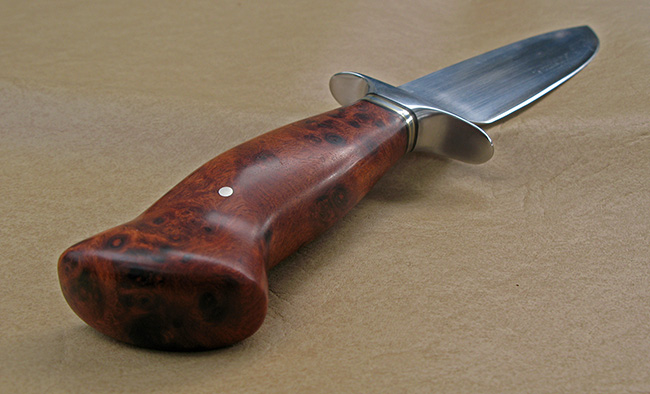
Wood Finish

Interestingly, most finishes labeled "Tung Oil" like Formby's and Minwax don't actually contain Tung Oil! They are oil/varnish blends. Check the cans out and you'll see what I mean. True Tung Oil comes from a tree and doesn't dry very well unless commercial drying agents are added.

I do a lot of furniture making and finishing at home. Here is a piece I made recently (although my wife ordered a gloss finish for this one for the dining room):

Buffet_4.jpg
 
I've been using this lately, and have had good results. I've tried the other methods of wet sanding and buffing (hate buffing knives!!) and this has gotten me the closest to what I'm looking for.

 
I ended up getting some Wipe On Poly. I put about 3 coats on it it turned out great! Hope to post pics soon. I finished my first knife last week, and had 3 others ready for finishing that I'm nearly done with. Hope to post pics soon.
 
John "Hutch" Skierka;14378430 said:
This has its merits, but I'm not convinced by that. By finish do you mean stain and varnish? Or any sort of finish? Tru-Oil and gun stock wax comes to mind. There are MANY, MANY, MANY firearms out there with wood stocks and grips. It does hold true though that everything you apply will eventually wear.

The more care in application, the longer it will last.

I would agree that polyurethane isn't a great choice for a handle.

I am in agreement with Mr. DeShivs. No finish needed if proper hardwoods are used.

Wood gun stocks are generally made of wood materials which do not need coatings. The gun coating finishes are mostly intended to fill and seal the exposed pores of the wood to make the wood more weather resistant and visually appealing.

Yet, I use a gun finish on some of my hard wood handled knives (such as amboyna and snakewood which have a lot of open voids), but it is only to seal the open grain. When I use them, the finish is eventually sanded completely off of the wood handle scales, leaving only finish remaining in the open grain and pores of the wood.

Here's an example. There is no remaining thickness of coating on the knife below which was sealed with "Pro Custom Oil" which is a hand rubbing gunstock finish made by Chem-Pak, Inc.

IMG_7177_650.jpg
 
I am in agreement with Mr. DeShivs. No finish needed if proper hardwoods are used.

Wood gun stocks are generally made of wood materials which do not need coatings. The gun coating finishes are mostly intended to fill and seal the exposed pores of the wood to make the wood more weather resistant and visually appealing.

Yet, I use a gun finish on some of my hard wood handled knives (such as amboyna and snakewood which have a lot of open voids), but it is only to seal the open grain. When I use them, the finish is eventually sanded completely off of the wood handle scales, leaving only finish remaining in the open grain and pores of the wood.

Here's an example. There is no remaining thickness of coating on the knife below which was sealed with "Pro Custom Oil" which is a hand rubbing gunstock finish made by Chem-Pak, Inc.

Yeah, that makes a lot more sense. Didn't intend to rub anyone the wrong way with my post. Basically I think I was just trying to say that polyurethane (If put on too thick) just builds up and will eventually wear off and look funky.

Still haven't figured out why they put that garbage on axe handles. Maybe so the customers think to themselves, "Oh look, SHINY!" I know for a fact that there are handles out there well over 25 years old that weren't coated like that. Probably linseed oil only, or nothing at all.

I had to laugh a little when you said "proper" hardwoods. All that I could think of was that crazy Wranglerstar guy from Youtube. :D
 
John,

Yes, so I am pretty much in agreement with you. I didn't really mean to single out your reply, as much as I wanted to convey that a layer of coating over the top of a knife scale is not desirable or needed, in my opinion.

Thanks,

Mike
 
John,

Yes, so I am pretty much in agreement with you. I didn't really mean to single out your reply, as much as I wanted to convey that a layer of coating over the top of a knife scale is not desirable or needed, in my opinion.

Thanks,

Mike

Nah, I didn't take any offense at all. Everything is peachy.
 
I tested an outdoors marine Oil/urethane from ?????( I can't remember, it was from the wood shop though and a high quality product) on a curly maple knife. I'm glad I didn't send it out on a sold product. Two months in it is dented, scuffed, and wearing through in parts. It just isn't hard enough for a knife handle, no matter how pretty it looked in the beginning. I love a good Danish oil or other oil finish though. I'm going to have to try some of that pro custom oil from Chem-Pak though. That looks like it would work really well on unstabilized maple.
 
Most of the oils are blends nowadays. Unless you go to a specialty store, it is difficult to get pure tung oil. The different brands differ in the amount of varnish and wax mixed in. Tru oil has a high varnish content and gets the highest gloss finish of the oils I have tried. My preference is Watco Danish oil as it is less plastic feeling than tru oil. The gloss of the finish is largely determined bu how well you finish the wood, and the type of wood. With a laquer finish, you rarely go above 320 or 400g, but with oil finishes, the first coat is applied at 400g, and I wet sand each coat in up to the finish I want. I have gone as high as 3000g, but typically stop between 1000g and 1500g. Some woods simply wont polish much more than that. Hand rubbing the oil is important, and final finish is with a paste wax. I think the wax I use is Blue Ribbon. I get most of my finishing supplies from Lee Valley, except the Watco oil from Windsor Plywood.
 
Most of the oils are blends nowadays. Unless you go to a specialty store, it is difficult to get pure tung oil. The different brands differ in the amount of varnish and wax mixed in. Tru oil has a high varnish content and gets the highest gloss finish of the oils I have tried. My preference is Watco Danish oil as it is less plastic feeling than tru oil. The gloss of the finish is largely determined bu how well you finish the wood, and the type of wood. With a laquer finish, you rarely go above 320 or 400g, but with oil finishes, the first coat is applied at 400g, and I wet sand each coat in up to the finish I want. I have gone as high as 3000g, but typically stop between 1000g and 1500g. Some woods simply wont polish much more than that. Hand rubbing the oil is important, and final finish is with a paste wax. I think the wax I use is Blue Ribbon. I get most of my finishing supplies from Lee Valley, except the Watco oil from Windsor Plywood.

I am trying some Watco danish on my bowie handle right now. I have used in the past on stocks and they have turned out very well.
Someone mentioned linseed oil. I used to use this, I was told some time later that linseed oil never truly dries completely. I do still use it on Osage Orange as I have a couple of "Self bows" made out of Osage that I used linseed oil on about 20 years ago and it has turned into a beautiful deep brown.
Willie after a coat dries on the Watco can I light hit it with 0000 steel wool, before I put anothe coat on? That is what I have done in the past with gun stocks.
 
I am trying some Watco danish on my bowie handle right now. I have used in the past on stocks and they have turned out very well.
Someone mentioned linseed oil. I used to use this, I was told some time later that linseed oil never truly dries completely. I do still use it on Osage Orange as I have a couple of "Self bows" made out of Osage that I used linseed oil on about 20 years ago and it has turned into a beautiful deep brown.
Willie after a coat dries on the Watco can I light hit it with 0000 steel wool, before I put anothe coat on? That is what I have done in the past with gun stocks.

You don't need to prepare the surface between each coat. You are not building a film on top of the surface, but impregnating the wood with the oil. I sand between coats with progressively finer sandpaper, but this is because the wood will sand better once the oil is helping support it than when dry, and secondly the oil penetrates better with the pores more open from the lower grits.

I wipe a thin coat on, and keep applying until the oil doesn't soak in any more, then let it sit for 1/2 hour, and wipe any excess off. 24h later I lightly buff or sand, and apply the next coat, once no longer accepting the finish, let sit 30 min, and wipe any excess off. Repeat until no more oil penetrates. The handle will be basically sealed, and I have seen handles done this way that only require a light buffing/touching up once a year or so.
 
You don't need to prepare the surface between each coat. You are not building a film on top of the surface, but impregnating the wood with the oil. I sand between coats with progressively finer sandpaper, but this is because the wood will sand better once the oil is helping support it than when dry, and secondly the oil penetrates better with the pores more open from the lower grits.

I wipe a thin coat on, and keep applying until the oil doesn't soak in any more, then let it sit for 1/2 hour, and wipe any excess off. 24h later I lightly buff or sand, and apply the next coat, once no longer accepting the finish, let sit 30 min, and wipe any excess off. Repeat until no more oil penetrates. The handle will be basically sealed, and I have seen handles done this way that only require a light buffing/touching up once a year or so.

Thanks Willie!
 
Back
Top