Wood spoon sealer ?

Joined
Mar 19, 2003
Messages
524
I carved my first wooden spoon out of a scrap piece of wood a couple days ago using my BH Bushcrafter and need some advice on how to seal it.

I originally thought to leave the wood untreated but when the spoon gets wet parts of the grain raise up and it looks pretty rough.

Is there a product I can seal it with that is also safe for using near food?

Thanks
 
Do you know which wood? This can help to give you the best answer.

Mine are usually maple or birch. After sanding, I wet the spoon to raise the grain, sand again, wet again, sand again, etc. After 6 or 8 cycles of this, when I don't feel any grain raising after the wet treatment, I let it dry thoroughly, and apply food grade mineral oil (2 or 3 applications, wipe excess between with a clean rag). That's how *I* do it but I suspect there's many methods.
 
I actually do not know what wood I used. It was a leftover piece of scrap I found at work. I can probably find out on Monday from my boss since he buys the wood from a local sawmill.
 
]Do you know which wood? This can help to give you the best answer.[/B]

Mine are usually maple or birch. After sanding, I wet the spoon to raise the grain, sand again, wet again, sand again, etc. After 6 or 8 cycles of this, when I don't feel any grain raising after the wet treatment, I let it dry thoroughly, and apply food grade mineral oil (2 or 3 applications, wipe excess between with a clean rag). That's how *I* do it but I suspect there's many methods.

As mentioned above, it can depend on what type of wood. The MOST important part is, are you carving DRY wood, or GREEN wood. I carve green wood mainly. When I'm done, I let it dry for about 3-4 weeks, and then use the same process as stated above with wetting, and sanding. I find that it takes about 3-4 cycles.

Dry wood takes a few more IMO.

You will be hard pressed to find a better sealer than food grade mineral oil. That is ALL I ever use and I have carved 100's of utensils. Good luck and have fun!:thumbup:
 
I actually do not know what wood I used. It was a leftover piece of scrap I found at work. I can probably find out on Monday from my boss since he buys the wood from a local sawmill.

You don't necessarily need to worry about what type as much as was it dry wood, or green wood you carved?
 
If you use oil, like walnut oil, FG mineral oil, veg oil, pure camellia, "salad bowl" butcher block" sealer will google up some suitable products as well.

Then whether green or dry it will not matter. ime a better way to finish is with suitable oil and burnishing. you could sand or scrape smooth prior to.

any finish is not doing to stay put on used wood ware. it doesn't hurt wood to get wet, as long as it dries. add oil buffed in with cloth when it looks like it needs more.
 
The wood I used for my spoon has been In my shop for a few weeks before I grabbed a piece and no moisture came out or was visible during carving. So im assuming that it was dry?


Maybe I will let it sit for another week just to be sure it's completely dry and then I will try wetting it to raise the grain and sanding it as stated above.

Then i will try the food grade mineral oil.

Sorry for my lack of wood working knowledge!! I'm a steel type of guy!!

Would anyone be able to determine the type of wood if I put a picture up?

Thanks everyone for the help!!
 
If it is just a scrap piece of mystery wood, don't use it with food. Alot of store-bought lumber is treated with all manner of toxic chemicals, creosote, formaldehyde etc to prevent rot and weatherproof it. Not the same as grabbing a hunk of wood from the forest, when you know what you're using.

However as far as sealing goes, there are food-safe varnishes and shelacks available, or mineral oils as mentioned already.
 
The wood I used for my spoon has been In my shop for a few weeks before I grabbed a piece and no moisture came out or was visible during carving. So im assuming that it was dry?


Maybe I will let it sit for another week just to be sure it's completely dry and then I will try wetting it to raise the grain and sanding it as stated above.

Then i will try the food grade mineral oil.

Sorry for my lack of wood working knowledge!! I'm a steel type of guy!!
Would anyone be able to determine the type of wood if I put a picture up?
Thanks everyone for the help!!

No reason to be sorry. :thumbup:;) That is what this forum is about from what I can tell, and...... maybe? If you post a pic it might be possible to tell you what it is.

If it is just a scrap piece of mystery wood, don't use it with food. Alot of store-bought lumber is treated with all manner of toxic chemicals, creosote, formaldehyde etc to prevent rot and weatherproof it. Not the same as grabbing a hunk of wood from the forest, when you know what you're using.

However as far as sealing goes, there are food-safe varnishes and shelacks available, or mineral oils as mentioned already.

Haze brings up a very good point here. You'll want to make damn sure it's not a piece of wood that has been treated with a chemical before you go and use it for food handling. Even if you sand it and treat it, those chemicals can soak in very deep.

Edited to add: you can still go through the process though if you suspect it has been chemically treated. It would be good practice, and just pit it in your garage/shop for...... whatever. Then when you get a good piece of green wood, or dry wood that isn't a mystery, you'll be that much the wiser. ;)
 
I'm pretty sure this is untreated wood. My boss buys it from a local sawmill and it's rough cut and pretty inexpensive. We only use it to reinforce pallets and boxes for shipping so I cant see him spending the extra money to buy treated lumber.

I will try and get a picture of the spoon up asap
 
Using "green wood" (freshly cut or oftentimes soaked for awhile to soften the grains) helps in the making process especially when working with extremely hard wood, i.e., mesquite, TX ebony, guayacan etc.. You'll dry the wood then douse it with food safe mineral oil (that's what I use) or natural linseed oil (not boiled linseed oil) or walnut oil or the like. Regardless, once the spoon has been used and thus dipped in water and washed it will start to degrade. In other words, splinters will rise. That's simply the nature of wood. All wooden spoons when subjected to repeated submersion will frizzle up. I've made many hundreds of wooden spoons and frizzing is just part of the deal. On the other hand, you might decide to make a "dry scoop" for coffee or tea or things of like that. You will never wash or immerse a dry scoop and it will always look nice. Remember that all organic products degrade over time when subjected to prolonged water exposure...and that's what you'll get from wooden spoons dipped in water.

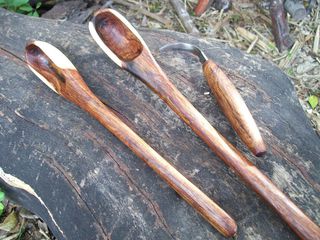
Check out the spoons on this thread. They are dry scoops and look as good today as when I first made them. I made the tools as well.

http://paleoplanet69529.yuku.com/topic/29428/Some-crooked-knives-and-spoon-knives-and-spoons
 
Thanks everyone for the advice so far I really appreciate it!!

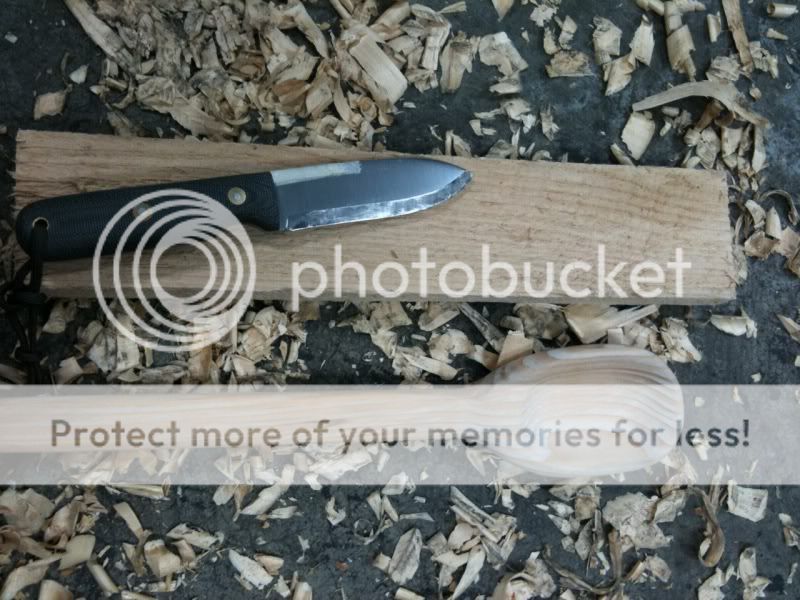
Here is the spoon and a piece of the board it was carved from
photo.jpg
 
Well done!!!!! I like your BHK as well. :thumbup:

The un-carved stock vaguely resembles oak. The carved spoon vaguely resembles ash. Kinda hard to tell. Both are VERY hard, so if it was oak, or ash it would have been a PITA to carve. It also resembles hemlock. That would have been much softer.

There ya go!!!!! Do I have you all confused yet..... I am. :confused:

It's hard to tell without touching/seeing it up close. Sorry I was so worthless. ;)
 
Thanks Cascade!!
haha!! I thought the wood was pretty easy to carve but using a scandi ground knife makes everything seem easy to carve IMO haha.
 
Last edited:
read somewhere in an old swedish carving book about using walnut oil mixed 1 part to 2 parts beeswax. thats what i use for eating utensils and other things made of wood. including an osage orange selfbow. after melting together in a double boiler i pour into an old altoids or other some such tin. it can be rubbed on solid or warmed.
 
read somewhere in an old swedish carving book about using walnut oil mixed 1 part to 2 parts beeswax. thats what i use for eating utensils and other things made of wood. including an osage orange selfbow. after melting together in a double boiler i pour into an old altoids or other some such tin. it can be rubbed on solid or warmed.

You bet. Walnut oil and bees wax is what I use on cups (kuskas) and bowls. If you re-coat them with the bees wax every so often, it will keep them water/liquid repellent. The only problem with this is if you're going to be using the them with HOT liquid. I have found that it can make the wax gummy.
 
Back
Top