
Wood Stabilizer?

Natlek - I created a whole thread for this. Undoubtedly K&G is better/more complete/fills more of the pores. Cactus juice, however, does not do "nothing". One of the people posting said that woodworkers who turn sparled and burled wood use stuff like cactus juice, and it stabilizes the wood enough to allow them to do that. Clearly not as heavy or maybe not with the finish people who make knives are looking for .... but I do not think it is the case that CJ has no place in the market.

(that said, part of that thread was trying to point out that the results obtained are very much process dependent. for the record, I myself would NOT buy from Ebay or Etse that someone claimed was "stabilized". I would not trust their process ... but I would trust K&G). I MIGHT trust my own if I had the time to learn the process. But like many have said - the costs might not make sense given the costs from K&G (resin and the equipment is not cheap).
 
Guys , I don t see that Cactus Juice is out of business ...so who buys it and uses it , IF home setup don t work as most of you say ?

it’s not that CJ doesn’t work, but K&G do a better job using better polymers and a process they have been tweaking for years. For the amount of wood I use it is not cost effective to do it myself. As with anything, there is a learning curve, which can also cost time and money. I also don’t get a lot of shop time with work, family and ‘Honey do list’ coming first, so I’d rather spend my time making knives than stabilizing wood. But don’t be afraid to try it if you really want to, however you will not get the same results and unless you are going through a lot of wood, it won’t be more cost effective.
 
Randy - I have been thinking of giving this a try myself - there are a couple wooded park areas near me (one city, one county), and have been meaning to give a call to the respective park authorities and asking them if it is ok for me to haul chunks of rotten deadfall out.

Question: is there a best time of year to do this scrounging? I had been thinking late summer/autumn ... giving the little bugs time to chew on the wood after falling during the winter snows.....
I just watch and when I see something that looks nice I cut a chunk or two off and take it home. I have the advantage of working in the bush in public lands that I am allowed to salvage on every day. Sometimes I have waited a year or two for a piece or stump to spalt nicer before grabbing a piece. Birch and maple look amazing after a couple years of being down and rotting/spalting. There was a dead maple with a bunch of burls on it in a local city park that the arborist had to drop. I talked to him and he helped me load my truck with burls. I had asked the city a year before if I could salvage the burls when they dropped the dead tree and they told me "no salvaging in parks. Period!" So sometimes it is who you know. The burl blocks I posted earlier are from that tree.

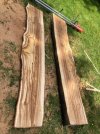
Here is some spalted birch I slabbed out recently. Down 2 years in the bush before slabbing. It was just white birch when I found it at first. Now it looks like this. These will be my countertops at our cabin in 3 years when they are dry.
58058811163__F5485D9D-7173-4991-B159-ADF22F2547A0.jpg
 
Last edited:
After getting burnt soo many times on piss poor stabilizing jobs on blocks from home brew CJ or other means outfits i will ONLY use wood that i sent to K&G or i know came from K&G. The one exception is Larry Davis/Gallery Hardwoods. His stuff is actually BETTER than K&G, and his prices are insanely good. I would send my wood to get stabilized to him as well if he offered it, but he doesn't do other peoples stuff, only his own. Have heard from a few folks that he is who showed K&G how to stabilize wood. Not sure if it's true or not, but yeah his stuff is top notch
 
I live in Europe, where shipping to and from K&G is slow and prohibitively expensive, not to mention hassles with customs, import duties etc. And while there are professional stabilizing outfits on this side of the pond their prices are much higher than K&G's and I don't even know if their process or product is any good. So I've begun to stabilize my own wood.

Here's what I've learned: getting good results requires an investment of time and money, but if done right the results can be superb. Two of the most important factors are getting the wood sufficiently dry (as close to 0% moisture content as possible), and getting proper penetration of the resin, which can actually take several days with most commercially available vaccuum systems. The process is probably too time consuming for folks selling home-stabilized wood on ebay, which is why their reputation is so poor, but again, if you put in the time to do it right your results can be outstanding.

The good folks at K&G have industrial equipment that allows them to stabilize large batches of wood in a very short amount of time. Their results speak for themselves. But this doesn't mean that all home stabilized woods will be inferior. In a way, it's like heat-treating your own blades. You probably don't have industrial-scale equipment in your home shop, but if you take the time to do it right you can still get excellent results. It will just take a bit longer to finish a large batch.
 
One other point worth mentioning: there are two major markets in the world of stabilized woods - knife makers and pen turners. Now think about the type of abuse that your typical pen might be subjected to at the office, and guess which of these markets has higher standards? So buyer beware. Wood sellers catering to pen turners probably shouldn't be relied upon to provide the same level of quality and durability in their woods as those who sell to knifemakers.
 
Agreed - very different uses and wear.
Pen turning wood is usually much less stabilized. The home kits to do turning wood are readily available from places like Woodcraft. The liquid used is similar to CJ. The finish on turned pens is applied after turning with a friction rubbed "French Polish". Pen turners want the wood stabilized for is some strength in turning and moisture related issues. The guys who do their wood at home for pen turning are using smaller blocks and it is often drilled down the center.
 
Question: is there a best time of year to do this scrounging?
I may be wrong, but I'd say, "no". The best time is when you find it and can get it.
My reason for this is that once in your possession, you can control what happens.

If it's not spalted enough, you can bury the end for 6 months or so to encourage that.
If it's too wet and soggy, you can get it out of the weather and encourage it to dry.

If you leave it where it is for 'nature' to take its course, it may be too rotted to be worth anything, the bugs may have had a feast and too many holes, or it may not be there the next time you check on it.
 
Here is some spalted birch I slabbed out recently. Down 2 years in the bush before slabbing. It was just white birch when I found it at first. Now it looks like this.
Randy - nice find! There is a piece of me that wonders whether "spalted wood is spalted wood" (i.e. the species almost does not matter??). so much of the figure comes from the fungal infection.....
 
I may be wrong, but I'd say, "no". The best time is when you find it and can get it.
My reason for this is that once in your possession, you can control what happens.
Good points. I think I will go ahead and ask ... but not sure if I will try to salvage - Between spalted wood from WEO, a few boards of store bought tropicals, and a slab of cherry burl from a guy here in MN, I kind of have a big supply right now.

Its just that this "search for cool wood" thing is almost addictive..... :-)
 
Randy, thank you so much for your advice regarding the shipping/receiving of the wood, much appreciated, there is some very good info and I thank you.
It all looks a lot better than I thought.
The wood that you displayed in your pictures is beautiful stuff, you seem to know which stuff turns out well.
Thanks again Sir.

Mike
 
Wulf, you make an interesting point too.
I am from South Africa originally and I have a friend there who does some pretty good stabilizing himself. It isn't as completely impregnated with polymer resin as the stuff by K&G but it has an attraction of it's own. I suppose it isn't as completely stabilized but it is also good in it's own way.
Gruss
 
As with any craft/hobby - use what you have if there isn't an affordable alternative. If you don't have professional stabilizers in your country, use a good home method like Cactus Juice or whatever the local equivalent is.
 
Back
Top