Wooden bolster on full tang handle

Joined
Aug 1, 2016
Messages
644
I'm a newbie to knife making and my google-fu is weak. I'm making kitchen knives and wanted to make a full tang handle with a wooden bolster and wood scales. I'd like to have a G10 or copper/brass spacer for decoration inbetween the two dissimilar woods. I plan to dovetail to help improve stability. And a G10 spacer between the tang and handle scales.

Should I glue on the spacer to tang, then glue and pin the wood bolster, then the rest? Or does it make more sense to try and glue up an assembled bolster/spacer/scale then drill and glue to the tang?

I guess I'm drunk with success of doing a simple full tang handle with G10 spacer and looking to do a more decorative handle for fun, also a chance to possibly mess up and learn a lot too. Maybe I should just do a simple wood bolster to wood scale dovetail to see if I can even do that before trying to get fancy?

Thank you, always learning a lot by reading the forums!
 
I wanna follow this I've been wondering how it's done. My guess is you epoxy everything together set it on the tang and drill the holes.
 
Since you've not had a "how to" response yet, I'll tell a bit how I glue up a scale using a wood bolster with a spacer between the two types of wood.

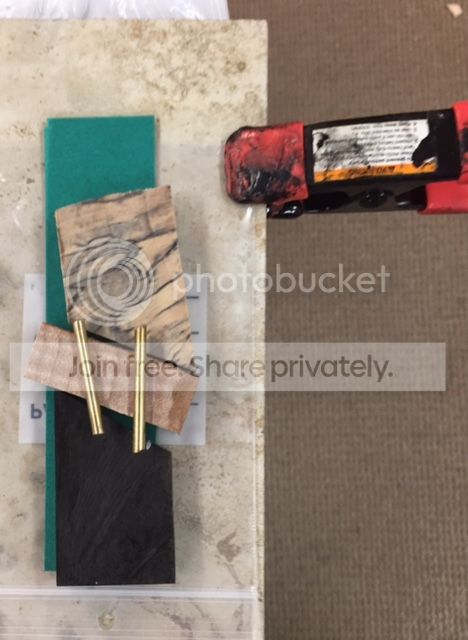
Do all your cutting, sanding, shaping of the joints so they fit together nicely. I'll then drill a 1 (or 2) holes into the edge of the bolster wood that matches two holes drilled in the scale wood. Then drill matching hole thru spacer, put a 3/32" pin thru these holes to hold everything lined up. The holes can be oversized and filled with epoxy if desired for easier fit. When it all fits, I'll then lay all three pieces on the liner to make sure it all lines up similar to photo, but fitted nicely.

Example-2_zpsasombfi7.jpg

Next would be to expoxy everything nicely because sure all holes are filled with epoxy, then insert pins to hold everything in place while clamping. Do NOT sure strong clamps that will squeeze all epoxy leaving a starved joint.

I hope this helps, just rough layout to show the idea.

Ken H>
 
Since you've not had a "how to" response yet, I'll tell a bit how I glue up a scale using a wood bolster with a spacer between the two types of wood.

Do all your cutting, sanding, shaping of the joints so they fit together nicely. I'll then drill a 1 (or 2) holes into the edge of the bolster wood that matches two holes drilled in the scale wood. Then drill matching hole thru spacer, put a 3/32" pin thru these holes to hold everything lined up. The holes can be oversized and filled with epoxy if desired for easier fit. When it all fits, I'll then lay all three pieces on the liner to make sure it all lines up similar to photo, but fitted nicely.

Example-2_zpsasombfi7.jpg

Next would be to expoxy everything nicely because sure all holes are filled with epoxy, then insert pins to hold everything in place while clamping. Do NOT sure strong clamps that will squeeze all epoxy leaving a starved joint.

I hope this helps, just rough layout to show the idea.

Ken H>

Wow that's great Ken I would have never guessed the pins help hold it all together
 
Glad to help, some folks might not use the pins, but still drill the holes and allow those to fill with epoxy, in effect using epoxy pins. Both ways work good, but I tend to like the metal (usually brass because it's easy to work with) pins better.

Ken H>
 
Glad to help, some folks might not use the pins, but still drill the holes and allow those to fill with epoxy, in effect using epoxy pins. Both ways work good, but I tend to like the metal (usually brass because it's easy to work with) pins better.

Ken H>

This is a wonderful idea.. question Ken, do you have a jig of some sort to ensure proper spacing on all pieces? And have you ever had issue with exposing brass while shaping the handle?
 
Glad to help, some folks might not use the pins, but still drill the holes and allow those to fill with epoxy, in effect using epoxy pins. Both ways work good, but I tend to like the metal (usually brass because it's easy to work with) pins better.

Thanks for the info and picture, Ken!

I hadn't seen your reply until now after I already started gluing up some parts. I have a three part spacer copper/G10/copper where I scuffed with low grit sandpaper before expoxying together. I was going to drill holes in the G10 to act as epoxy pin but was afraid I might expose this upon sanding for handle shaping (these will be the spacer between the wood bolster and wood scale). Are you just really careful about the position of the pins so this doesn't happen?
 
YES!! VERY careful about location of holes for pins. I try to place those in the lower portion next to close to liner to be sure the hole/pins are not exposed during handle shaping. Yep, I did learn that the hard way - had my wood fairly thick, drilled in center..... after shaping I had a tiny spot exposed. It was in solid black ebony so I mixed up some black sanding dust with epoxy, used a ball grinder to make a recess, then filled with the ebony dust/epoxy mixture and it "almost" disappeared.

I did rig up a type of jig to hold all pieces in place while gluing up - I'll try to get a photo later today..... maybe after Alabama ball game - SWMBO has Alabama games at top of "to do" list for me during football season.

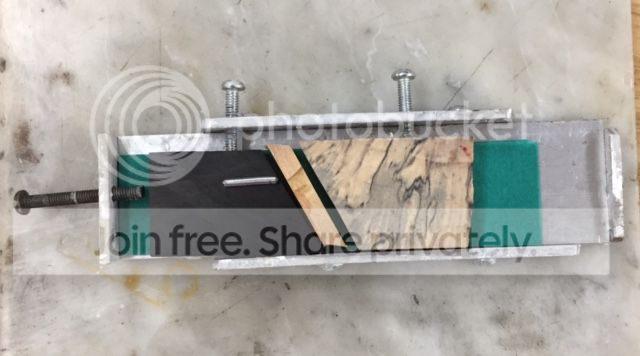
edit to add photo: I think you can see it's just a rough jig, with the two screws on top holding the wood blocks down against bottom rail. In actual use, one block would be a good bit longer so the screw on left would hold blocks all together. I always put a sheet of plastic (saran wrap, etc) between liner and jig so nothing sticks. The pin shows direction of holes in everything - doesn't have to be long - extending thru the center spacer into the bolster and scale 1/8" or so is plenty. I usually use two pins, but suspect one pin would be plenty. Perhaps I should have shown a couple of clamps holding wood pressed against green liner also - a weak clamp is all that's needed, just to make sure the whole assembly is pressed together, but not pressed enough to press epoxy to starve joints.

Jig_zpsi7fvrrmk.jpg


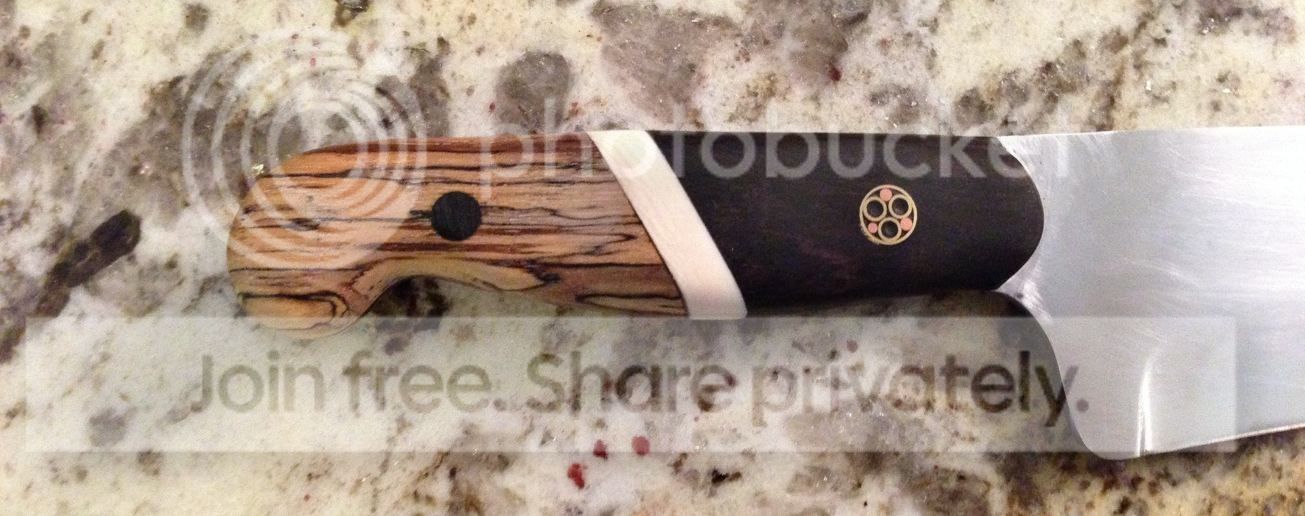
This is an example of finished product - stabilized spalted pecan, mammoth ivory, and ebony.
Inside_Handle-s_zpsxbsgrpqx.jpg


Ken H>
 
Last edited:
YES!! VERY careful about location of holes for pins. I try to place those in the lower portion next to close to liner to be sure the hole/pins are not exposed during handle shaping. Yep, I did learn that the hard way - had my wood fairly thick, drilled in center..... after shaping I had a tiny spot exposed. It was in solid black ebony so I mixed up some black sanding dust with epoxy, used a ball grinder to make a recess, then filled with the ebony dust/epoxy mixture and it "almost" disappeared.

I did rig up a type of jig to hold all pieces in place while gluing up - I'll try to get a photo later today..... maybe after Alabama ball game - SWMBO has Alabama games at top of "to do" list for me during football season.

edit to add photo: I think you can see it's just a rough jig, with the two screws on top holding the wood blocks down against bottom rail. In actual use, one block would be a good bit longer so the screw on left would hold blocks all together. I always put a sheet of plastic (saran wrap, etc) between liner and jig so nothing sticks. The pin shows direction of holes in everything - doesn't have to be long - extending thru the center spacer into the bolster and scale 1/8" or so is plenty. I usually use two pins, but suspect one pin would be plenty. Perhaps I should have shown a couple of clamps holding wood pressed against green liner also - a weak clamp is all that's needed, just to make sure the whole assembly is pressed together, but not pressed enough to press epoxy to starve joints.

Jig_zpsi7fvrrmk.jpg


This is an example of finished product - stabilized spalted pecan, mammoth ivory, and ebony.
Inside_Handle-s_zpsxbsgrpqx.jpg


Ken H>

That's a sweet little jig! I might use that idea. Thanks Ken! As always words of wisdom.
 
YES!! VERY careful about location of holes for pins. I try to place those in the lower portion next to close to liner to be sure the hole/pins are not exposed during handle shaping.

edit to add photo: I think you can see it's just a rough jig, with the two screws on top holding the wood blocks down against bottom rail. In actual use, one block would be a good bit longer so the screw on left would hold blocks all together.

Jig_zpsi7fvrrmk.jpg


This is an example of finished product - stabilized spalted pecan, mammoth ivory, and ebony.
Inside_Handle-s_zpsxbsgrpqx.jpg

Thank you for sharing your knowledge and experience, Ken! Your photos make it especially clear, even for a dummy like me.


Post some progress pics

I took your suggestion and posted this for what I did so far:
http://www.bladeforums.com/forums/showthread.php/1447051-Newbie-second-knife-WIP

Also saw you said in another post that you're close to Ocala, and I'm a Gainesville resident, small world! :)
 
Thank you for sharing your knowledge and experience, Ken! Your photos make it especially clear, even for a dummy like me.


I took your suggestion and posted this for what I did so far:
http://www.bladeforums.com/forums/showthread.php/1447051-Newbie-second-knife-WIP

Also saw you said in another post that you're close to Ocala, and I'm a Gainesville resident, small world! :)

Hahaha yeah ithat is. I'll be heading up to ft white in a couple of weeks to get a motor off craigslist.
Your knives look great man. Alot better than what I've been producing
 
Back
Top