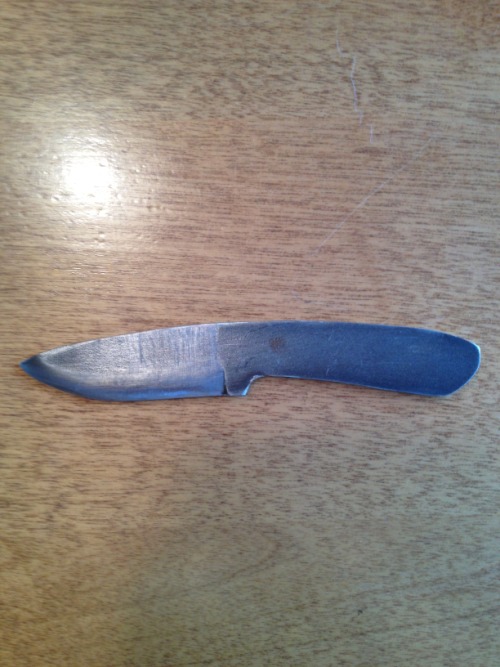
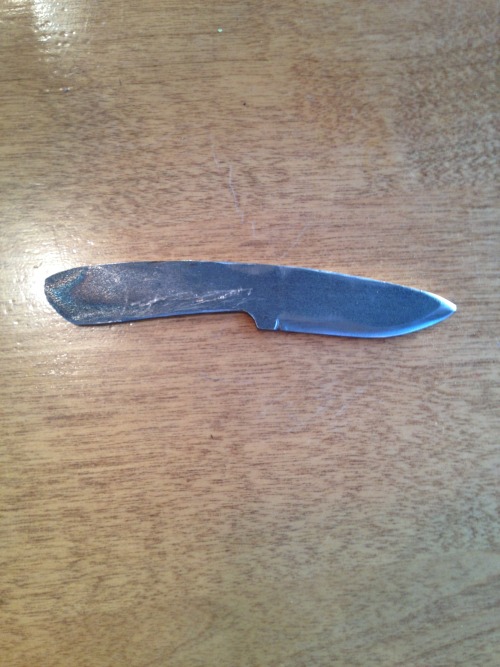
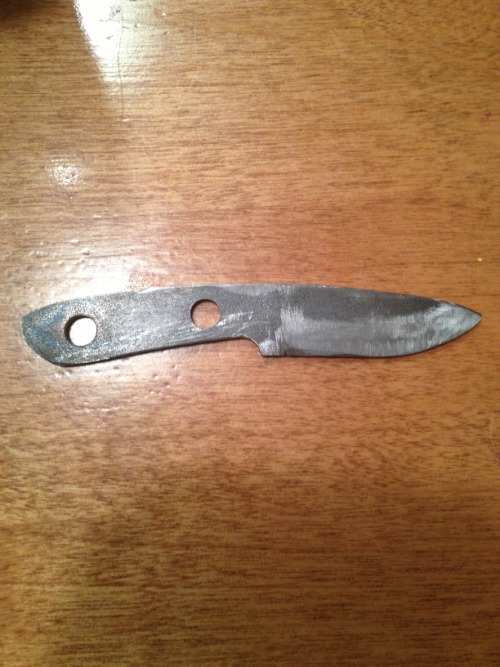
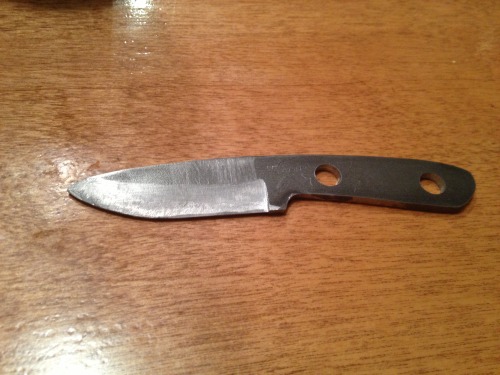
Work in progress... Fresh off the grinder

Joined
Jun 13, 2012
Messages
86
I'm starting what will hopefully be my first "good" looking knife, so I'd like to ask for your help and criticism along the way to make sure it comes out right...
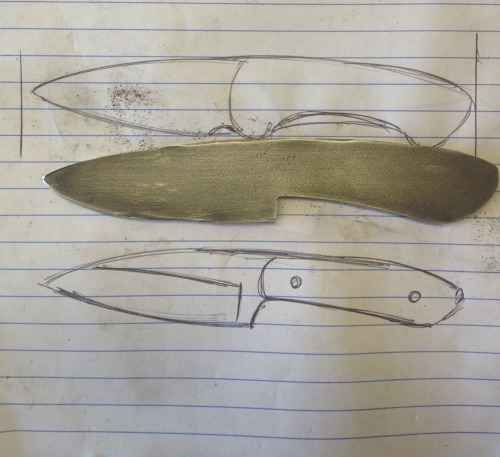
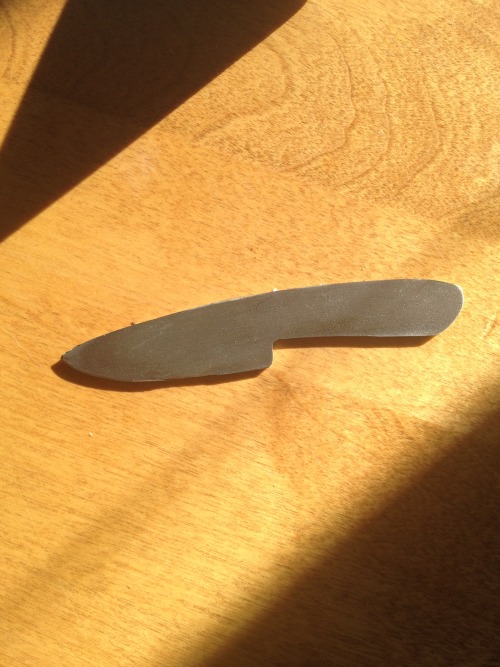
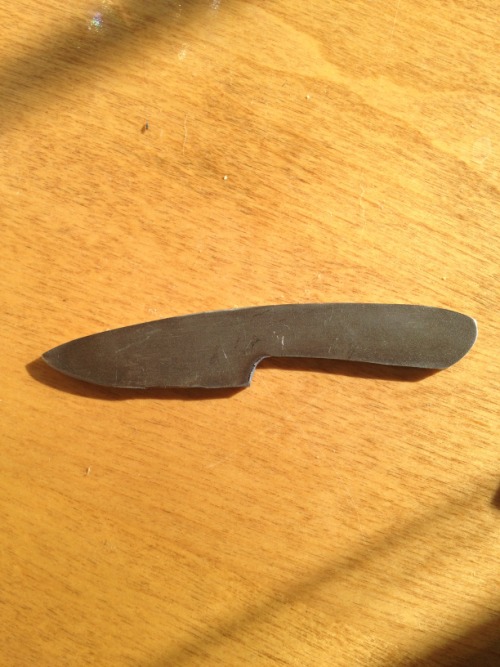
Here it is so far.
tumblr_mjesy0dTKX1rdxad1o1_500.jpg

(The bottom one is the design for it)
 
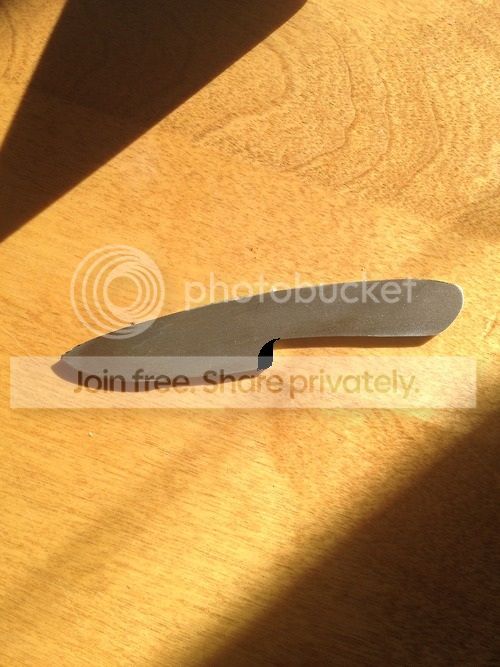
Your handle will be much more ergonomic if you grind, file, etc. the part I blacked out here off.
Poorkid_zps4c61d5a3.jpg
 
Last edited:
Bad.

That's the first thing that come to mind, I absolutely do not wish to be offensive but rather to say what I think and offer advice if it will help.
The most obvious thing is that the grinds are of different height on each side. There are grinding scratches up onto your flat on the mark side, and the flats are not ground clean. I don't know what the stock thickness is, but if it's 1/8" or more, that blade is way too thick if left with grinds that low. Your grinds look to be sort of uneven/convex. In fact, other than the small plunge cuts, there are no grind lines to speak of.
What are you grinding with? Depending on what you are using, you may be better off trying with files to get a flat grind. If you are using a 1x30 or something, getting lower grit, new sharp belts, will help.
What kind of steel are you using? Is it fully annealed?
 
I'm not sure what you are trying to accomplish here. It looks like you are hand filing, which is fine. Everyone has to start somewhere, and there are even a few makers who are content to work with only hand tools. But from what I see, you need to learn to slow down and control the tools you are using. It looks like your files (or belt sander, or whatever you are using) are jumping around all over the place. I see scrape marks on your flats, some shiny areas on the spine, marred areas on the ricasso, etc., that tells me you are filing or grinding where you don't want to be. Your "plunge" is poorly defined, which tells me that if you are filing, your arms are flopping all over the place and you can't keep it on the same track, or whatever belt sander you are using tracks so poorly that the plunge is washing out. (If the latter is the case, then give up on that machine and learn to use a file).

Posting every hour or so with pics and a comment like "Hey, how does this look now?" really isn't a constructive use of anyone's time. I presume you know what a knife should look like and what it is supposed to do. Do your homework, learn to control your tools, go make a knife, then use it and decide whether or not you are happy with what it does and what it looks like. If, at that point, you are not sure what to do next to correct anything you don't like, then there are a ton of makers here willing to help.

 
It looks like one side of the blade has a fairly well defined grind line but the other side is real messy. It is hard for me to get sharp, even grind lines as I seem to have a tough time holding the blade at the same angle each time I apply it to the grinding belt. Using a jig of some sort to hold the blade at the angle while grinding is one way of getting consistent grinds. Or use a "bubble jig" that tells you when you're holding it at the right angle.

I suspect one reason some people use convex grinds, or single-side grinds is because it is difficult to get a consistent, even flat or concave grind on both sides of the blade.

I find that the first part of grinding goes relatively fast, but as the grind climbs up the side of the blade and the angle gets smaller progress slows down and it gets more difficult to hold and apply the blade to the belt.

There is no crime in using a grinder for a part of the blade and finishing up with files. The point is to make a good knife not win a race.

It is possible to improve your plunge lines by making them with a file before grinding. I use a 1/8" round file to make mine. You could probably clean up your existing plunge lines with files since you have plenty of steel yet to play with.

Best of luck with your project.

- Paul Meske
 
Hi there! I'm pretty new to knife making and I tend to go at it from the "cheaper is better" method of operation. If you are doing the same and only using the tools you can scourge up, I recommend you sacrifice one of your files and grind off the edges of it, leaving the faces as pristine as possible. Use this modified file to cut your plunge line. It will really help get them clearly defined... At least it has for me...
 
Back
Top