Would this blade shape work?

Joined
Jun 17, 2006
Messages
578
Hey everybody, I have been carrying a tanto blade lately and love how the thing cuts at the junction of the two edges. So this is what I came up with. Looks like it would be a slicy son of a B . But once I thought about it for a sec, it occurred how hard this sucker is probably going to be to grind! What do you think about it? Thx
20131220_151252-1_resized_zps5f24ef62.jpg
[/URL][/IMG]
 
Yes , that overall blade shape would work . However , in your drawing you have omitted the line separating the two planes of the grind . What I mean is where the two facets join at the corner of the edge. Know what I mean?
 
Yes , that overall blade shape would work . However , in your drawing you have omitted the line separating the two planes of the grind . What I mean is where the two facets join at the corner of the edge. Know what I mean?

yes. How is that angle set?? should it just be vertical? thx
 
What about a convex grind on the long length and a flat grind on the tip portion?
 
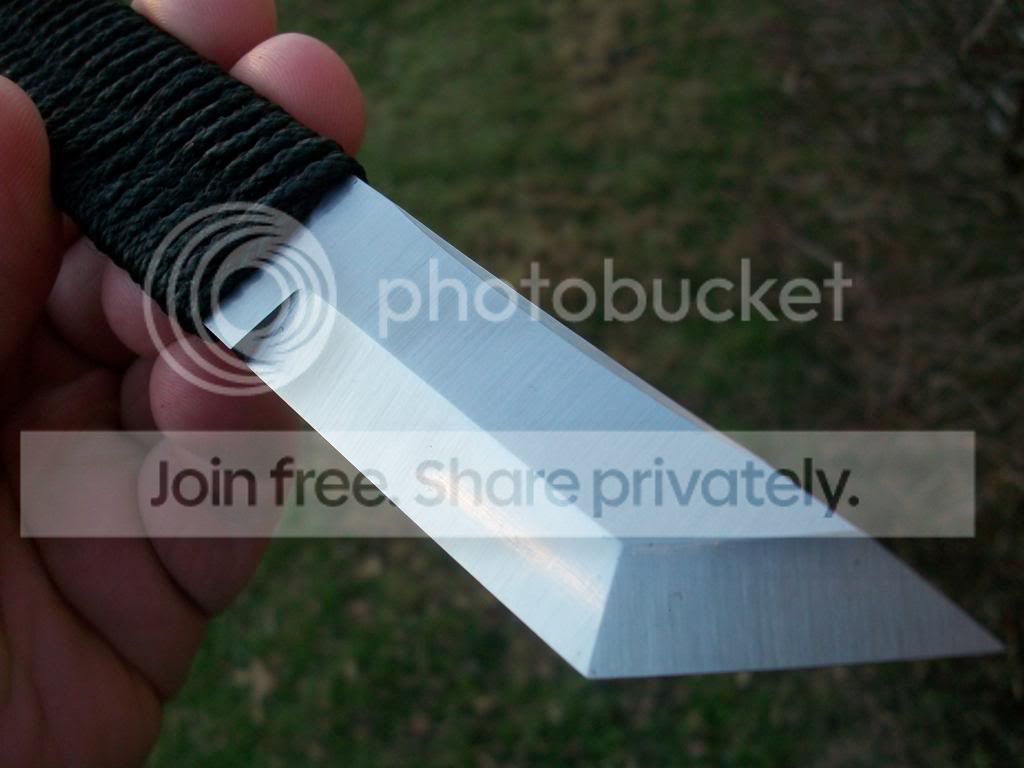
That line is the yokote on a Japanese blade. PT Doc's idea is a great one. The convex grind would give a nice gently curved yokote and would lend slightly different utility to the two cutting edges. That is going to be my plan when I make my own interpretation of a Razel. The original ones had two hollow grinds, I think. But like me, I suspect that you do not have access to a nice grinder with a large wheel. So it's convex and flat grinds for us. Hollow grinds are pretty but I like flat and convex better for use anyhow. Draw it ten more times and see what you end up with.

I went back and looked at your drawing and I'm not sure you would like how the front end of the blade would look with the current design. I believe that you have the bottom edge angled sharply so as to project that little point at the tip of the yokote. I carry an americanized tanto bladed knife everyday and like that little point too. I think though that the yokote would be at near to a right angle to the bottom edge therefore giving very little real estate from the yokote to the tip for that bevel. That front bevel can be long and thin for a super sharp chisel effect or short and thick for robust chipping or scrapping or wedging into stuff like you shouldn't. Perhaps a maker with actual experience making such a knife will chime in to educate both of us.
 
Then again...


DSC_0611_zpsd6ca4fb8.jpg


When I hold a right angle up to it there seems to be plenty of tip to bevel.
 
On second thought, hollow grind the long portion then flat grind the short. I like the lower point between the 2 flats. Maybe mske a few variations. I'd love to see it.
 
thanks for the input! ya, I think I may be in over my head with this design. I need alot more practice in general, and a grinder with a contact wheel before I would feel comfortable trying this design. This one is going up on the shop wall to try later...
 
On second thought, hollow grind the long portion then flat grind the short. I like the lower point between the 2 flats. Maybe mske a few variations. I'd love to see it.

+1

For compound grinds a hollow with a flat forward is the most appealing to me. The junction line is curved and I believe it's a complex design. Certainly nothing I would try without a lot of experience doing both grind types.
 
Ok. Here's how this works.

Its a matter of blade positioning and parallels. Get a sharpie marker and draw a horizontal line directly onto the belt that is on your platen. Use your tool rest or a machinists square. I got a piece of glass and drew your blade shape on it. Here's how to approach this grind. This is how I'd do it anyway.

Line your edge up with the horizontal line that you drew on your belt. This will establish your hand position.

65BCF7A1-A1A2-43EE-84DD-595131EBDB24_zpspvzeevee.jpg


Grind your main bevel all the way straight across. Don't worry about the tip at this point.

713551AA-D2B5-4449-BC9C-62A7B86F5B6B_zpslsj5wpij.jpg


Here's what your ground bevel could look like

10412719-9994-4FDF-847F-E33002B62EF6_zpswmh5oeg3.jpg


For the tip, it's the same idea. Line up your edge parallel to the line you drew on your belt. This is now your hand positioning for your tip grind.

E52D4C4E-57F3-4EC1-A7FC-11433EF974C9_zpsio3fc591.jpg


If your edge thicknesses match on both planes, you will get a even yokote line that you want.

AC25AD47-F32D-411F-95A5-34FCDCF81579_zpsewwrcdw6.jpg


AB3AAF25-54B3-42DA-B3A0-A70D9341F0F5_zpsbo76evea.jpg


100_0672_zpscdd7d584.jpg


Hope this helps! Good luck with your grinding!
 
Sick! You make it seem so easy. Lol. I will definitely be trying it using your method. Is the tanto in the pic a chisel grind? If I wanted to do both sides, what thickness would you use? Thanks you and everyone for all the help and suggestions. .
 
Pretty tough to grind these things sometimes. I use my tool rest for the main bevels. Lay the spine of the blade on it for support. The knife pictured is a chisel ground knife. It works the same for a double grind. How thick really depends on if you grind hard or not. For an annealed piece of steel, I'd grind maybe a dime's thickness on the edge. Hard steel goes to near zero. The edge thickness on both planes must be even for the yokote to line up.
 
Excellent advise guys. I really like the design. I have never used any jigs or rests everything is free hand. To me the compound grind tantos are some of the easiest to do with good hand eye control and practice you can keep the grinds straight and the meeting point will just happen. Here is one I recently finished. Its 3/16" cpm3v chisel grind. It is similar to what your grind might look like finished.

 
Back
Top