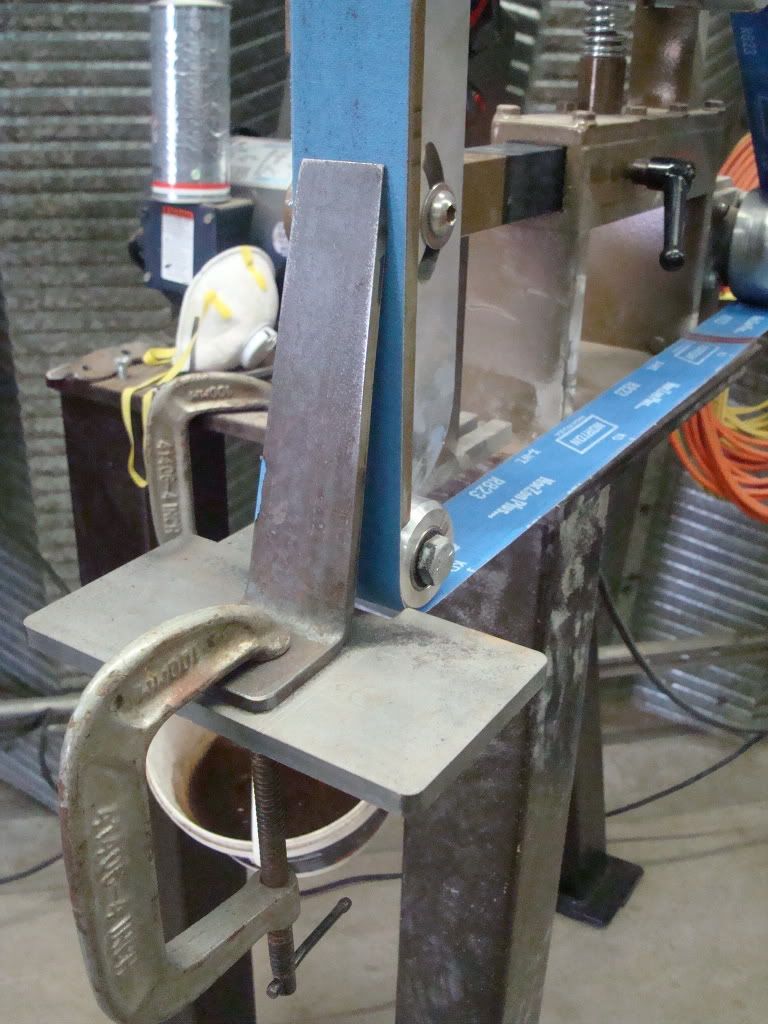
First of all, I don't want this to turn into a debate on the use of jigs. I understand both points of view and I guarantee you that my first attempts will be free-hand but with the amount of cash I have put into this venture I really need something to fall back on if I suck free handed.
Basically all I have left to purchase is some safety gear and I'm still looking for a good deal on a used drill press. After that I'll be good to go. My KMG is all set and runs great! So...
I have read tons of posts on knife making and watched lots of vids. The only part of the process that has me doubting my abilities is grinding the bevel. What I would like to make are large fixed blades so that is what I hope this jig would aid in. I see immediate problems in this jig on smaller blades where the edge doesn't stay parallel to the spine for very long but that's not an issue for me.
I started with some rather complex ideas and plans but kept going simpler and simpler and here is where I am now.
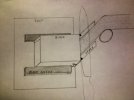
Sorry for the crappy drawing but I'm no artist and only had a pencil with no eraser and a book to use as a straight edge, but I think I get the idea across.
The material list is: 4"x1" block, (2) .5"x3" pieces of mild steel, and whatever to use as a block guide. That's it. The fence needs to be at 90 degrees to the work rest and the bevel angle would be set by adjusting the platen. Let's say toeing it in 4 degrees for my purposes.
The block would be under some pressure in the block guide but would be able to slide closer to the belt after each couple of passes. The lower edge of the blade would need to be kept firmly against the fence and the problem here is that maintaining that pressure would be increasingly difficult as the bevel is brought down towards the spine (less surface area in contact with the fence) but then again it may not be a problem since, once the initial bevel is created and large enough, there should be adequate suface area there to self align with the belt. I have some rare earth magnets just lying around at home and I was thinking of mounting them flush or behind the bottom of the fence to pull the spine in (black dots in pic). I dunno, like I say, it may not be necessary. One hand would be kept on the block with knuckle pressure towards the center of the belt on the spine. As the blade is pulled across and the tip gets nearer to the belt the handle is brought down, keeping the edge high and the spine only contacting the trailing (or would it be leading?) edge of the block.
I hope I explained it okay.
I will either make this jig and try it or defer to your expertise and scrap the idea if it's garbage. So, will it work?
Basically all I have left to purchase is some safety gear and I'm still looking for a good deal on a used drill press. After that I'll be good to go. My KMG is all set and runs great! So...
I have read tons of posts on knife making and watched lots of vids. The only part of the process that has me doubting my abilities is grinding the bevel. What I would like to make are large fixed blades so that is what I hope this jig would aid in. I see immediate problems in this jig on smaller blades where the edge doesn't stay parallel to the spine for very long but that's not an issue for me.
I started with some rather complex ideas and plans but kept going simpler and simpler and here is where I am now.
Sorry for the crappy drawing but I'm no artist and only had a pencil with no eraser and a book to use as a straight edge, but I think I get the idea across.
The material list is: 4"x1" block, (2) .5"x3" pieces of mild steel, and whatever to use as a block guide. That's it. The fence needs to be at 90 degrees to the work rest and the bevel angle would be set by adjusting the platen. Let's say toeing it in 4 degrees for my purposes.
The block would be under some pressure in the block guide but would be able to slide closer to the belt after each couple of passes. The lower edge of the blade would need to be kept firmly against the fence and the problem here is that maintaining that pressure would be increasingly difficult as the bevel is brought down towards the spine (less surface area in contact with the fence) but then again it may not be a problem since, once the initial bevel is created and large enough, there should be adequate suface area there to self align with the belt. I have some rare earth magnets just lying around at home and I was thinking of mounting them flush or behind the bottom of the fence to pull the spine in (black dots in pic). I dunno, like I say, it may not be necessary. One hand would be kept on the block with knuckle pressure towards the center of the belt on the spine. As the blade is pulled across and the tip gets nearer to the belt the handle is brought down, keeping the edge high and the spine only contacting the trailing (or would it be leading?) edge of the block.
I hope I explained it okay.
I will either make this jig and try it or defer to your expertise and scrap the idea if it's garbage. So, will it work?
Last edited: