Wow! This is a definite must for my backpack!

Joined
Sep 30, 2007
Messages
20,235
Advertised as "a temporary remedy that stops bleeding fast through the direct concentration of a hemostatic clotting agent." If it works as advertised, this will be huge.

http://www.z-medica.com/
 
Advertised as "a temporary remedy that stops bleeding fast through the direct concentration of a hemostatic clotting agent." If it works as advertised, this will be huge.

http://www.z-medica.com/

Been around for years. It burns like a bastard and is the reason why it hasnt caught on in the civilian world. But it does work. Another product called Celox does the same thing without the high temps.

This is mostly for battlefield tauma as most civilian injuries can be stopped by direct pressure.

Skam
 
That's what I love about this forum - you guys are always a wealth of information. Thanks for the tip.
 
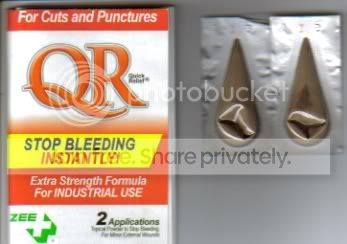
There was a thread on coagulants a while ago. Another one w/o the burning is the stuff I pack:
QRpic.jpg

It's also made of natural materials...ground up hippies maybe?
 
where do you guys get that stuff? I have heard of quickclot, is it the same kind of stuff?
 
None that I've ever found. It's supposed to be hypoallergenic as well, but I don't have allergies so I can't say from experience. The cuts and such that I've used it on seemed to scar even less than with a bandaid, maybe because it excludes dirt and crud from getting into the cut?

I haven't needed it for anything major and that's one field test I'm happy to postpone as long as possible !

I've been getting it from the company that maintains our first aid kits at work. If anyone's interested, I can scan and post the leaflet that describes the composition and directions.
 
I carry both celox and quikclot bandage with me in my PSK/medical kit. Quikclot does have the potential to cause burns. Sometimes it does, sometimes it doesn't. If I have to use granules I like the celox better since there isn't the potential for burning. However when dealing with something that pressure and a tourniquet won't solve (read messy) sometimes its hard to get the granules where they need to go, especially if thats near a major artery. In this case, the bandage is pretty good for getting things where they need to go without worring about things flowing away or being blown away.

Just my .02.
 
Review from the site^
"I work for a large Sheriff's Office in Florida. A few years ago, we purchased QuikClot for every deputy. Since then, our agency has been able to save numerous lives by immediately stopping severe blood loss.
About six months ago, one of our own undercover detectives was shot. Fortunately, his backup quickly used QuikClot. Had they not had QuikClot, I don't think he would have survived. AMAZING!
Since then, our agency has purchased another 1,000 units of QuikClot. Because of its lifesaving benefits, QuikClot has become a priority for our agency.
This product works so well, that I purchased a packet for each of my personal cars. I believe that QuikClot is the cheapest life insurance policy on the market.
I highly recommend this product!!!!!!!!!!!"

 
I saw a Western once when the dude had a through and through gunshot that was bleeding.... he poured gunpowder into the would and lit it.... instant cauterisation.

I think it must have stung a bit though :D
 
wasn't that "the last outlaw''?
I think I'm gonna look into getting some of this for our long distance hikes.I think blood loss is the injury I fear the most in the back country.
 
I saw a Western once when the dude had a through and through gunshot that was bleeding.... he poured gunpowder into the would and lit it.... instant cauterisation.

I think it must have stung a bit though :D

Didn't Rambo do that as well?

I always thought that the NC would either just be too wet to burn, or would have taken his side off. Maybe the wetness just slowed it down enough... :rolleyes:
 
I saw a Western once when the dude had a through and through gunshot that was bleeding.... he poured gunpowder into the would and lit it.... instant cauterisation.

I think it must have stung a bit though :D

that would be a good myth to bust or confirm on Myth Busters on Discovery. But yeah that would be a good idea to have something like this on a hiking trip. Once I fell on a 1" sapling stump that someone had cut down and it lituraly slit my wrist the way i fell on it. It wasnt deep but it could have been.
 
yes some of the older stuff burns likes hell....i havent had to use the new stuff (thank god) so i dont know how it feels...
 
I used the stuff from first aid kit at work on a fellow employee and he said it did not burn and seems to work good,so i keep a few in my 1st. aid kit & it would be used only on large gashes or deep cuts that look troublesome while out hiking or camping.
 
that would be a good myth to bust or confirm on Myth Busters on Discovery. But yeah that would be a good idea to have something like this on a hiking trip. Once I fell on a 1" sapling stump that someone had cut down and it lituraly slit my wrist the way i fell on it. It wasnt deep but it could have been.

Other than outright falls, falling onto broken saplings or brush is one of my feared scenarios in the woods. There have been a lot of loggers injured over the years from sharp sticks and splinters. Many times I have walked on or over blow-down logs with broken off branches all down the trunk. Nasty stuff to fall on-- even clearing the side could get you caught up or sliced on the way down.

Other than outright exposure, falls, falls with impalings, foot and leg injuries, and stream crossings gone bad are the things that would get me into real trouble while hiking.
 
Other than the femoral artery all arterial bleeds can be stopped by direct pressure. Excluding of course massive trauma found in vehicle accidents or war theaters. Not an issue in the bush 99.9% of the time.

If it allows you to sleep at night buy some.

Skam
 
Back
Top