Yet another fine score thread

Joined
Jan 27, 2008
Messages
2,010
In an attempt to fill this entire page with threads about wonderful scores, I'm adding this one. :p

Walrus tusk!!

Today I dropped by my good friend's woodworking shop for some help on a display cabinet I'm building. He disappeared for a moment then returned with these two tusks and said that he'll never use them....do I want them?

"Ummmm....... YES!!"

Ive never used with this product, but plan on using them for knife handles. Does anyone have experience with this stuff? Is there anything I should be aware of prior to working with this material?

Thanks,

Peter

 
Cheap and plentiful Walrus and Narwhal are about the only things I envy you Canadians over.
 
Nice score on the tusk:D

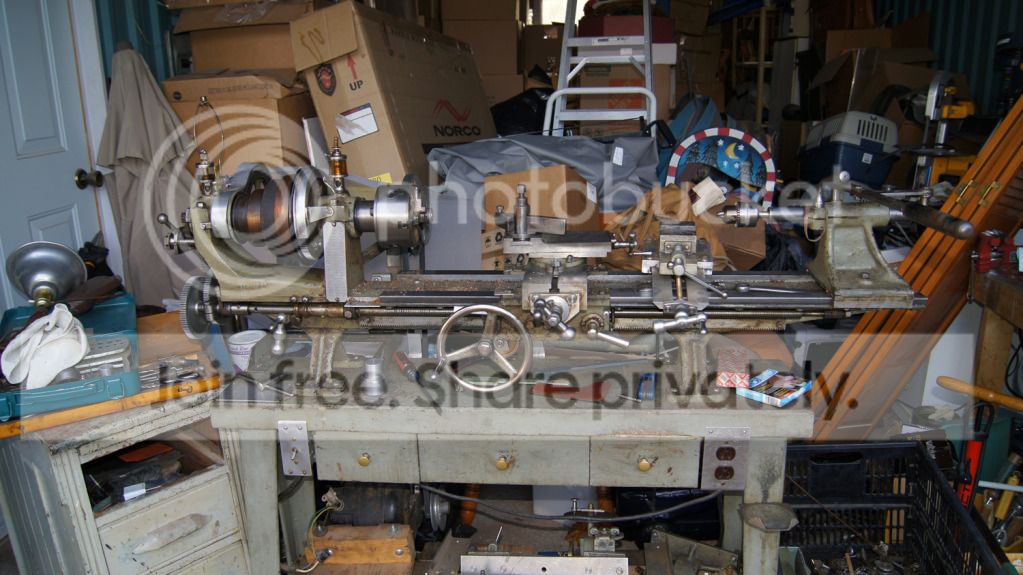
My score happened on the weekend, not sure how much its going to help with my slow knife making, but I was given a pre WWII metal lathe. I have no idea on the manufacture and where exactly it was made other than some where in Europe. Best of all it works and it was free:thumbup:

DSC00986.jpg


The picture is right after unloading it, the little cabinet beside it came with it and is full of all sorts of goodies, brass bars, hex and rounds, stainless rounds, weldable steel flates and rounds, and aluminum of all sorts. There is also a bunch of sheets of brass in there. It also came with all sorts of accessories, bit and end mills.

Yes that space was formally my shop space, but renos took over the space. I reclaimed a good chunk of it on Monday because I got one room finished, only 3 to go now:o
 
Unky that is sick! I'm looking for a nice used lathe that size right now and they don't come cheap!
 
Well, it seems I can't do a damn thing with this stuff!! I guess I'll be making a couple of awfully fine knives for my own collection.

I'm having a tough time finding any direct citations from Canadian sources, but its regulated under CITES and that applies.

International Trade
Under CITES, international trade of walruses and walrus ivory is prohibited with one exception. If the purpose is non-commercial, for instance scientific research, then trade may take place if it is previously authorized by CITES through an import permit and an expert permit.

Marine Mammal Protection Act
The Marine Mammal Protection Act of 1972 protects all marine mammals, including walruses. It prohibits capturing, harming, or taking parts of any marine mammals in waters of the United States or by U.S. citizens when traveling in international waters, with some exceptions. Certain Eskimo tribes are allowed to hunt a limited number of walruses, but only for their own use and not for trade. No other hunting or trading of walruses and their ivory is allowed.

Death by Natural Causes
In the United States, the National Oceanic and Atmospheric Administration (NOAA) says that if a walrus is found dead of natural causes on a beach or within one quarter of a mile of an ocean, then the ivory may be collected by the finder. It cannot be sold for profit, but can be kept by the finder.

I think these are going to be returned!
 
Last edited:
Unky that is sick! I'm looking for a nice used lathe that size right now and they don't come cheap!

There was one stipulation to me getting the lathe, I have to use it. I have been playing around with it, and I am getting a handle on just what I can do with it.

Well, it seems I can't do a damn thing with this stuff!! I guess I'll be making a couple of awfully fine knives for my own collection.

I'm having a tough time finding any direct citations from Canadian sources, but its regulated under CITES and that applies.

International Trade
Under CITES, international trade of walruses and walrus ivory is prohibited with one exception. If the purpose is non-commercial, for instance scientific research, then trade may take place if it is previously authorized by CITES through an import permit and an expert permit.

Marine Mammal Protection Act
The Marine Mammal Protection Act of 1972 protects all marine mammals, including walruses. It prohibits capturing, harming, or taking parts of any marine mammals in waters of the United States or by U.S. citizens when traveling in international waters, with some exceptions. Certain Eskimo tribes are allowed to hunt a limited number of walruses, but only for their own use and not for trade. No other hunting or trading of walruses and their ivory is allowed.

Death by Natural Causes
In the United States, the National Oceanic and Atmospheric Administration (NOAA) says that if a walrus is found dead of natural causes on a beach or within one quarter of a mile of an ocean, then the ivory may be collected by the finder. It cannot be sold for profit, but can be kept by the finder.

I think you are safe as long as they stay in Canada. This guy is selling walrus and narwhal tusks, you may need some sort of special permit though.
 
Peter.
You can legally use and sell it in Canada. No CITIES thing on this. Just don't try to send it anywhere. No its not cheap by the way. It's easy to work but use the usual precaution. Don't get it hot and usually coarse belts are better to get it shaped rather than thinking use the finer ones so that you aren't rough with it. My wife has a small liner lock I made some for the scales. The pieces were a gift from Jeff Deoite Frank
 
Make knives from those lovely tusks and keep them in Canada and you have no problems.

What I mean by cheap and plentiful is that it is available at a realistic price.
Down here the price is crazy, as we are limited to what comes from Alaska or was already here pre-ban. I used to purchase a narwhal tusk for $500. Once I purchased three small ones for $900 ( they are the best for knives). Now they want $15,000 for a narwhal tusk. In Canada they are legally hunted and available for a fraction of that.

Not all that long ago I would buy a set of tusks like yours for $300-400. I would get laughed at by ivory sellers if I offered that for a single tusk now.

At a show recently a person was looking at a knife of mine with a walrus handle. He commented to his friend that a walrus handle added about $50 to the value of a knife. I smiled and just shook my head. I figure it runs at least $200 (cost) per knife for a good walrus handle.
 
Last weekend Saint Gobain had their annual tent sale. I picked up 25 belts more than half are blaze ceramic. 2-100 sheet rolls of 8in sanding discs.
Some sanding sponges, and some sandpaper ranging in grit from 100 to 600. I stacked it up so you could see how much was there, more than 6in.
Price $40.
 
Bummer on that technicality... hope it works out.

Unky, I'm freakin' BLUE with envy on that lathe. I want one real bad right now, too, and can't afford it!
 
First off, not sure a public forum is the best place for that last post Peter. Maybe some editing would do.

Second, maybe your friend wants them back? And maybe that is what you intended to do with them all along, right? Right?
 
This is from Canadianivory.com : Regulations

The walrus and narwhal are primarily hunted for their meat by the Inuit of northern Canada. This hunt is regulated by the Department of Fisheries and Oceans and pilot projects are providing more local autonomy. The tusks provide a secondary resource and source of cash and are not the primary objective of the hunt. The tusks have historical significance in providing the medium for the creation of implements, toys and religious objects. Trade in this ivory and its ownership is legal within Canada.

I can't speak for it's legality, but maybe give them a call and ask them?
 
Back
Top