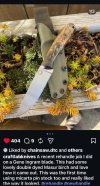
Your thoughts on a maker reworking another makers blade. 🙄

Joined
Jan 23, 2026
Messages
1
My first post as DoubleHKnives. I had been a 15 year member here as Godogs57 when the dual authentication kicked in and flamboozeled me out of existence.

Anyway, on a hunting forum I frequent there was a thread where one of Gene Ingrahm’s blades, owned by a poster was sent to another maker I’m not familiar with. The maker removed Gene’s ivory micarta and replaced with some funky burl wood. It just didn’t pass the smell test to me so to speak……unless Gene gave his permission for the other guy to tear his blade apart and rehandle it, I don’t see how maker two agreed to the refurb request. No mention of blessings given were noted.

As I was mentored by a few makers 44 years back, Heron being one, you never ever take another man’s blade and destroy his creation. You turn down the request out of curtesy. Years ago I had a gentleman that bought my knives and flipped them. In the process, he’d take my sheath and use it on another maker’s blade that had a crappy sheath. I make a very good sheath myself and it po’d me something bad to see my work riding in a crappy sheath. An unsuspecting buyer might think I make dreadful sheaths! We had a very serious conversation about him compromising my blades and I didn’t appreciate that.

What’s y’all’s thought about this. I see to remember in Ed Fowler book about never doing that…..but could be wrong. I think it’s proper business ethics.
 
Last edited:
I have zero interest working on a knife someone else made, so I’d have to decline.

It could also be viewed as deceptive depending on how the knife was represented afterwards.

Seems like a bad idea all around.
 
Ok question? I have a knife from a maker.in another country... The handle cracked and I there's no way I'm sending it back and paying duties out the wazoo...So no one would or should fix this handle for me. 🤔....

I get it and agree with the morality of the idea.but.my whiny ass wants my knife.fixed..😥!!!!!

Always enjoy seeing what's going on here..👌
 
case by case basis... also depending on your skill and competency relative to the rework and the level of the original knife work

in the kitchen knife world, knives are rehandled, thinned, sharpened, polished, reground, etc all the time by someone else other than the original maker.

I can see that you feel strongly in your position, but why does the rework maker need the permission of the original maker Gene? the knife belongs to the owner who made the request, doesn't he have the right to do what he wants with his knife? .. are we missing some details here, was the ivory micarta handle damaged and needed repair/replacement?

here's another one, doesn't seem to me that he did any disservice to anyoneIMG_0801.jpeg
 
Last edited:
If the rework is Quality, and respectfully done, to Non-Historical pieces, I have no problem with it.

I've been asked, and needed to re handle a few knives already, and I've still got a couple more.
 
I repair knives.
If the custom maker is alive and still working, I will not work on their knife.
Otherwise, I take this type of work on a case-by case basis.
I too repair and "restore" mostly vintage knives for locals who still want to use their beat up oldies. I have declined modifying modern knives.
 
I agree with the others. If the original maker is not alive, not making knives anymore, or does not want to repair/modify the knife it is OK for cosmetic work and repair. Modification of the knife shape/style is problematic.
You have to apply some common sense in knife restoration, repair, or modification. No one would even be asking this question if the knife was a Buck/Sebenza/Kabar/etc. Most wouldn't have a problem with working on a knife by someone unknown, If the knife is from a famous maker, it may be worth more damaged as-is than repaired, even if the work done was perfect. Intent is the large point to consider - why is the knife being modified???

OK Scenarios:
1) The tip broke off or blade has a severe chip in the edge - it is OK to regrind the blade into a functional knife.
2) Handle is not pleasing/doesn't fit the owner, damaged, severely worn, etc. - It is perfectly fine to modify or replace the handle. A Handle is basically a consumable part.
3) Loose fitting or broken parts - From swords to folders, they may need to be repaired and modified if heavily used. This is a common practice, and usually done by a skilled and qualified person like Bill DeShivs.

I have repaired handmade knives with damage like these scenarios, including a Moran and a Loveless. I'm sure Bill DeShivs has torn down many high value knives to do a repair or modification.

Not OK scenarios:
1) The owner wants the blade shape changed drastically.
2) The owner wants you to add your name (or his) to the blade.
3) The repair is done so the knife can be sold by the owner.
4) You lack the skills to do the repair/modification.


Disclaimer - I repair and finish knives by Ron Frazier. I purchased/inherited his knifemaking estate and have permission from his widow to do this. Before he passed, I finished or restored a lot of his knives for him to keep income flowing for him and Suzzie. In cleaning up his shop after he passed, I found 100's of dirty/rusty finished knives, partially finished knives, and finished blades that needed hardware. I recovered his sketch books, photos, and papers with his handle and bolster plans for many of these knives, and future projects. I also got his marking equipment and stencil books. If Ron marked the knives/blades, I leave his mark (even if faint) and finish or clean up his work. If a blade is finished but unmarked, and has the handle and hardware with it, I mark it for him and assemble. The partly ground blades and other semi-finished projects I finish in Ron's style and leave unmarked, but provide a provenance certificate. On a rare few that have great value and were unmarked, I use only Ron's materials and mark them, "Started by Ron Frazier - Completed by Stacy E. Apelt - and provide a provenance certificate with photos of Ron's shop and the recovery of the blade. I inform every buyer of all the details and history of the Frazier knife they buy.
 
Broken handle or chipped tip of a production knife? Sure. Custom? Only if the maker is no longer around or there are extenuating circumstances like some noted above. Just my personal philosophy, no right or wrong answer here IMO.
 
Disclaimer - I repair and finish knives by Ron Frazier. I purchased/inherited his knifemaking estate and have permission from his widow to do this. Before he passed, I finished or restored a lot of his knives for him to keep income flowing for him and Suzzie. In cleaning up his shop after he passed, I found 100's of dirty/rusty finished knives, partially finished knives, and finished blades that needed hardware. I recovered his sketch books, photos, and papers with his handle and bolster plans for many of these knives, and future projects. I also got his marking equipment and stencil books. If Ron marked the knives/blades, I leave his mark (even if faint) and finish or clean up his work. If a blade is finished but unmarked, and has the handle and hardware with it, I mark it for him and assemble. The partly ground blades and other semi-finished projects I finish in Ron's style and leave unmarked, but provide a provenance certificate. On a rare few that have great value and were unmarked, I use only Ron's materials and mark them, "Started by Ron Frazier - Completed by Stacy E. Apelt - and provide a provenance certificate with photos of Ron's shop and the recovery of the blade. I inform every buyer of all the details and history of the Frazier knife they buy.
Ron was a lovely man and a brilliant knife maker. I had a chance to have a really good chat with him in 1988 at the US Guild Show in Dallas. He had a beautiful Persian dagger with Elephant skin in the handle and sheath. I wish I would have had the money to buy it. He was a superb craftsman and I still look at his knives whenever they come up for sale on dealers sites.

We have lost so much unbelievable talent in the custom knife world...........
 
I have a good bit of Ron's elephant hide. I'd offer you a piece, but there is no way to send it back to Africa. However, if anyone in the USA with the skills to make a Frazier tribute knife wants a piece to make a sheath or handle, send me an email.
Much appreciated. I'm sure Ron would have liked it to go onto U.S. knives. 🙏 :)
 
So I’ve pondered this and have discussed with others both as a customer looking to have a truly fine tuned piece and as a maker who has worked on other makers knives.

First off once someone buys the knife it’s not yours anymore and they can do anything they want to it.

Do you go back to the dealer you bought your car from and ask them if another shop can put tires on your car?

That being said if someone reaches out to me to have work done on a knife that isn’t mine I ask them if they’ve talked to the maker about the changes they want to have done.

Some makers downright refuse to made modifications to knives they made. One example is there’s a maker who makes very thick crowbar like knives that honestly suck at cutting we’re talking at least .05 BTE with an obtuse apex. He will not grind his knives thinner. So a customer asked me to do it and I did.

Another example is someone bought a knife from a maker and didn’t like the handle and also wanted a tapered tang. They loved the blade design a craftsmanship. The maker wouldn’t rehandle it and they don’t do tapered tangs. So the customer contacted another maker that would.

I bought a knife from a maker that I really liked but after receiving it I wanted the handle to be shaped differently. I contacted a maker who wasn’t really making at the time but knew how I liked my handles shaped. I sent it off to him to have the work done. One of the primary reasons I did that was one he knew what I wanted and maybe even more importantly if the original maker were to do it I would’ve been waiting a year or more to have it done.

Lastly had a customer that a bunch of knives that were done by someone and they were thick behind the edge and the heat treatment was soft. He contacted me to regrind and reheat treat since I’ve proven in the past that I can knock out some well performing knives.
 
Last edited:
I had a Wisconsin Knife maker duplicate a knife Elmer Keith designed. He did a wonderful job except for 2 small details that bug me at least 18 years on. He charged me a ptitance, no complaint, and I asked him to stamp his name on the blade. The grooves for a thumb rest, back of the blade are really ugly, and the guard and the pommel are skewed just slightly off true, one to the other. I would leave his name on the blade in every case. I suspect a fix would cost as much as the original knife. The maker has likely passed, he was a good bit older than I was when he made the knife. Still one of the special ones in my collection, wish I could post photos, but I haven't found an acceptable way to pay for membership. He also designed a small knife to pair with the Keith. If I had it made, I would credit him as designer, and the credit maker as well!
 
Last edited:
I had a Wisconsin Knife maker duplicate a knife Elmer Keith designed. He did a wonderful job except for 2 small details that bug me at least 18 years on. He charged me a ptitance, no complaint, and I asked him to stamp his name on the blade. The grooves for a thumb rest, back of the blade are really ugly, and the guard and the pommel are skewed just slightly off true, one to the other. I would leave his name on the blade in every case. I suspect a fix would cost as much as the original knife. The maker has likely passed, he was a good bit older than I was when he made the knife. Still one of the special ones in my collection, wish I could post photos, but I haven't found an acceptable way to pay for membership. He also designed a small knife to pair with the Keith. If I had it made, I would credit him as designer, and the credit maker as well!
That reminds me I had a customer reach out to have me clone a knife because he wanted it in magnacut but the maker said they wouldn’t use it so he started asking around.
 
I think there’s a big difference between replacing a cracked/loose handle, re-profiling a broken tip or something like that as opposed to completely changing someone else’s overall design. But, even then, I think there’s a difference in changing it to become more suited to the users needs as opposed to making it look “cooler.”

I’d certainly hope someone would have one of mine repaired if needed and keep using it rather than throw it in a drawer to rust out of fear of hurting my feelings.
 
Back
Top