I read opposing views on if ziricote needs to be stabilized. I hear it weeps fairly bad but if I can wait a year, is it worth it. If ziricote works fine unstablilized that would be super. Is it a general rule that wood turns darker after stabilization . If so, I assume you lose the figure on wood that's naturally dark? TYB

-
The BladeForums.com 2024 Traditional Knife is available! Price is $250 ea (shipped within CONUS).
Order here: https://www.bladeforums.com/help/2024-traditional/
You are using an out of date browser. It may not display this or other websites correctly.
You should upgrade or use an alternative browser.
You should upgrade or use an alternative browser.
Ziricote stabilize or not
- Thread starter bluerain
- Start date

Horsewright
Knifemaker / Craftsman / Service Provider
I've used un stabilized Zircote many times. On some hard use kitchen knives too. Its held up very well. My experience its one of those that does not need to be stabilized.

People that believe full hardily in stabilizing will probably tell ya it cant hurt, however my experience is it works great the way it is and its a heavy dense wood that absorbs less resin when stabilized but you will still pay the full weight of the wood upon completion. Basically you will pay alot of money for minimal gains IMHO. I am all for stabilizing and it does wonders for burls and softer woods but when it comes to certain stuff I think its a waste of money personally.


Stacy E. Apelt - Bladesmith
ilmarinen - MODERATOR
Moderator
Knifemaker / Craftsman / Service Provider
I lump ziricote in with ebony, cocobolo, and ironwood....not needing or cooperative with stabilization.
While on the subject this is how to pronounce:
Ziricote - zira-coa(t)-Tay ( alternate sear-uh-coa(t)-Tay)
Wenge - when-Gee
Paduak/Padauk/Padouk - pah-Duke
While on the subject this is how to pronounce:
Ziricote - zira-coa(t)-Tay ( alternate sear-uh-coa(t)-Tay)
Wenge - when-Gee
Paduak/Padauk/Padouk - pah-Duke

I too have used Ziricote that was not stabilized and it has held up to some pretty good use over a year. I use Tung Oil to treat it.
Ryan sent me a couple of leftover pieces of the Ziricote from what he was using a while back.
I had them stabilized by K&G. No weeping and it only darkened about as much as you would get with an oil finish.
Natural Ziricote is prone to the same sort of checking and cracks as ebony if overheated or not finished well.
It is a beautiful wood. When cut correctly it can show cool landscape type patterns.
I am surprised it hasn't caught on with the knife makers.
After reading Stacy's post I felt I should clarify myself.
I am sure weeping can be an issue with some of the stabilizing companies.
Especially if it is a stabilizer that uses one formula for everything.
My only experience has been with K&G.
They use a different formula on dense oily woods than what is used for stuff like maple.
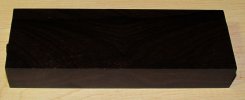
There was a noticeable weight gain in the Ziricote blocks I had stabilized.
This is one I got from Ryan. Just came back from K&G about a week ago.
Last edited:
If the stabilizing places charged according to weight gain of the wood and not total weight after stabilization I would be more tempted to have denser woods stabilized. I just think the way they charge for the service Ill save it for woods that actually need it.
Ziricote is one of my favorite woods, I agree with Mark that the patterns are very impressive on knife handles.
Ziricote is one of my favorite woods, I agree with Mark that the patterns are very impressive on knife handles.
If the stabilizing places charged according to weight gain of the wood and not total weight after stabilization I would be more tempted to have denser woods stabilized. I just think the way they charge for the service Ill save it for woods that actually need it.
I did my own stabilizing for a couple years so I have a different perspective toward the cost of stabilizing.
In my opinion what the stabilizing companies charge is cheap.
What I pay to K&G for stabilizing is less than what I used to spend on chemicals alone.
That's not taking into consideration the labor and hazards.
I figure spending an extra $10 or less to have a piece stabilized is a cheap insurance policy.
Stacy E. Apelt - Bladesmith
ilmarinen - MODERATOR
Moderator
Knifemaker / Craftsman / Service Provider
If the stabilizing places charged according to weight gain of the wood and not total weight after stabilization I would be more tempted to have denser woods stabilized. I just think the way they charge for the service Ill save it for woods that actually need it.
.
This has been my complaint. I send wood in big batches ( 100# or more). I expect to pay for the stabilizing, and like Mark consider the cost a bargain. However, to pay the same to stabilize buckeye burl as I pay to stabilize persimmon seems odd.
These numbers aren't based on actual weighing, but are for example:
A one pound piece of buckeye burl comes back as a two pound block....so it gained 1 pound of resin.
A one pound block of persimmon comes back at 1.2 pounds......so it gained 0.2 pounds of resin.
The buckeye took a large amount of stabilizer, but at $10/Lb fees, cost $20.....which is $20 per pound of stabilizing resin added.
The persimmon took only 1/5 that amount of stabilizer, and cost $12....which is $60 per pound of stabilizing resin added.
I asked one of the stabilizers about it once, and he explained that the only way to make the paperwork bearable was to charge on the final weight. That makes sense in 1-2 block orders were many orders are run at the same time. But running 100 pounds of wood at one time should not be particularly hard to weigh before and after. I suppose that is part of why he gives a discount for large batches. It won't stop me from getting wood stabilized, but it has stopped me from putting in large blocks of very heavy wood.