
-
The BladeForums.com 2024 Traditional Knife is available! Price is $250 ea (shipped within CONUS).
Order here: https://www.bladeforums.com/help/2024-traditional/
You are using an out of date browser. It may not display this or other websites correctly.
You should upgrade or use an alternative browser.
You should upgrade or use an alternative browser.
2017 Summer Kitchen Knife Kith. WooHoo! My knife arrived!
- Thread starter Willie71
- Start date




- Joined
- Jul 31, 2015
- Messages
- 3,118
Yeah, they even have his picture on the wall.Happy it got there safe. I have a few friends at the post office....lol...
Hope you enjoy the knife.


- Joined
- Nov 21, 2013
- Messages
- 288
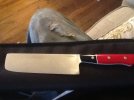
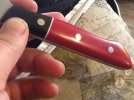
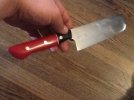 Just got my knife today and it is a beauty... The knife is from Stefan Stromberg, it is a nakiri and is razor sharp. The steel is 01..The fit and finish is perfect, the handle fits my hand perfectly too. I am very pleased with the knife. The choice of handle materials fits the build just right. The red and black micarta with the white liner is a great combination. I am really liking this knife and can not wait to use it. Great work Stefan
Stromberg Knives
strombergknives.com
- Joined
- Jan 3, 2015
- Messages
- 856
Thank you! Good to hear you like it! And I'm amazed the shipping time from Sweden to the hands of Mr Navarro in the states, was only 5 days.
I hope it'll provide enjoyment every time you need to chop an onion.
I hope it'll provide enjoyment every time you need to chop an onion.
- Joined
- Jul 31, 2015
- Messages
- 3,118
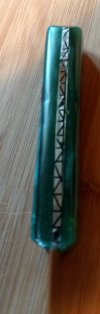
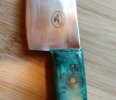
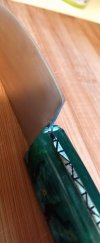
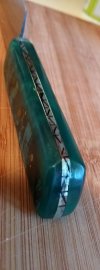
Mine just got here kitchen chopper from Jay Griesser. Thanks Jay.
Last edited:
- Joined
- May 12, 2017
- Messages
- 41
Your welcome, Kevin.View attachment 762628 View attachment 762629 View attachment 762630 View attachment 762631 Mine just got here kitchen chopper from Jay Griesser. Thanks Jay.

- Joined
- Oct 22, 2015
- Messages
- 65
So sad I missed this. I will be on the look out for the next one and hopefully my skills will be up to par.
- Joined
- Nov 23, 2013
- Messages
- 306
I got a priority mail box from Georgia today! It contained a very nice chef's knife from Mr. Fish30114! It cut garden fresh taters and onion quite nicely. I know, taters and onions don't test an edge quite like tomatoes do, but hey, it's what I was already needing to cut up for dinner. Mr. Fish30114 commented that the blade finish wasn't quite as good as he usually likes, and I did notice a few faint sanding lines perpendicular to the blade, but you gotta be looking for them to notice. The handle is very comfortable, and overall fit and finish is quite good. My critique is that the tip of the saya is starting to delaminate a bit. I don't think that's Mr. Fish30114's fault at all, but rather a dramatic humidity change (I've heard that Georgia is kinda humid this time of year, Alaska definitely isn't)
Mr. Fish30114, may I ask what kind of glue you used to assemble the saya? I think I may be able to repair it once the wood has stopped moving.
The details (per the note he included in the box and simple observation):
8" blade from Sandvik 12C27 stainless
Walnut and brass handle
Mahogany and walnut saya with a teak pin


Mr. Fish30114, thank you for the knife, I (well, ok, mostly my wife) will put it to good use for many years!
Thank you all for the opportunity to participate in the KITH!
Mr. Fish30114, may I ask what kind of glue you used to assemble the saya? I think I may be able to repair it once the wood has stopped moving.
The details (per the note he included in the box and simple observation):
8" blade from Sandvik 12C27 stainless
Walnut and brass handle
Mahogany and walnut saya with a teak pin
Mr. Fish30114, thank you for the knife, I (well, ok, mostly my wife) will put it to good use for many years!
Thank you all for the opportunity to participate in the KITH!
- Joined
- Jul 31, 2015
- Messages
- 3,118
View attachment 762628 View attachment 762629 View attachment 762630 View attachment 762631
Mine just got here- kitchen chopper from Jay Griesser. Thanks Jay.
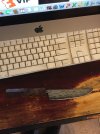
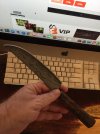
I wanted to reach out to Jay directly, but I don't have his contact information. I feel I should give feedback on the knife I received, as this is the greatest benefit to us for improvement.
Blade geometry: The blade is 1/8" at the spine. This can work for a chopper, although on one of this size I would have gone with thinner stock. I would call this a "rock chopper". As in, using it in a rocking motion to dice vegetables. I'm also leaning this way for the intended purpose of this knife, as the entire edge is curved. Basically, it's all belly. It kind of reminds me an an Inuit Ulu. Since the stock started out fairly thick for this purpose, it should at the very least be a full flat grind. On the face of the blade, this is the case, on the back the grind takes a dive from .20" of flat to the edge. It looks like a multifaceted grind on the back of the blade and the result is reduced cutting performance. More time should be spent getting the bevel closer to zero before sharpening. There's just too much thickness behind the edge.
Fit and finish: The finish is close. Unfortunately, there are 60 grit scratches throughout. It is frustrating to get to a high finish and find low grit scratches, but it's the kind of thing you just have to bite the bullet as soon as you see them and go back to the next grit above those scratches to get them out. It sucks, I know, but there is no other solution. There is interesting geometric embellishment on the tang. This is pretty neat, but it also draws your eye to the large gaps between the scales and tang. Crawl, walk, run. Fancy does not hide basic flaws. Gaps are a pretty telling sign of craftsmanship, and they should not be present on a well made knife. Gaps of this size on a kitchen knife are a big problem as they can actually create a food safety hazard. The gaps here are up to .026" and there is air space, no epoxy filling these gaps.
Handle: I really like the mosaic pins. I have never used them, or had a knife with them and they are really cool. As cool as they are, they are the last thing I noticed due to other issues. The gaps, mentioned above are of course an issue. The scales were described as "stablized maple from Oregon". The scales on this knife appear to be a poured resin scaled with a very thin veneer of wood inlaid near the surface. There are nicks and scratches and the left scale is noticeably thinner than the right. If you are buying these scales and the seller is marketing them as stabilized wood, you should never buy from them again.
To Jay:
I realize what I have written above may seem harsh. It is not intended to be. I love making knives. I can tell by this knife that you love this craft as well. There is evidence of your design and creativity throughout, and it is a disservice to your creativity to hobble it with poor execution. My advice is to get back to basics. Tang- FLAT, Scales - FLAT. Get the grind flat and a bit thinner and you're good with geometry. Get those scratches out. If you aren't making a living making knives, then you (as I) are doing this because you enjoy it. So take your time and enjoy it. You and I have been making knives for the same amount of time (2 years). You can do things that 99% of people can't do when it comes to making knives. Don't leave that last 1% on the table.

Willie71
Warren J. Krywko
- Joined
- Feb 23, 2013
- Messages
- 12,214
I wanted to reach out to Jay directly, but I don't have his contact information. I feel I should give feedback on the knife I received, as this is the greatest benefit to us for improvement.
Blade geometry: The blade is 1/8" at the spine. This can work for a chopper, although on one of this size I would have gone with thinner stock. I would call this a "rock chopper". As in, using it in a rocking motion to dice vegetables. I'm also leaning this way for the intended purpose of this knife, as the entire edge is curved. Basically, it's all belly. It kind of reminds me an an Inuit Ulu. Since the stock started out fairly thick for this purpose, it should at the very least be a full flat grind. On the face of the blade, this is the case, on the back the grind takes a dive from .20" of flat to the edge. It looks like a multifaceted grind on the back of the blade and the result is reduced cutting performance. More time should be spent getting the bevel closer to zero before sharpening. There's just too much thickness behind the edge.
Fit and finish: The finish is close. Unfortunately, there are 60 grit scratches throughout. It is frustrating to get to a high finish and find low grit scratches, but it's the kind of thing you just have to bite the bullet as soon as you see them and go back to the next grit above those scratches to get them out. It sucks, I know, but there is no other solution. There is interesting geometric embellishment on the tang. This is pretty neat, but it also draws your eye to the large gaps between the scales and tang. Crawl, walk, run. Fancy does not hide basic flaws. Gaps are a pretty telling sign of craftsmanship, and they should not be present on a well made knife. Gaps of this size on a kitchen knife are a big problem as they can actually create a food safety hazard. The gaps here are up to .026" and there is air space, no epoxy filling these gaps.
Handle: I really like the mosaic pins. I have never used them, or had a knife with them and they are really cool. As cool as they are, they are the last thing I noticed due to other issues. The gaps, mentioned above are of course an issue. The scales were described as "stablized maple from Oregon". The scales on this knife appear to be a poured resin scaled with a very thin veneer of wood inlaid near the surface. There are nicks and scratches and the left scale is noticeably thinner than the right. If you are buying these scales and the seller is marketing them as stabilized wood, you should never buy from them again.
To Jay:
I realize what I have written above may seem harsh. It is not intended to be. I love making knives. I can tell by this knife that you love this craft as well. There is evidence of your design and creativity throughout, and it is a disservice to your creativity to hobble it with poor execution. My advice is to get back to basics. Tang- FLAT, Scales - FLAT. Get the grind flat and a bit thinner and you're good with geometry. Get those scratches out. If you aren't making a living making knives, then you (as I) are doing this because you enjoy it. So take your time and enjoy it. You and I have been making knives for the same amount of time (2 years). You can do things that 99% of people can't do when it comes to making knives. Don't leave that last 1% on the table.
This is a well done critique. You pointed out areas to improve without being harsh or rude. Thank you for taking the time to do this.
Warren

- Joined
- Jan 5, 2014
- Messages
- 1,495
Hey Alaskan Hunter, I'm glad the knife at least got there, I'm terribly sorry about the Saya, I must admit I finished it up while still under the affects of my stroke which has me with one eye closed--the glue I used was Titebond III and some CA glue in spots actually. I've actually found both to work well in the past. That piece of steel is the same as some I have made several other kitchen knives from and they have all performed very well for their owners, so I hope this does for you, and your wife, as well!
Best regards!
Best regards!
- Joined
- Nov 23, 2013
- Messages
- 306
Thanks, and don't worry about it. I'll give it a week or two to settle down and quit moving, then it sounds like running some thin CA glue in the gap and clamping should cure it. I've heard of guys over on the ABS forum talking about wood moving on test presentation knives, and I always thought "I'm sure they know what they're talking about, but c'mon how much can that wood really be moving?" Well, it moves more than I thought it would/could!Hey Alaskan Hunter, I'm glad the knife at least got there, I'm terribly sorry about the Saya, I must admit I finished it up while still under the affects of my stroke which has me with one eye closed--the glue I used was Titebond III and some CA glue in spots actually. I've actually found both to work well in the past. That piece of steel is the same as some I have made several other kitchen knives from and they have all performed very well for their owners, so I hope this does for you, and your wife, as well!
Best regards!
Maybe this isn't the right place to ask, but how is your recovery going? I didn't realize you had a stroke- I gotta say, that's some impressive work considering that part of you wasn't really cooperating with what you wanted it to do!
Willie71
Warren J. Krywko
- Joined
- Feb 23, 2013
- Messages
- 12,214
Unstabilized wood can move quite a bit from one environment to another. Mahogany and Walnut are more stable than most woods are, but drastic changes of environment can cause problems, especially with wood bought within a year of use. It's still acclimatizing for quite a while. Wood bought from turning suppliers can be especially problematic as slightly wet wood is more forgiving for turners. It's too wet for our use as handles and scales for one to two years from purchase.
- Joined
- Jan 5, 2014
- Messages
- 1,495
Hey guys, I purchased the wood I used for the Saya from Amazon about 6 months ago, so I'm not sure about the dryness level of it, I will say the mahogany in the center cut very easily and seemed pretty 'undry'.... Alaskan Hunter thanks for asking, I am recovering well from the stroke, my eyelid is almost back to being open, but I still have double vision something severe, so I just walk around with my right eye closed all the time, and really am not safe around power tools yet--so sanding and cutting is pretty much out of doing except a little by hand here and there. Anyway I appreciate your thoughts and well wishes 

- Joined
- Dec 1, 2016
- Messages
- 474
I got a priority mail box from Georgia today! It contained a very nice chef's knife from Mr. Fish30114! It cut garden fresh taters and onion quite nicely. I know, taters and onions don't test an edge quite like tomatoes do, but hey, it's what I was already needing to cut up for dinner. Mr. Fish30114 commented that the blade finish wasn't quite as good as he usually likes, and I did notice a few faint sanding lines perpendicular to the blade, but you gotta be looking for them to notice. The handle is very comfortable, and overall fit and finish is quite good. My critique is that the tip of the saya is starting to delaminate a bit. I don't think that's Mr. Fish30114's fault at all, but rather a dramatic humidity change (I've heard that Georgia is kinda humid this time of year, Alaska definitely isn't)
Mr. Fish30114, may I ask what kind of glue you used to assemble the saya? I think I may be able to repair it once the wood has stopped moving.
The details (per the note he included in the box and simple observation):
8" blade from Sandvik 12C27 stainless
Walnut and brass handle
Mahogany and walnut saya with a teak pin
Mr. Fish30114, thank you for the knife, I (well, ok, mostly my wife) will put it to good use for many years!
Thank you all for the opportunity to participate in the KITH!
That's awesome! May I ask the width at the widest point on the blade? Thanks.
Daniel.
- Joined
- Nov 23, 2013
- Messages
- 306
1.8" @ the heel.That's awesome! May I ask the width at the widest point on the blade? Thanks.
Daniel.