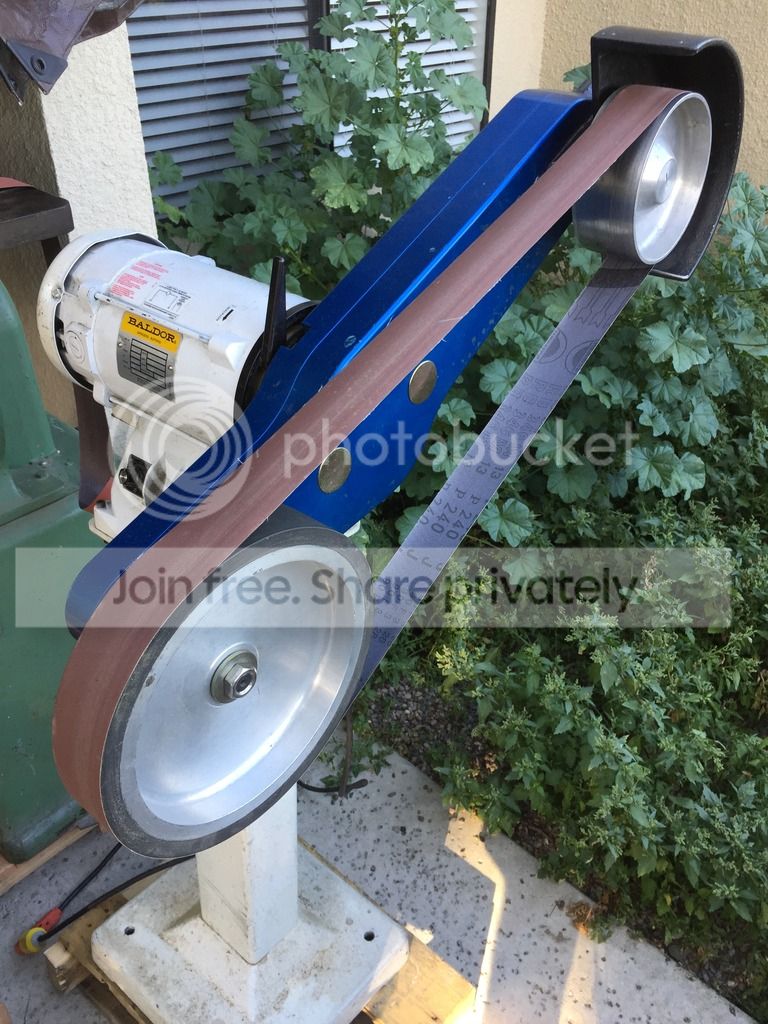
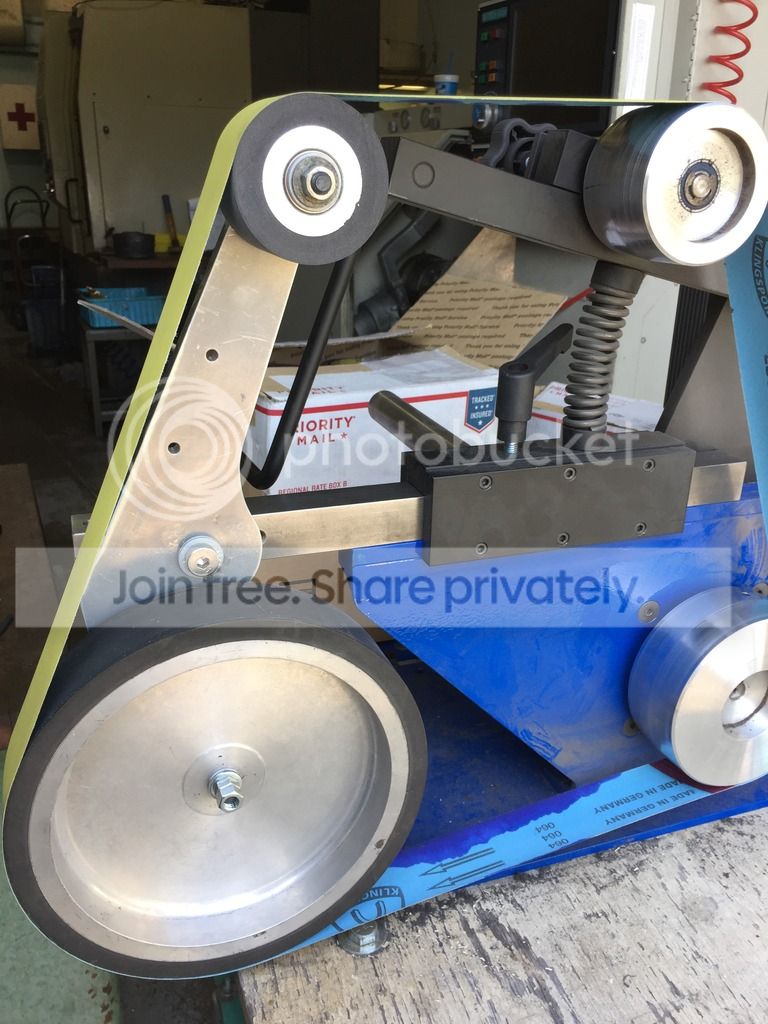
2x72 Grinder

If money was no object, I'd be driving a TW-90. Since I needed a good machine with the ability to spread the expense out over time, I chose to build a Grinder in a Box from Polar Bear Forge.
 
I bought a kmg and it works great, although honestly if I had the money at the time I would have bought the esteem.
 
Are you going to need a surface grinder? The TW-90 will give you that too at the time of purchase or later. I only build liner locking folders and sure wish I had a surface grinder. They are rare around here and most are huge. I'll be moving in a couple of weeks. I shop I'll have for at least some time might accommodate one ,- but that would be it for equipment so the TW-90 would be super. By the way those mentioned are good grinders for sure.
Frank
 
Wilmont TAG-101 or LB-1000 if budget concerns.

The TW-90 is a great option also. It's important to figure out your expectations regarding use.


These two are pretty much the undisputed top end grinders, but they approach things differently. If you've only got the space for one grinder and no big machinery, the TW-90 may be the best option with the surface grinder attachment. If you've got space, and foresee having multiple 2x72's and a real surface grinder (which can typically be had for less than the SG attachment for the TW-90) then consider other options.


I've got 2 TAG-101's, one LB-1000 permanently mounted in horizontal position, and two surface grinders. 1 large hydro-feed 6x18 and one smaller 6x12, which I acquired both (total) for around what the TW-90 attachment costs. I've used nearly every grinder (except for the hardcore maximizer or whatever it's called) out there. Baders of all types, square wheels, of various manufacture, grizzly, TW-90s, KMGs, pheer, GIBs, blademasters, you name it, I've spent time on it. Teaching classes at various schools or working in other maker's shops. Many of these I wouldn't even remotely recommend.

The only things I'd seriously consider IMHO are Wilmont (TAG-101 or LB), Wuertz TW-90, Bader B-III, or KMG. I'm omitting their various "clones", intentionally.


Whatever you choose, if you foresee multiple belt grinders in your future, it's important, or at least, prudent, to make sure they operate in the same ecosystem of tooling. The Wilmonts and KMGs use the same sized tooling arm slots, and are compatible with each other's tooling with minimal or zero reconfiguration. The TW-90 and the Baders use the same tooling arm slots also, but each having only one, requires you to build residuals off the existing tooling arms.


IMHO, and admittedly, I'm good friends with the owner of Wilmont, so I'm biased, but I think the Wilmont LB-1000 is the *best* starter 2x72 available, for the money, but regardless. Especially if you go ahead and upgrade to variable speed. It's less expensive than the KMG, it has two tooling arms, so offers much more versatility, but is compatible with all the tooling from both companies. It offers a large upgrade path, with no fear of depreciated use. You can buy two or three of them for the price of a TW-90 or a TAG-101, which for certain methods, would be significantly more productive.


In the end, you'll have to figure out what matters to you, but I urge you to take first hand information from owners of these machines who've worked with many if you want objective feedback. The KMG is a great machine but I don't think it (personally) offers the best value proposition in the market currently. It's a tried and true design however, with well earned reputation, but much of the recommendations you'll get for it aren't tempered with comparisons to newer offerings.


You can't go wrong with a TW-90 or a TAG-101, but as they're both "flagship" designs, with very different focuses. That's a good thing, but it makes getting the best bang for your buck more difficult.
 
I have used burr kings since 96 I like em much but if ya only plan on 1 grinder wouldn't recommend it they aren't the quickest at changing attachments . If ya plan on 2 or 3 you'll never have a problem and I would recommend . Wise move with the variable speed
 
I have an Esteem and highly recommend it. You can call it a Bader clone if you want but it's nicer than a Bader in my opinion.
 
Can you be specific, what part is better ?

I spent a few minutes on one and didn't find it better than a bader BIII at all. It tracked poorly, and I very much dislike the way the tool rest adjustment works. Seems like it needs 3 hands to adjust. I'm not saying the grinder was junk, but considering it's pretty much a pure clone of the B3, I'm uncertain what could be better about it? Better than a B2 certainly, but pretty much anything is.


Wheel quality on the Baders is top notch also. With the large drive wheel and variable speed setup they produce very nice top end SFPM, and because of the gentle crown, belts ride exceptionally flat across the platen (like the TW-90). Although it's still no comparison to a 3hp TAG with a 6" poly coated drive wheel (no slippage), which is the only setup I can't stall when flat grinding.


I have used some really clapped out Baders at some of the schools, but that's not a fair reflection on the machines, the motors were just completely worn out. Both the Bader and the Esteem come with freakin angle iron flat platens also, that pretty much suck, and need to be replaced first thing, if you don't want to be struggling with plunges. Personally I wouldn't recommend buying a Bader though unless you can find a good deal on a used one.


Anyway, I'm curious also to hear what you think is better Brian. Maybe I'm missing something. Price I'm guessing is likely much better.
 
I have an Esteem and Hardcore Grinder. The Esteem I bought new, the Hardcore I acquired used, it has a Baldor DC variable motor and 2500 RPM.

I think the Hardcore might be more versatile...at least for me....
With all the attachments, the Hardcore and TW-90 might be about the same pricing

my Esteem has some glass on the platen.
I agree the Esteem tool rest needs 3 hands to make it work. I don't like it very much
I also feel like I can stall the motor when flat grinding

with a 10" wheel
IMG_0823_zpsmybgemv1.jpg


with a swivel platen I made
IMG_1240_zpslqgjmuxj.jpg
 
Last edited:
The hard core is a knock off of a burr king . Like I said earlier real good but not the quickest at changing attachments. I wouldn't trade em but 2 will save you a whole lot of time from changing attachments.
 
I swear by my KMG, most overbuilt tool I own, if i ever have a family my great grand-kids could inherit it and it'd still be working fine =)
 
What ever machine you end up with, there is no substitute for horse power and belt speed. If you operate a machine that can be stalled easily the machine doesn't have enough HP. When grinding bevels ceramic belts are the choice of most makers. They cut better and faster and last longer than any other belt. Running ceramic belts requires belt speed to grind efficiently. If your using an underpowered machine the money spent on ceramic belts is wasted.

I run two KMG's one with a 2 hp the other is a 3 hp machine. They both operate at 5400 sfm belt speed. If you spend the money on your machine so you end up with high belt speeds and strong HP you save huge amounts of time grinding. It takes much less time to grind a blade with these two features.

Best of luck, Fred
 
I agree Fred, Have been told all 1 1/2 horse 2x72 grinders are under powered . They should be 1 hr per 1" width of belt. I believe that to probably be the truth. Both mine are 1 1/2 hr and I don't have any problems but I make Folders on the smaller size.

Cliff
 
Thanks for all the help so far guys, got a lot of good options to consider here already.

As far as whether I need a surface grinder, not really to sure of this at the moment. I am assuming this is for doing higher grit finish/polishes, no?
 
To answer the why it's nicer. Well, it's cheaper as you mentioned. The fit and finish is excellent and mine has a horizontal tilt option. I have 2HP with a 6" drive wheel so it has good SFPM for ceramic belts.
If you had one that didn't track well I would guess that whoever put the drive wheel on when it was assembled didn't line it up properly.
I agree about the tool rest. I plan on buying a D-D tool rest to solve that issue.
 
Thanks for all the help so far guys, got a lot of good options to consider here already.

As far as whether I need a surface grinder, not really to sure of this at the moment. I am assuming this is for doing higher grit finish/polishes, no?

Surface grinder and a mill, are the two IMHO, most important machine tools you can add to your shop for productivity. Neither will do stuff that cant be done by more manual methods, but both do things an order of magnitude easier, and better than most's hand methods. (Not to discount skilled and patient hand work, which can be just as good, but exceedingly difficult to master)

Personally, I wouldn't want to live without a surface grinder. Those of us that have them, I think most would agree. They're useful for establishing "truly" flat and parallel planes on a knife. Primarily in the ricasso, on a fixed blade, which is used as the metrological foundation of a knife (the point where you index measurements and guides, i.e. centerline your bevel based on that foundation's thickness and parallelism), or for getting parts completely "flat" on both sides, for the same, and various other layout purposes.


They can also do a ton of other things. With belt mods they're excellent for hogging material quickly (for damascus billet as an example) and getting specialty finishes. On my smaller one I run a mag sine plate for doing compound angles precisely, and beveled wheels for cutting nail nicks on my pocket knife blades after grinding.

With fixtures and jigs they can do thousands of other shop tasks, making and sharpening punches, drills, end mills, slotting, internal and external radiuses, the list goes on and on. Although this precludes an actual surface grinder, not an attachment.
 
Back
Top